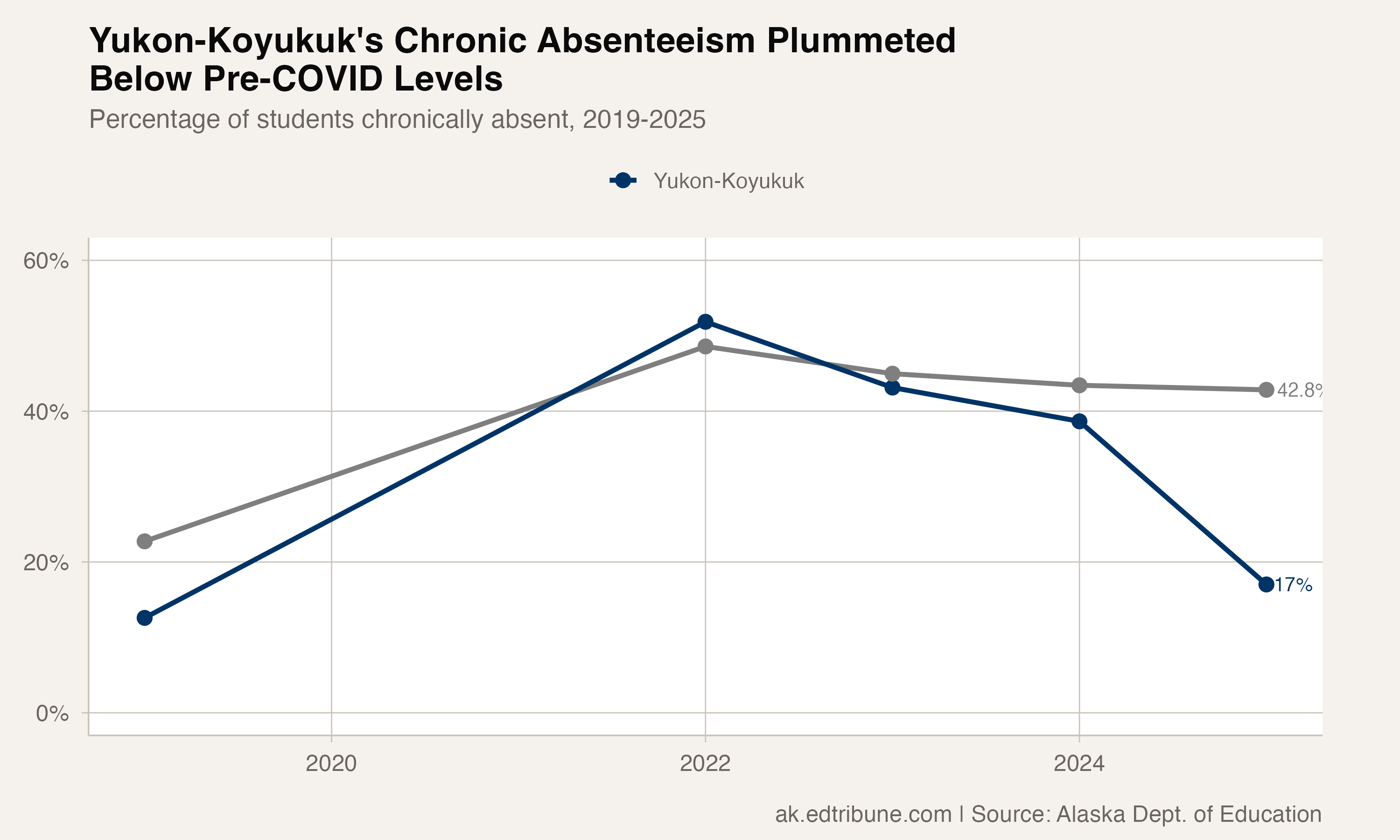
Three years ago, more than half of the students in the Yukon-Koyukuk School District↗ET were chronically absent. By 2025, that figure had plummeted to 17%.
The 34.8 percentage-point drop is the largest chronic absenteeism improvement of any district in Alaska. It's also one of the most improbable. Yukon-Koyukuk serves roughly 3,870 students across 10 villages in Interior Alaska, communities accessible only by air or river, where winter temperatures routinely drop below minus 40 and daylight disappears for weeks at a time. These are exactly the conditions that make school attendance hardest to sustain.
Yet in 2024-2025, four of the district's 10 schools -- Allakaket, Andrew K. Demoski, Johnny Oldman, and Rampart -- reported zero chronically absent students.
The trajectory
Yukon-Koyukuk's chronic absenteeism rate sat at 12.6% before the pandemic, already well below what most remote districts were experiencing. COVID shattered that: by 2021-2022, the rate had quadrupled to 51.8%. More than one in every two students was missing 10% or more of school days.
Then the recovery began. It wasn't a single-year event. It happened in grinding increments:
- 2022-2023: 51.8% to 43.1% (down 8.7 points)
- 2023-2024: 43.1% to 38.6% (down 4.5 points)
- 2024-2025: 38.6% to 17.0% (down 21.6 points)
The 2025 rate of 17% is only 4.4 points above the district's pre-COVID baseline of 12.6%. At the current pace, Yukon-Koyukuk could fully recover within the next year.
Every subgroup improved
What sets Yukon-Koyukuk apart is the breadth of the recovery. The district serves a predominantly Alaska Native population, and the improvement was not concentrated in any one group.
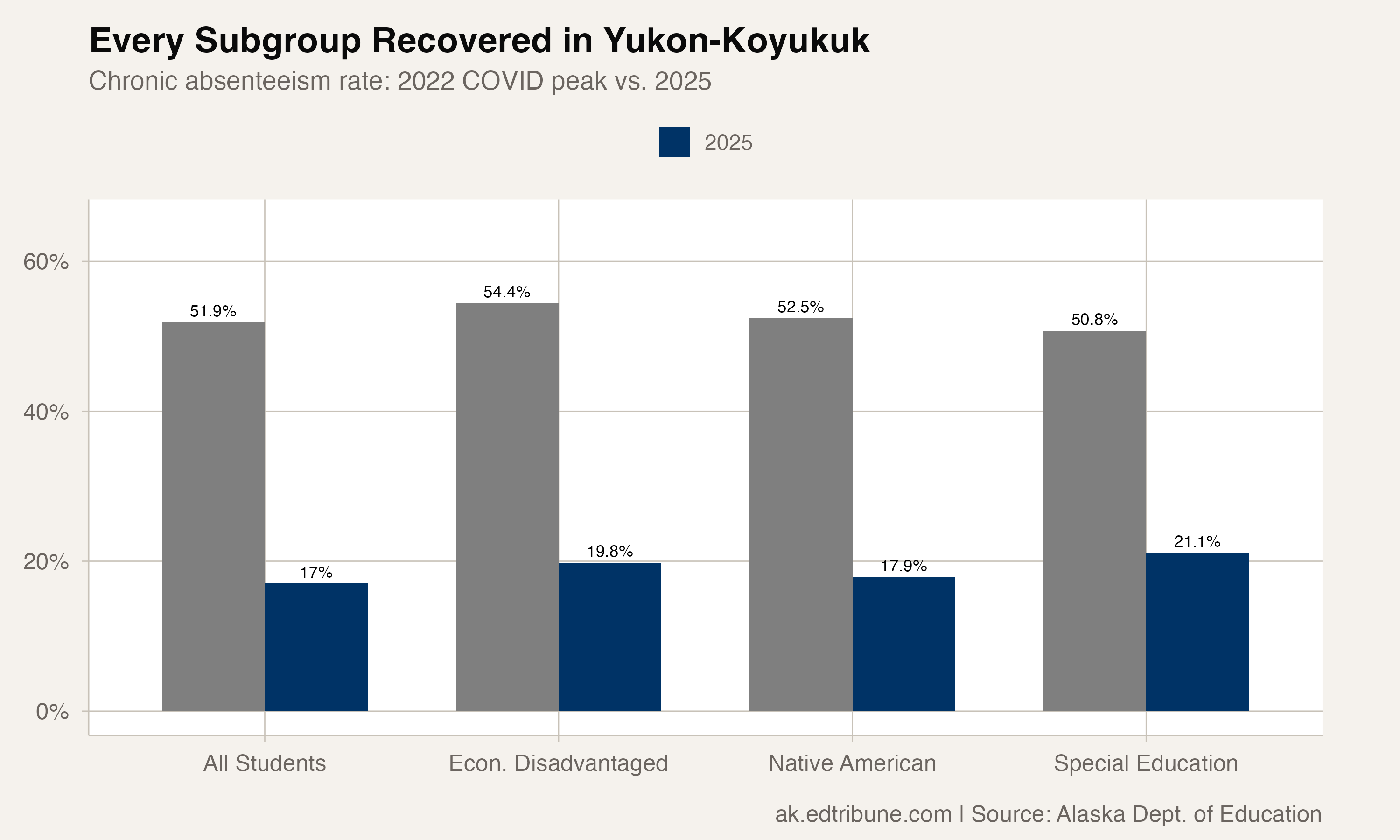
Native American students -- who make up the vast majority of enrollment -- saw their chronic rate fall from 52.4% at the 2022 peak to 17.9% in 2025, a 34.6-point improvement. Economically disadvantaged students improved from 54.4% to 19.8%. Special education students, often the hardest population to move, dropped from 50.8% to 21.1%.
The consistency suggests something systemic changed, not just a program targeting one group.
Four schools at zero
Perhaps the most remarkable data point is at the school level. In 2024-2025, four of Yukon-Koyukuk's 10 schools reported zero students who were chronically absent: Allakaket School, Andrew K. Demoski School, Johnny Oldman School, and Rampart School.
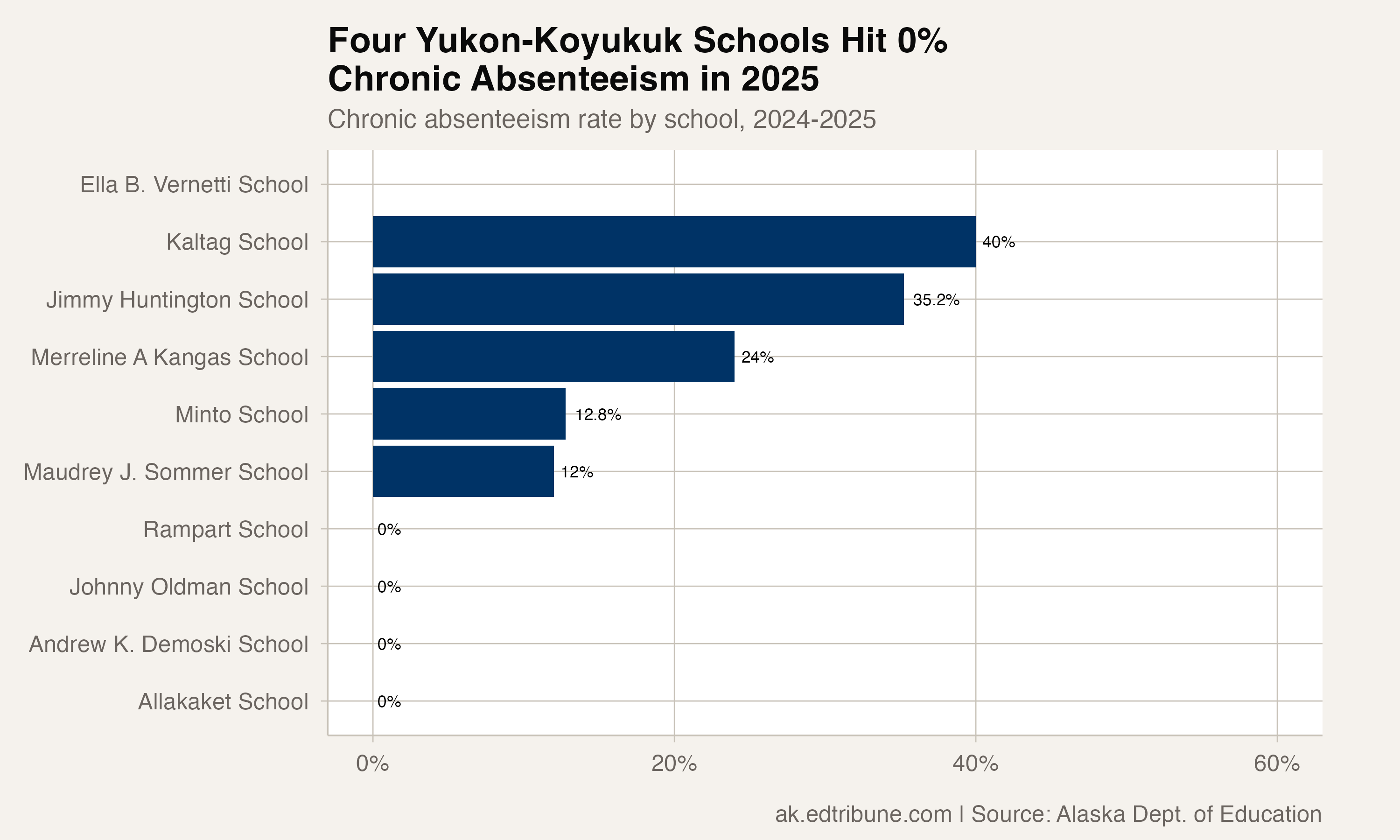
These are small village schools, but the achievement is notable even accounting for size. Maudrey J. Sommer School and Minto School also posted rates of 12% and 12.8%, respectively, well below the statewide average of 42.8%.
Only two schools remained above the state average: Jimmy Huntington (35.2%) and Kaltag (40%). Even these represent significant improvement from prior years.
What's behind the numbers
The data alone cannot explain what changed. In a region where geography, weather, and isolation create barriers that most school districts never face, a 35-point attendance swing demands a story that the numbers don't tell.
Statewide, Alaska's chronic absenteeism rate barely moved over the same period -- from 48.6% in 2022 to 42.8% in 2025, a 5.8-point improvement. Whatever is happening in Yukon-Koyukuk is specific to the district, not part of a broader recovery trend.
Detailed code that reproduces the analysis and figures in this article is available exclusively to EdTribune subscribers.
Discussion
Sign in to join the discussion.
Loading comments...