Correction (July 23, 2026): An earlier version said Mat-Su had grown 3.3% since its first full year in the dataset. The correct figure is 4.1%.
Christine Fik's children attended Pearl Creek Elementary, a school their family considered a community, not just a building. In February 2025, the Fairbanks North Star Borough↗ET school board voted 5-2 to close Pearl Creek along with Midnight Sun Elementary and Two Rivers Elementary. Fik told a local reporter her kids "feel like they are the last puffins, like they're going extinct."
The closures were supposed to help close a $16 million budget deficit. They did. And the district is still shrinking.
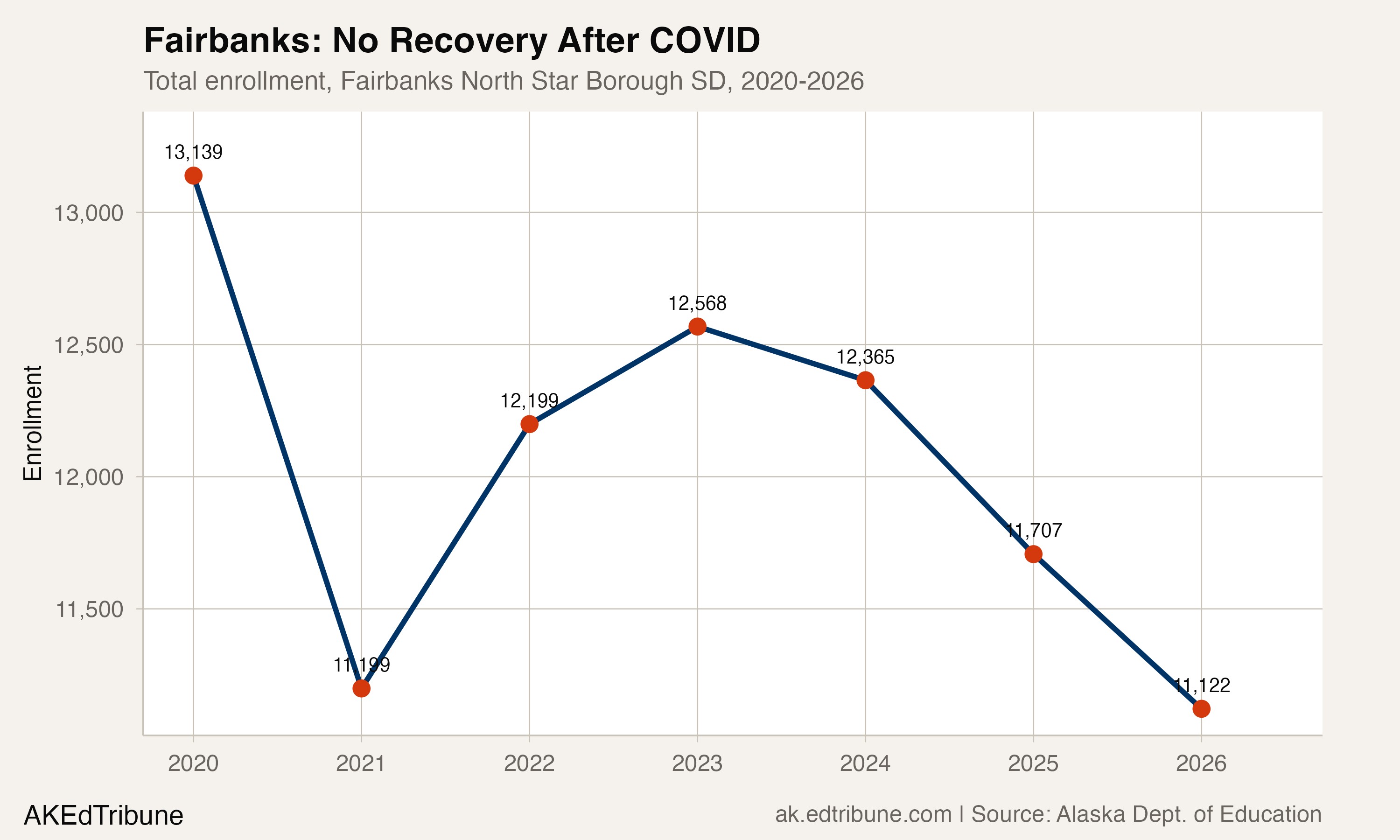
Fairbanks North Star Borough School District, Alaska's second largest, enrolled 11,122 students in 2025-26. That is 2,017 fewer than the 13,139 it enrolled in 2019-20, a 15.4% decline in seven years, six times the statewide rate. It is the lowest enrollment in the dataset. And the 2025-26 drop of 585 students was the district's second-largest annual loss, trailing only the 1,940-student COVID crash in 2020-21.
The Recovery That Wasn't
The raw trend line is not a straight descent. Fairbanks lost nearly 15% of its enrollment in a single year during COVID, then clawed back 1,000 students in 2021-22 and another 369 in 2022-23, reaching 12,568. For two years, it looked like the district might stabilize.
It did not. Enrollment dropped 203 in 2023-24, then 658 in 2024-25, then 585 in 2025-26. The three-year slide erased the entire post-COVID recovery and pushed enrollment 1,446 below its pre-recovery peak.
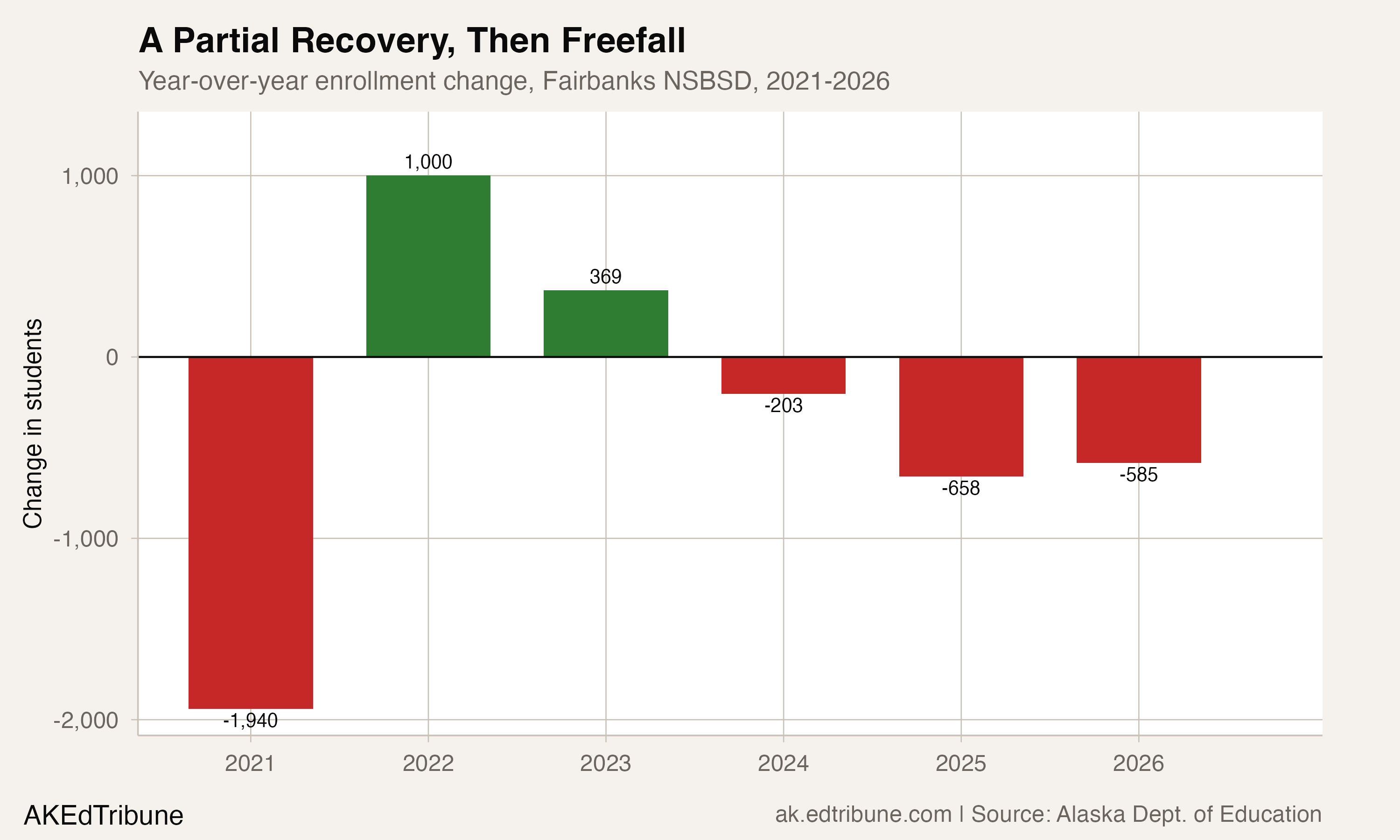
The pattern matters because it reframes the district's fiscal planning. School administrators who budgeted around a stabilizing enrollment of 12,000-plus are now operating a district of 11,122 with infrastructure built for 13,000. The October 2025 head count came in 189 students below the district's own September projection, costing an estimated $2.72 million in anticipated state funding.
One District, 62% of Alaska's Enrollment Loss
Fairbanks accounts for 61.6% of Alaska's total enrollment decline since 2019-20, despite enrolling less than 9% of the state's students. The state lost 3,272 students over that span. Fairbanks alone lost 2,017.
Among Alaska's five largest traditional districts, Fairbanks has fallen the furthest in percentage terms. Anchorage↗ET is down 10.0%. Juneau↗ET dropped 16.5%, a steeper rate but on a much smaller base of 4,562 students. Kenai Peninsula↗ET has held relatively steady, losing 4.8%. Mat-Su↗ET, the only large traditional district to grow, is up 4.1% since its first full year in the dataset.
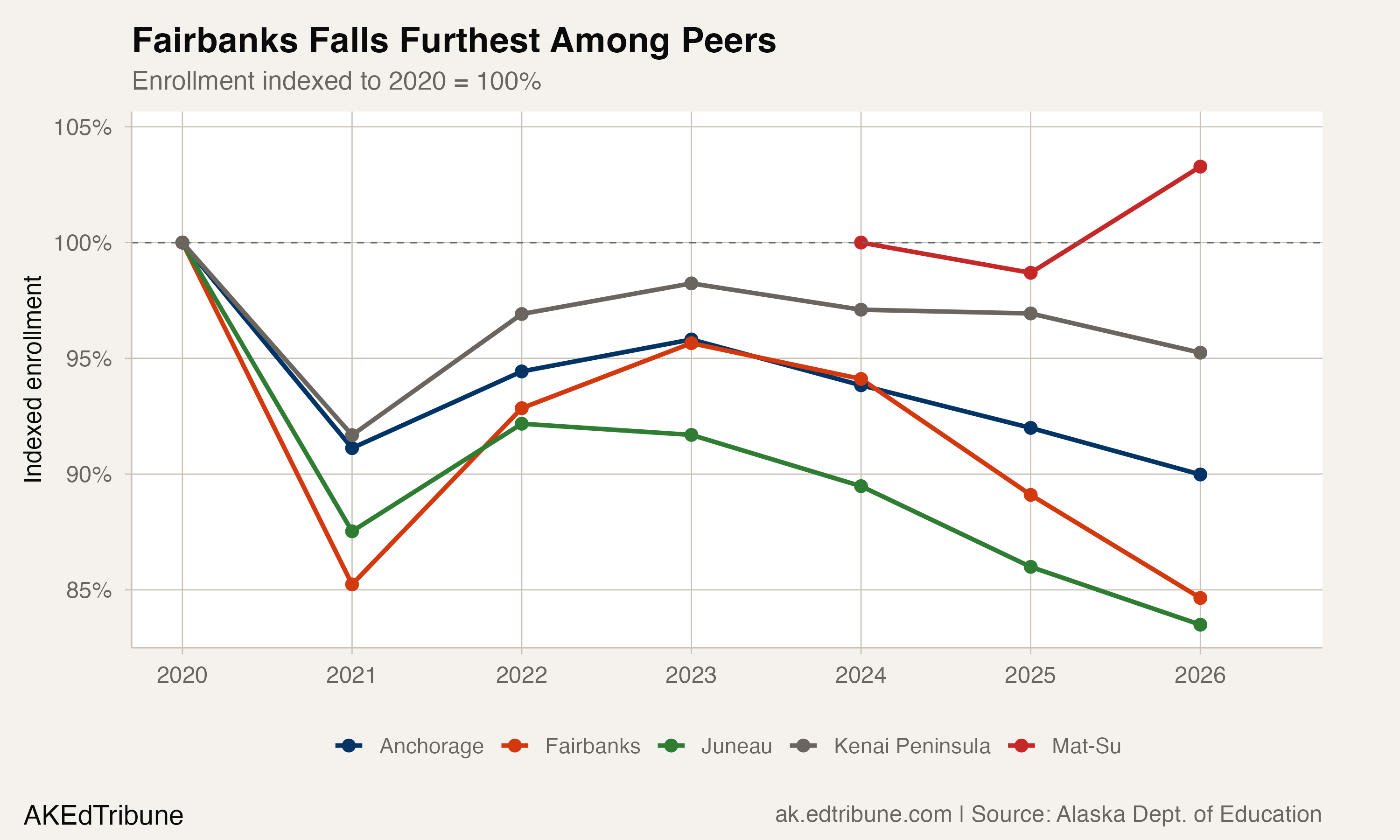
Fairbanks's share of state enrollment slipped from 10.2% in 2019-20 to 8.9% in 2025-26. That 1.3-percentage-point drop translates to a significant revenue loss. At the current Base Student Allocation of $6,660 per student, 2,017 fewer students represents roughly $13.4 million in forgone annual formula funding before district cost factors and other adjustments.
Who Is Leaving
The decline reaches across every racial and ethnic group except Pacific Islanders, who gained 22 students. White students account for the largest absolute loss: 1,468 fewer since 2019-20, a 19.5% drop. Black enrollment fell 38.5%, the steepest rate of any group, though on a small base of 538 to 331 students. Multiracial students declined 9.8%, Native American students 6.4%, Hispanic students 3.1%, and Asian students 10.7%.
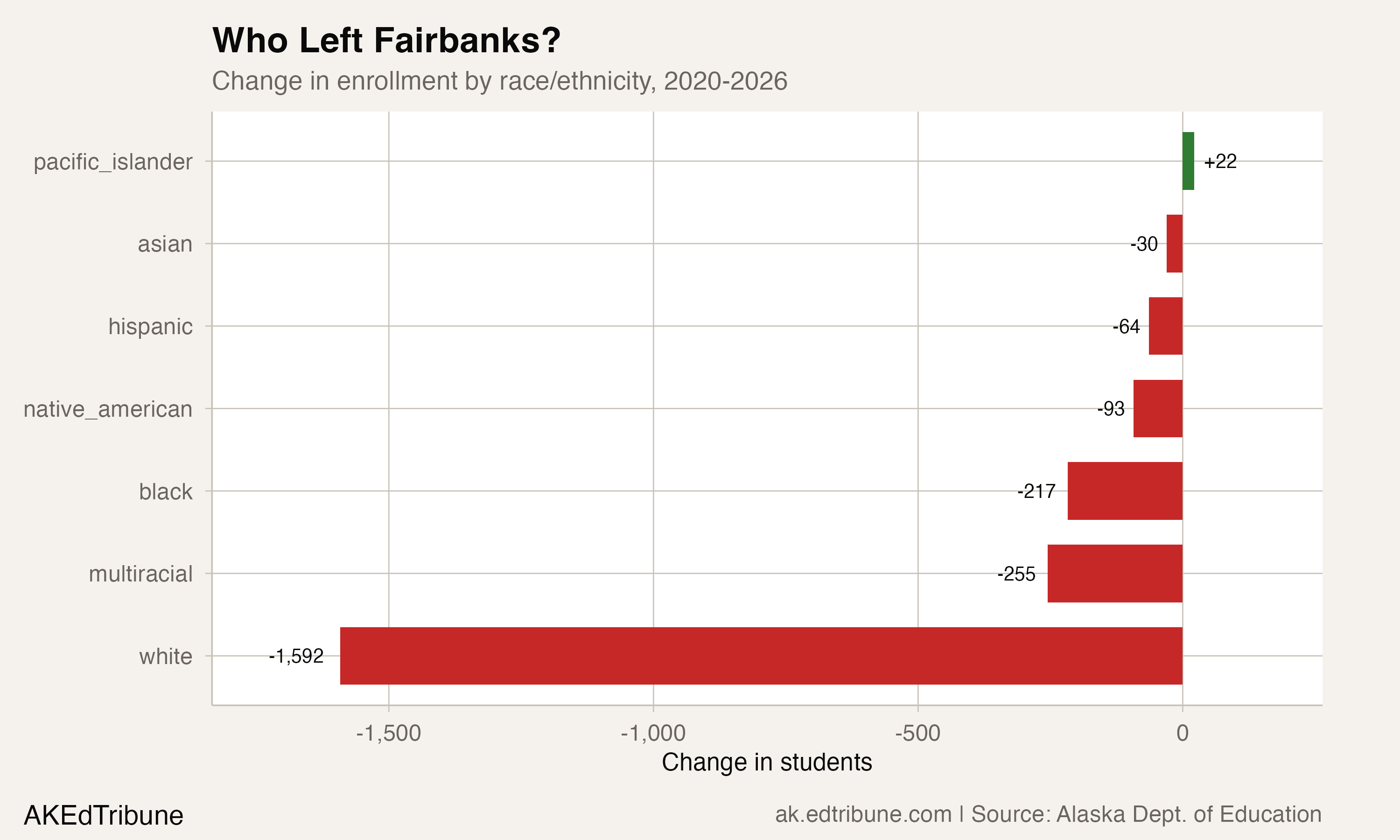
The breadth of the decline across demographic groups suggests a structural driver, not a shift within the population. Families are not choosing different schools within Fairbanks. They are leaving.
The district's own analysis confirms this. Senior Research Analyst Ellis M. Ott found that more than half of the students who left in 2025-26 did so because their families moved out of Alaska entirely. In grades K-8, 77% of departing students had families who left the borough, and the majority of those left the state. Another 165 students transferred to correspondence programs outside the district, part of a statewide shift toward virtual and home-based instruction. Statewide, correspondence programs now enroll more than 16,000 Alaska students, and districts like Galena↗ET, home to the IDEA correspondence program, have grown 60.6% in seven years while traditional districts shrink.
The Military Variable
Fort Wainwright and Eielson Air Force Base anchor the borough's economy and demographics. Military families cycle through on deployment rotations, making enrollment inherently volatile. The arrival of F-35 fighter jets at Eielson brought approximately 3,500 active-duty airmen and dependents to the area in the late 2010s, a demographic boost that state demographer David Howell noted has since been outweighed by broader outmigration patterns.
The military connection creates a structural instability that civilian communities do not face. A single redeployment order can move hundreds of families. But the current decline is not solely a military story. The borough's civilian population is also shrinking. Alaska's Department of Labor projects the Fairbanks North Star Borough will fall from about 96,000 residents to 88,800 by 2050, a 7.5% decline, driven by net outmigration that has exceeded natural growth for over a decade.
"Losses due to net migration have outweighed their growth from natural increase." — State Demographer David Howell, KTVF, July 2024
One competing explanation: a housing shortage. The borough needs an estimated 4,000 additional housing units. Families who might otherwise stay cannot find housing they can afford, creating a paradox where a shrinking population coexists with unmet housing demand. The school district loses students either way.
The Pipeline Under the Pipeline
Kindergarten enrollment tells the longer story. Fairbanks enrolled 1,093 kindergartners in 2019-20. In 2025-26, it enrolled 750, a 31.4% drop. That is not a COVID artifact. The number peaked at 1,057 in 2022-23 during the partial recovery, then fell every year since.
The grade-level data shows losses across the board. First grade lost 244 students (22.5%). Sixth grade lost 201 (18.4%). Every grade from PK through 11th declined. The only grade that grew was 12th, which added 44 students, likely reflecting retained or returning students rather than new arrivals.
At the school level, the losses are concentrated in the two traditional high schools. West Valley High lost 229 students (23.2%) and Lathrop High lost 216 (22.7%). Meanwhile, Fairbanks B.E.S.T., an alternative education program, grew from 274 to 891 students, a 225% increase that suggests families are seeking nontraditional options within the district even as they leave it.
A Lawsuit and a Budget
In January 2026, the Fairbanks North Star Borough School District and Kuspuk↗ET School District filed an adequacy lawsuit against the state, arguing that Alaska "funds education based on what they can afford, not what it actually costs." The districts are seeking a court-ordered study to determine what it actually costs to educate an Alaska student, plus an annual inflation adjustment.
The lawsuit cites more than $400 million in deferred maintenance across the Fairbanks district and argues the state has funded schools at levels "woefully inadequate and have no reasonable or logical connection to the actual cost" of education. The three schools closed in 2025 were projected to save roughly $10 million combined with outsourced custodial services, against a $16 million gap. Even after absorbing those cuts, Chief Operations Officer Andy DeGraw told KUAC the district could face up to a $5 million deficit for 2026-27.
"If things line up in our favor, we could have a very small to no deficit. If things don't fall in our favor, it could be as high as $5 million." — Andy DeGraw, Chief Operations Officer, KUAC, Oct. 2025
The district has now closed seven schools in five years and eliminated 300 staff positions. At some point, consolidation runs out of buildings to close. The question is whether the enrollment line flattens before the options do.
Detailed code that reproduces the analysis and figures in this article is available exclusively to EdTribune subscribers.
Discussion
Sign in to join the discussion.
Loading comments...