Campbell STEM Elementary is Alaska's only STEM-certified elementary school. It has a waitlist. And it was approved for closure at the end of the 2025-26 school year because the Anchorage↗ET School District could not afford to keep its doors open.
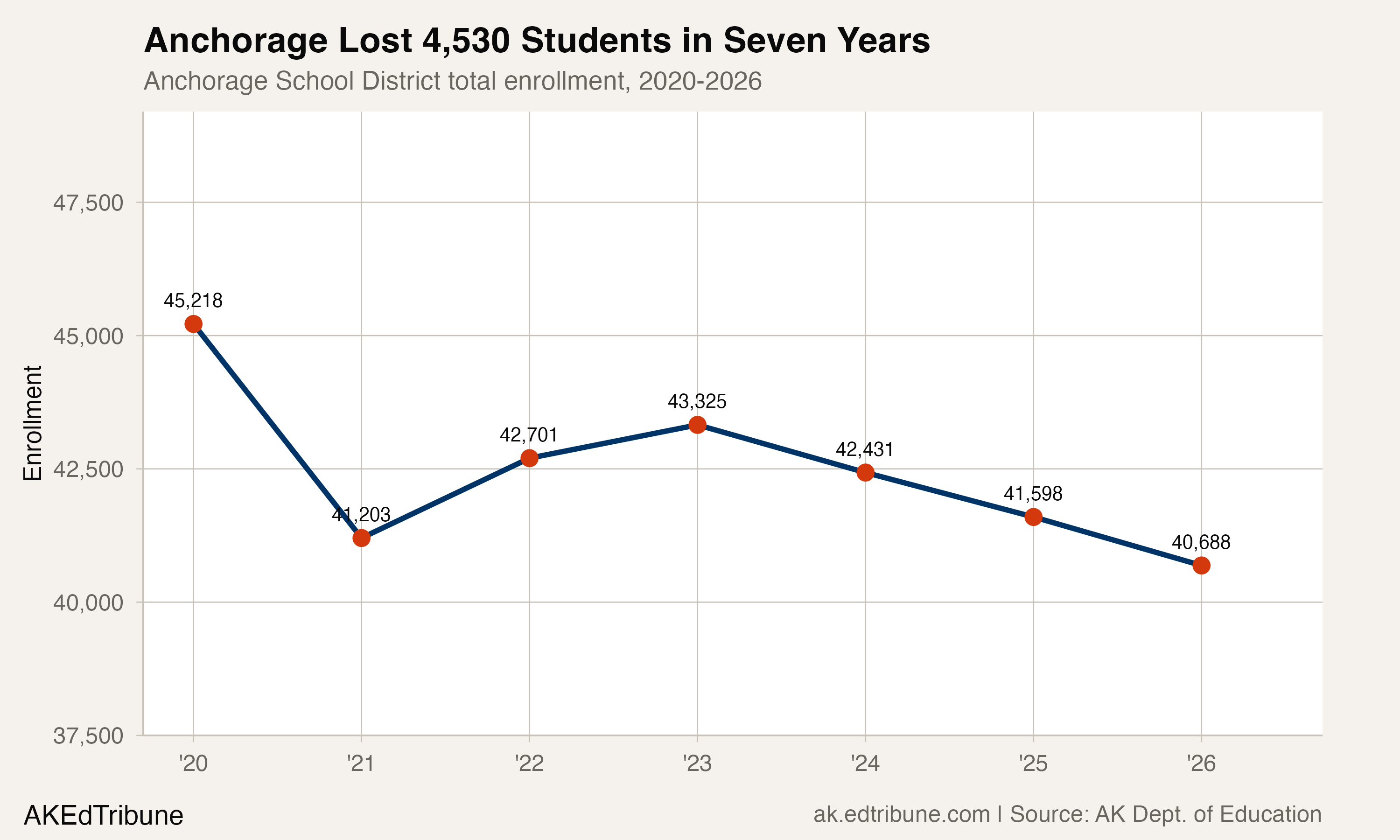
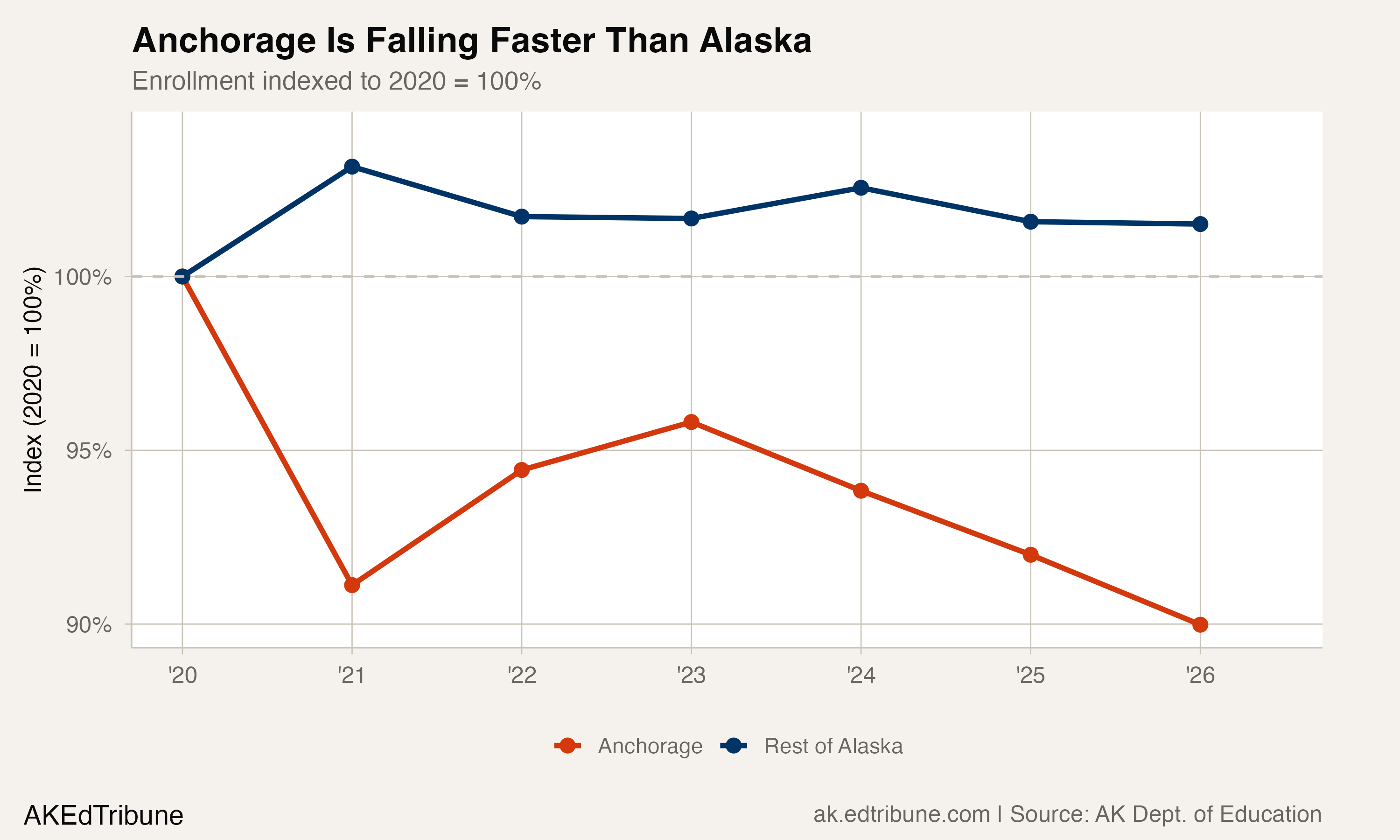
The district has lost 4,530 students since 2020, a 10.0% decline that dropped enrollment from 45,218 to 40,688. That loss is larger than the entire state's enrollment decline over the same period. Alaska lost 3,272 students statewide. The rest of the state, outside Anchorage, actually gained 1,258.
Anchorage is not just shrinking. It is shrinking faster than everything around it, and it is running out of ways to absorb the fiscal consequences.
A $90 Million Hole in a $700 Million Budget
In February 2026, the Anchorage School Board voted 5-2 to close three elementary schools: Campbell STEM, Fire Lake, and Lake Otis. The closures bring the total to eight schools shuttered in 10 years. They are projected to save roughly $900,000 each, less than 3% of the $90 million structural deficit.
The real savings come from people. The budget eliminates nearly 300 teaching positions, eight school nurses, 25 elementary specialists, and nine principals. Class sizes will increase by four students per grade level. At some high schools, that means 36 students per classroom. The district's IGNITE program for gifted students is gone. Art and music will merge into a single "fine arts" class.
"This budget purely reflects [the] difficult reality of declining enrollment, rising costs, and funding uncertainty." — Superintendent Jharrett Bryantt, Anchorage Daily News, Feb. 2026
The district is staring at a $42 million projected deficit for 2027-28 even after these cuts take effect.
An Unstable Trajectory
Anchorage's enrollment pattern is not a clean decline. It is a series of lurches.
The district lost 4,015 students in a single year during COVID (2020-2021), an 8.9% drop. It then recovered 1,498 students in 2022 and another 624 in 2023, briefly suggesting the worst had passed. But the recovery stalled. Since 2024, the district has lost students in three consecutive years: 894, then 833, then 910.
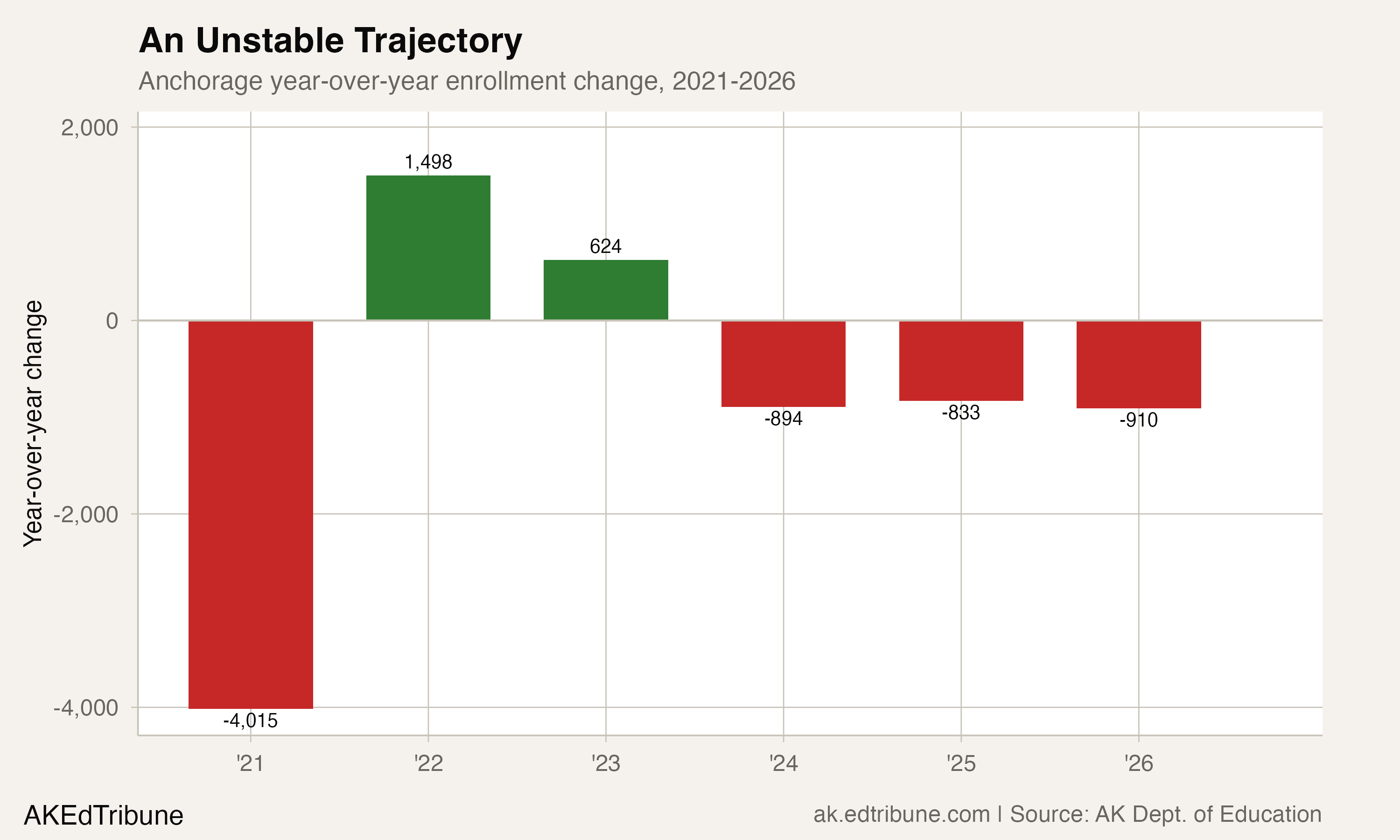
The recovery was never more than partial. Even at its post-COVID peak of 43,325 in 2023, Anchorage was still 1,893 students below its 2020 level. The 2022-2023 gains only recovered about half of the COVID loss before the decline resumed.
At its current pace of roughly 900 students per year, Anchorage will drop below 40,000 students during the 2026-27 school year. Each lost student carries approximately $6,660 in state base student allocation (BSA) funding, meaning the 4,530-student decline translates to roughly $30 million in annual funding that followed those students out of the district.
The Rest of Alaska Gained Students
Anchorage's decline is not a reflection of a statewide collapse. It is specific to Anchorage and, to a lesser extent, to other traditional brick-and-mortar districts.
Indexed to 2020, the rest of Alaska's enrollment has been essentially flat, hovering near 101% of its baseline for most of the period before dipping slightly to 101.5% by 2026. Anchorage, meanwhile, has fallen to 90.0%.
The biggest gainer by far is Galena City School District↗ET, home to the IDEA (Interior Distance Education of Alaska) correspondence program. Galena grew from 5,155 students in 2020 to 8,279 in 2026, a 60.6% increase of 3,124 students. Yukon-Koyukuk School District↗ET doubled its enrollment from 1,933 to 3,869 over the same period. Both are correspondence/virtual programs that serve families across the state, including many in Anchorage.
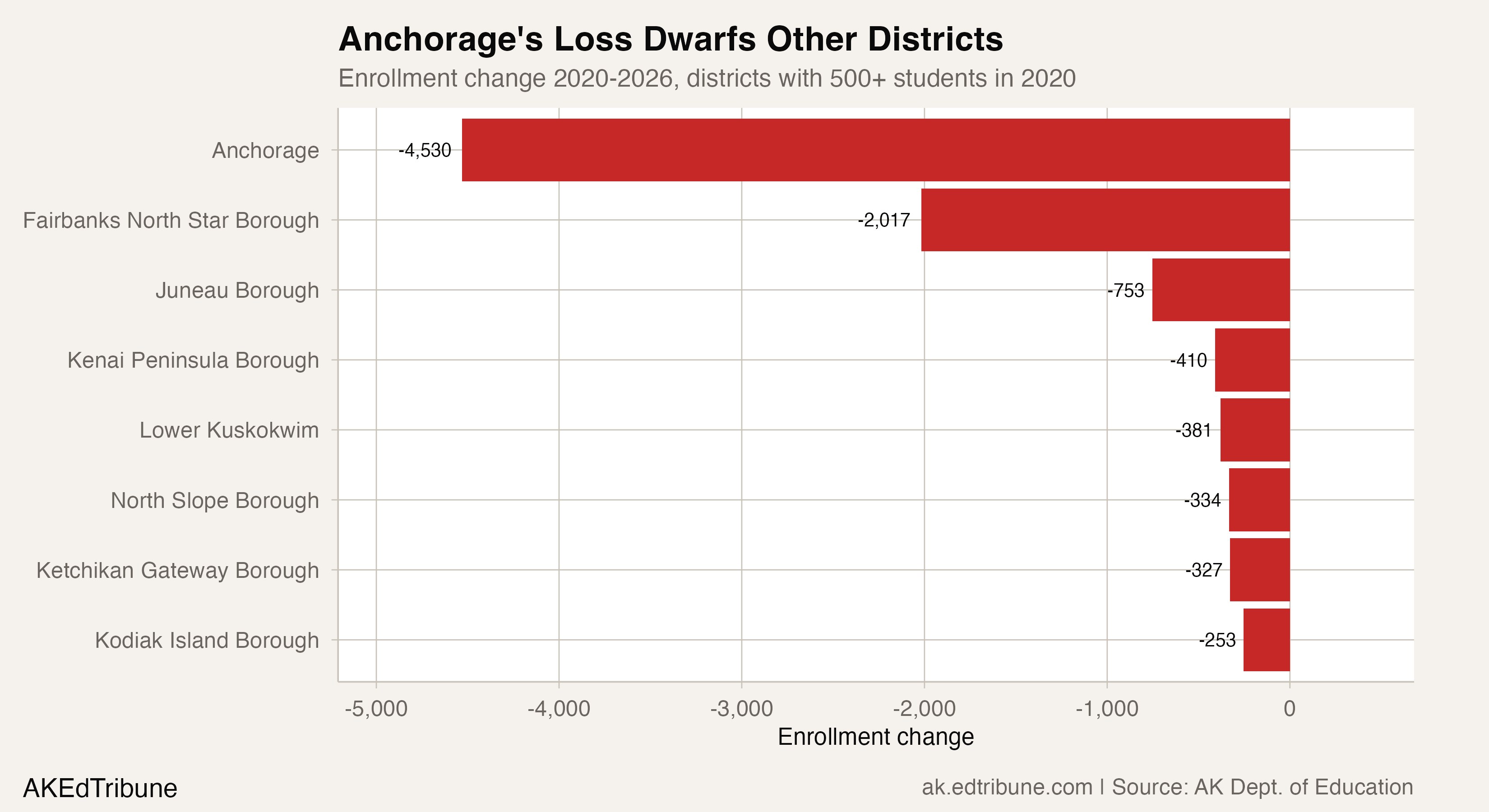
Among the eight districts with 500 or more students in 2020 that lost enrollment, Fairbanks North Star Borough↗ET lost 2,017 students (-15.4%), and Juneau↗ET lost 753 (-16.5%). But neither approaches Anchorage's absolute scale of loss.
Fewer Kindergartners, Same Number of Seniors
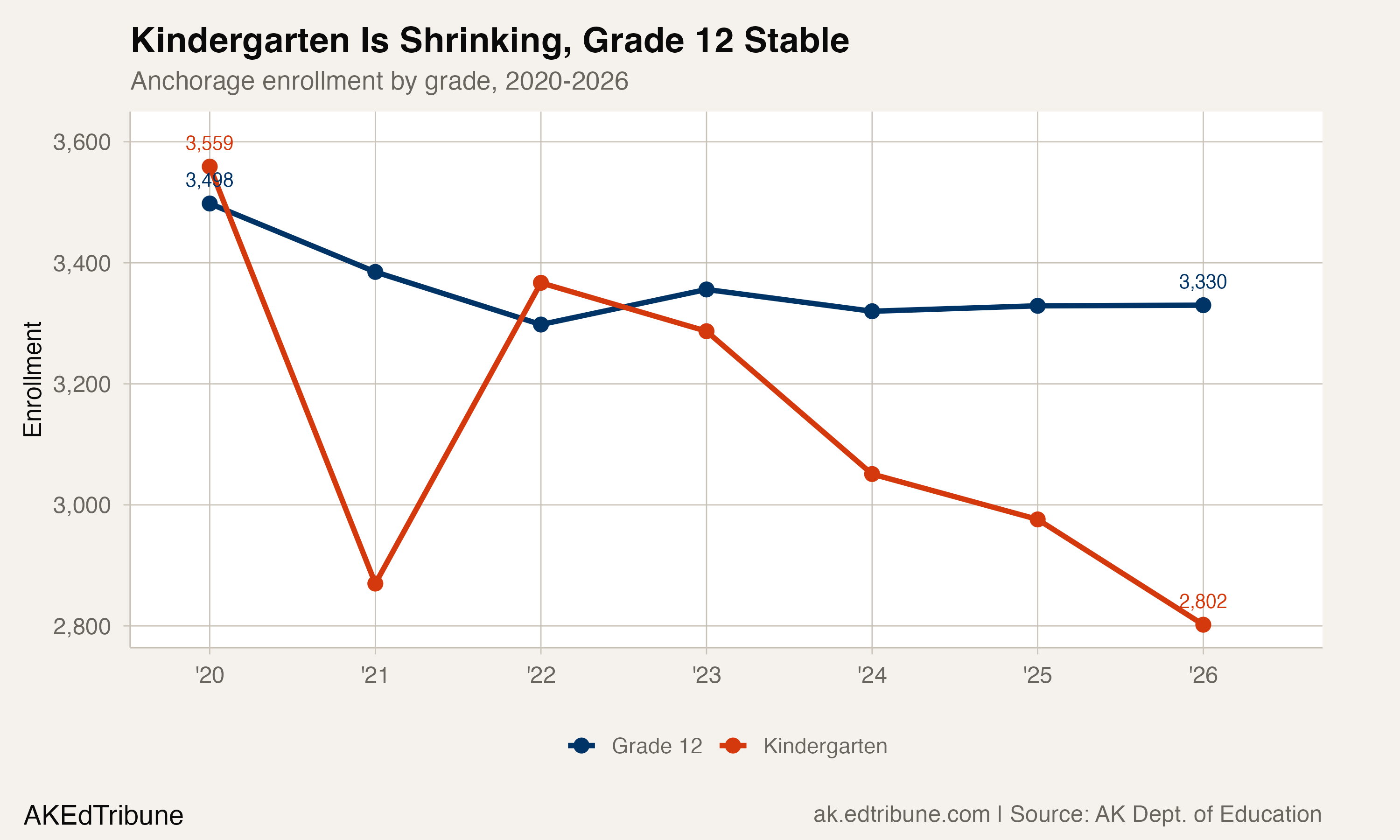
The enrollment pipeline tells the second part of the story. Anchorage enrolled 3,559 kindergartners in 2020 and 2,802 in 2026, a 21.3% drop. Grade 12, by contrast, has been flat: 3,498 in 2020 and 3,330 in 2026, a 4.8% decline.
That gap has a mechanical consequence. Every year, Anchorage graduates roughly 3,300 seniors but enrolls only about 2,800 kindergartners. The district is losing approximately 500 students annually to pipeline shrinkage alone, before any net outmigration is factored in.
Elementary enrollment (PK through grade 5) fell from 22,325 in 2020 to 19,358 in 2026, a loss of 2,967 students. Secondary enrollment (grades 6-12) fell from 23,859 to 22,313, a loss of 1,546. Elementary is losing students at nearly twice the rate of secondary, which is why all three schools approved for closure are elementaries.
What Is Driving Families Out
The most direct explanation is that Alaska's population engine is stalling. The state completed its 13th consecutive year of net outmigration in 2024, the longest streak since World War II. In 2024 alone, 1,740 more people left Alaska than moved in. Alaska's overall population still grew slightly (0.2%) because births exceeded deaths, but that margin is narrowing. Annual births have fallen from over 12,000 in the mid-1980s to approximately 9,000 in recent years.
But outmigration alone does not explain why Anchorage is losing students while virtual and correspondence programs are growing. The growth of IDEA (Galena) and Yukon-Koyukuk's correspondence program suggests that some families are staying in Anchorage physically but enrolling their children elsewhere. This is consistent with a national post-COVID pattern in which parents who tried homeschooling or virtual learning during the pandemic stuck with it.
A competing explanation is Alaska's flat education funding. The base student allocation was frozen for a decade before lawmakers approved a $700 increase in 2025. But as Mat-Su Superintendent Randy Trani pointed out, only $20 of that increase was permanent. The rest was one-time funding. Anchorage's superintendent estimated the district lost roughly $1,400 in per-student purchasing power compared to 2011 levels.
The result is a feedback loop: declining enrollment reduces revenue, which forces service cuts, which gives families another reason to leave. Nearly 80% of Alaska's school districts now face budget deficits. Mat-Su↗ET is planning its own three school closures amid a $22.5 million shortfall.
Who Remains
Anchorage's demographic composition has shifted as enrollment dropped. White enrollment fell from 18,925 in 2020 to 15,955 in 2026, a loss of 2,970 students (-15.7%). That single group accounts for 65.6% of the district's total enrollment loss. Asian enrollment dropped 17.4% (-836 students), and Black enrollment fell 18.2% (-397).
Two groups bucked the trend. Native American enrollment grew 6.3% (from 4,113 to 4,373), and Pacific Islander enrollment grew 2.3% (from 3,097 to 3,169). Hispanic enrollment declined 3.8% (-197), a quarter of the rate of white enrollment loss.
White students' share of enrollment fell from 41.9% to 39.2% between 2020 and 2026. Native American share rose from 9.1% to 10.7%, and Pacific Islander share rose from 6.8% to 7.8%.
Campbell STEM and the Politics of Closure
The Campbell STEM closure drew the sharpest community response of the three, in part because the school had a waitlist and in part because the notification timeline was compressed.
"You can't tell parents on a Friday afternoon before a three-day weekend, that your only chance to come and publicly testify in person is Tuesday." — Sarah Anderson, Taku-Campbell Community Council President, Alaska Public Media, March 2026
Fire Lake and Lake Otis had weeks of community conversation before the vote. Campbell STEM had roughly 11 days. The school board has since acknowledged that additional state funding is the only path to keeping Campbell STEM open.
An $11.8 million tax levy on the April ballot (Proposition 9) would have reinstated 80 teachers and cut the class size increase in half, but it would not have reversed any of the closures. ASD said on April 16, 2026, that voters did not approve Proposition 9, forcing the district to move forward with fewer classroom teacher positions.
What to Watch
Anchorage's kindergarten class of 2,802 is the smallest on record in this data. If the incoming 2027 kindergarten cohort is smaller still, the pipeline gap between entering and exiting students will widen, and the district will face another round of building utilization decisions before the current closures are fully absorbed.
The April vote on Proposition 9 did not halve the class size increase. The broader question is whether the Alaska Legislature will make the BSA increase permanent. Legislators proposed raising the BSA by $630, from $6,660 to $7,290, while House Bill 261 later advanced to the Senate Finance Committee. If a durable increase passes, Anchorage would gain roughly $25.6 million in annual revenue. If it does not, the 2027-28 budget cycle begins with a $42 million hole and no one-time funds left to fill it.
Detailed code that reproduces the analysis and figures in this article is available exclusively to EdTribune subscribers.
Discussion
Sign in to join the discussion.
Loading comments...