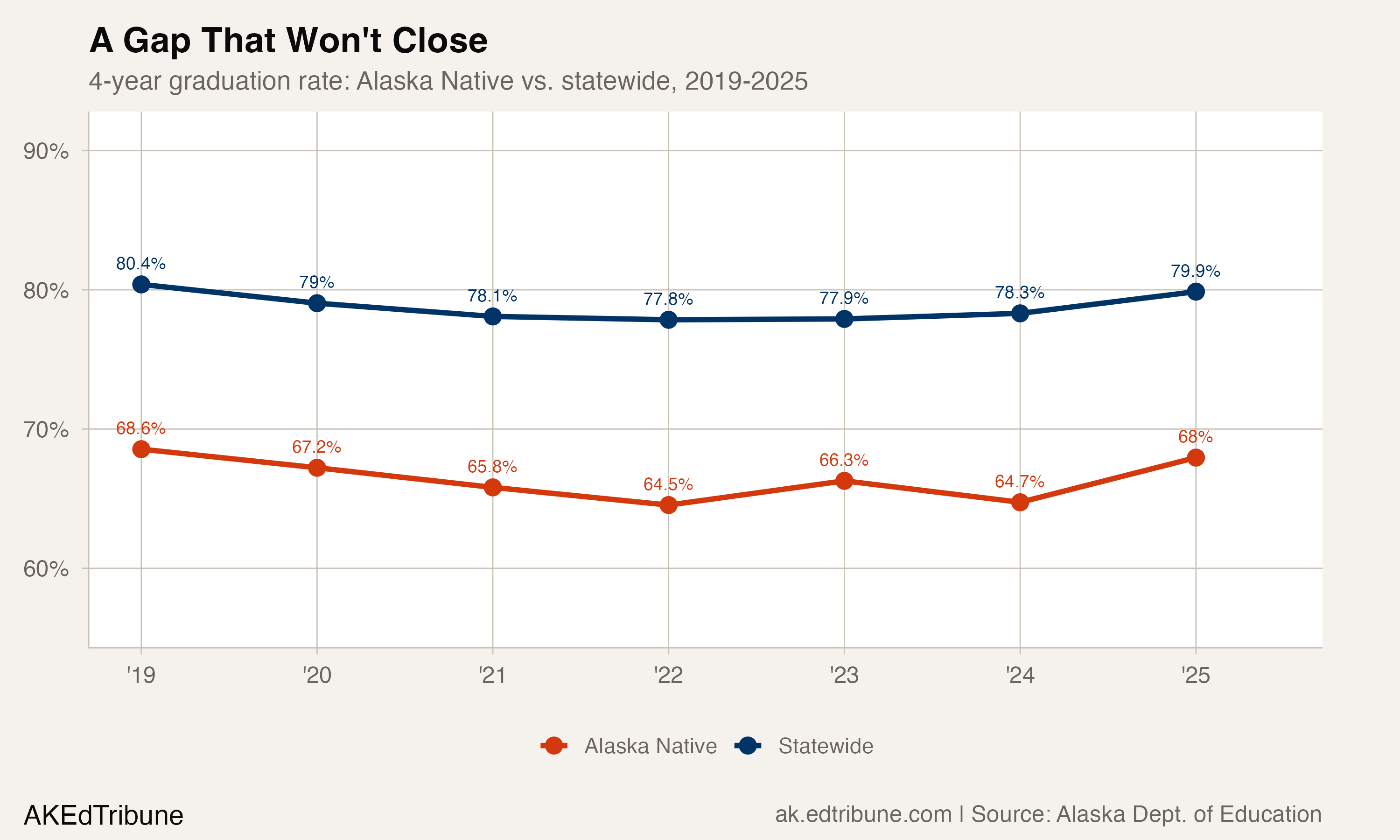
In 2022, 64.5% of Alaska Native students graduated from high school on time. It was the lowest point in seven years of data. Three years later, the rate has clawed back to 68.0%. That recovery, such as it is, returned Alaska Native graduation rates to roughly where they started in 2019, when the rate was 68.6%.
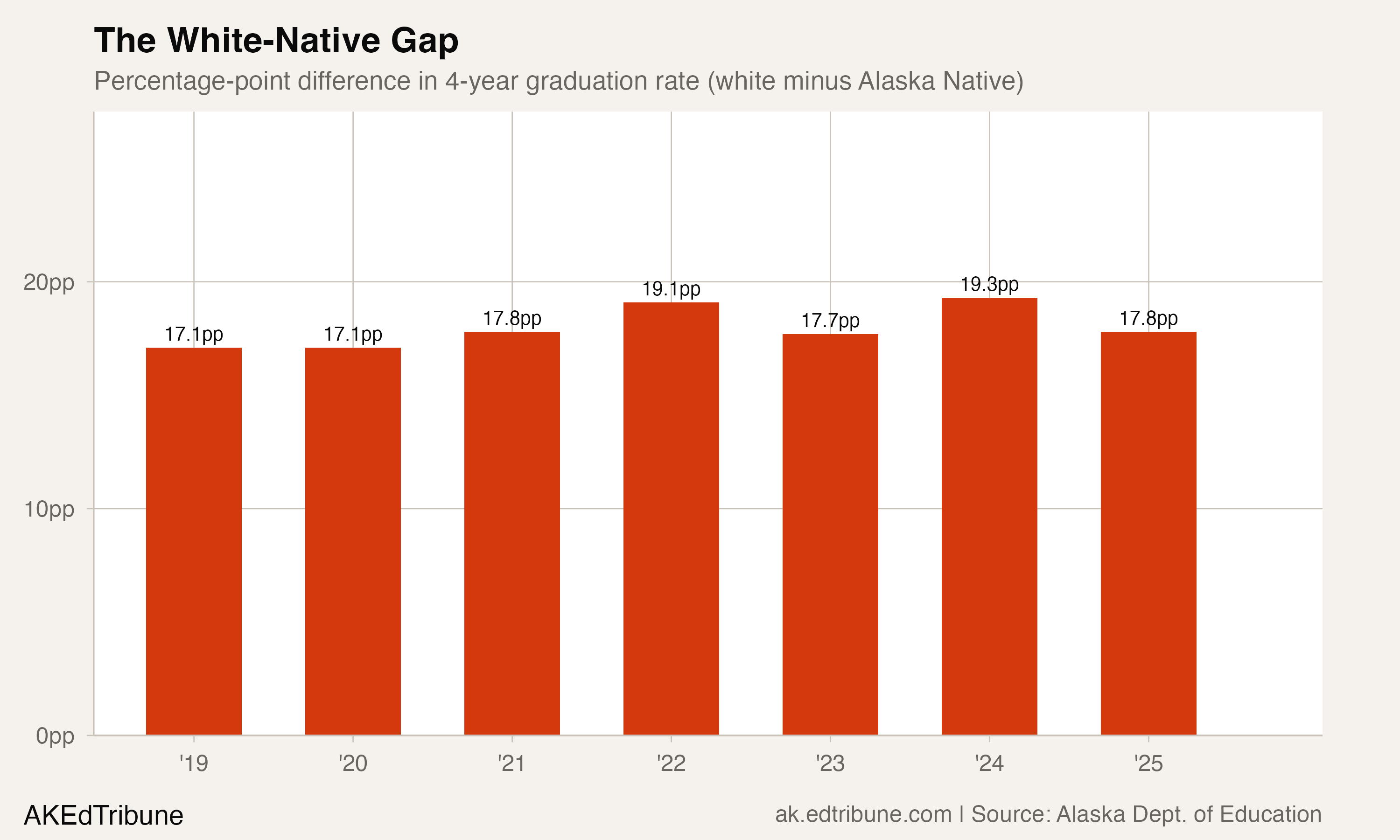
The gap between Alaska Native students and the statewide average has hovered between 11.6 and 13.6 percentage points for every year on record. In 2025, it stands at 11.9 points. Measured against white students, the chasm is wider: 17.8 percentage points separate Alaska Native graduates from their white peers, a disparity that has never dipped below 17 points in the dataset.
This is not a gap that is closing. It is a gap that oscillates.

One in five seniors, one in three non-graduates
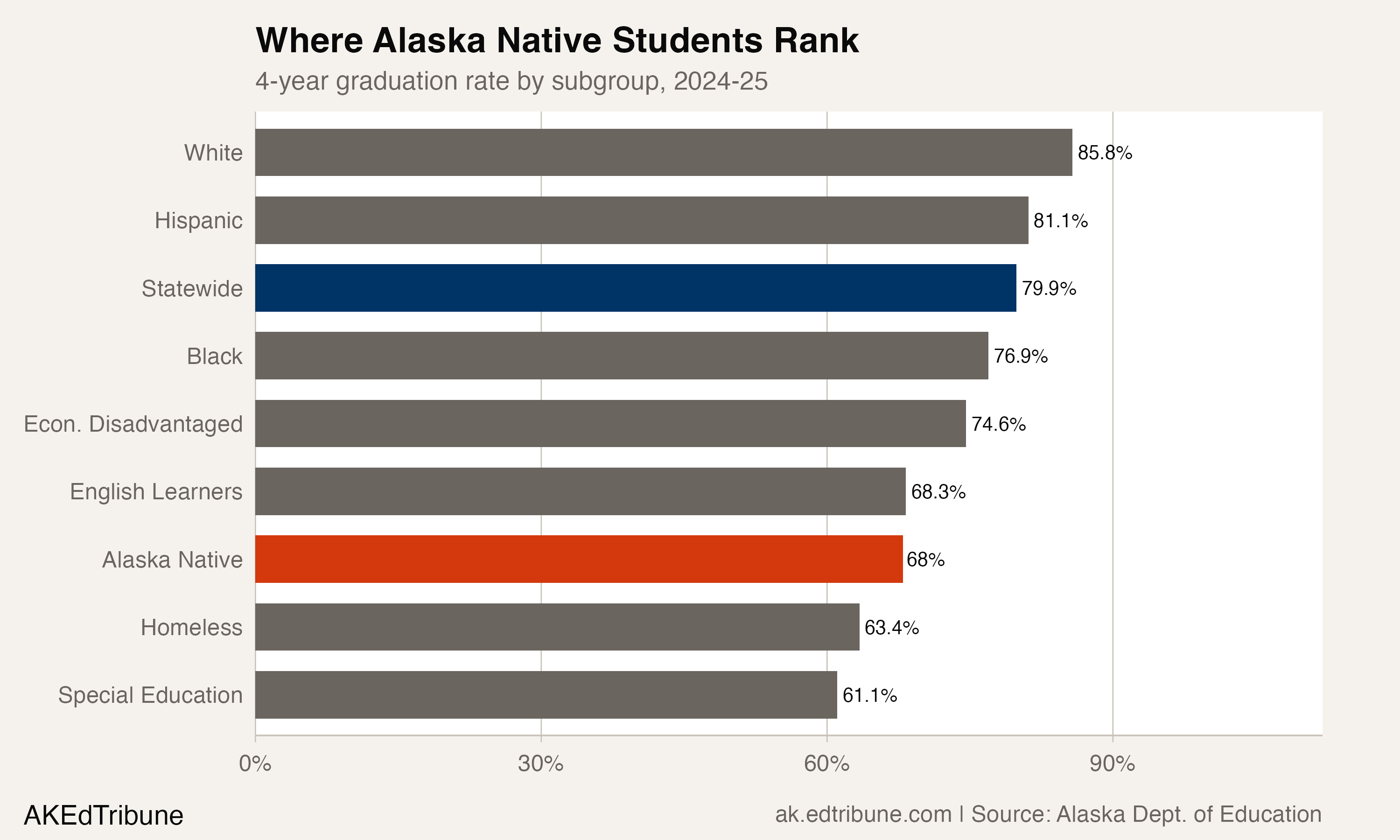
Alaska Native students make up 21.0% of the state's graduating cohort, roughly 2,081 seniors in 2025. But their graduation rate of 68.0% means 667 Alaska Native students did not finish on time, roughly one-third of all non-graduates statewide. Only students with disabilities (61.1%) and students experiencing homelessness (63.4%) graduate at lower rates. English learners, at 68.3%, are nearly identical to the Alaska Native rate, though the two populations overlap substantially in rural communities where Yup'ik, Inupiaq, and other indigenous languages are spoken at home.

The white-Alaska Native gap averaged 18.0 percentage points over the seven-year span and peaked at 19.3 points in 2024. That peak year is instructive: the state average barely moved (78.3%), white students held steady at 84.0%, and Alaska Native students dropped to 64.7%. When the statewide rate ticks up or down a point, Alaska Native rates swing by three or four.

The geography of 46%
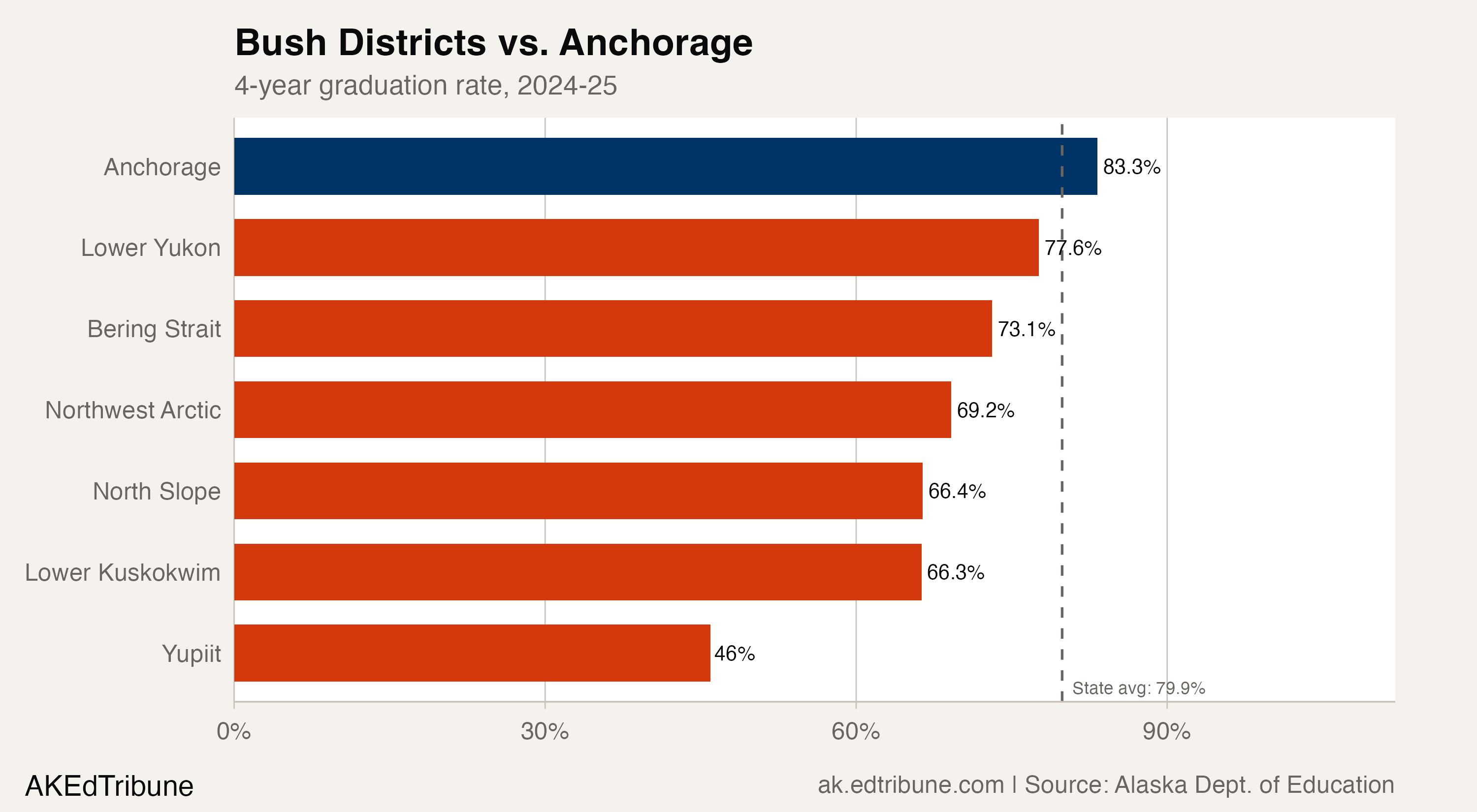
The Yupiit School District↗ET, serving three Yup'ik villages in southwest Alaska, graduated 46.0% of its 2025 cohort, 17 of 37 seniors. Across the Yukon-Kuskokwim Delta, the Lower Kuskokwim School District↗ET, the state's largest predominantly Native district, managed 66.3%. The North Slope Borough School District↗ET, home to Utqiagvik and eight Inupiat villages along the Arctic coast, graduated 66.4%. The Northwest Arctic Borough School District↗ET, centered on Kotzebue, posted 69.2%.
All four districts sit below the statewide average of 79.9%. The chart does not prove why those rural rates trail the state; it shows where the graduation gap is most visible.

Anchorage School District↗ET, by contrast, graduated 83.3% of its cohort, a rate 37 points higher than Yupiit's. That 37-point spread within a single state school system captures the divide between urban Alaska and the Bush districts discussed in the staffing section below.
RELATED: Alaska Loses One in 11 Native Students in Seven YearsET
The staffing pipeline
The teacher shortage in rural Alaska is not background context. It is the mechanism. Only 10% of Alaska's teachers are Alaska Native or American Indian, compared to 22% of the student population. In Bush districts, the gap is starker: some schools staff 50% to 80% of positions with international educators on temporary visas. When those teachers leave after one or two years, they take with them the relationships and cultural knowledge that keep students on track.
"High teacher turnover is directly correlated with poor student achievement, and our children are suffering." -- David Nogg, Principal, Goldenview Middle School, Alaska Public Media, April 2026
A new federal visa fee of $100,000 per H-1B applicant threatens to shrink even this tenuous pipeline. The Bering Strait School District alone stands to lose access to 86 international teachers, roughly 40% of its certified staff.
The extra year
One detail softens the picture slightly. The 5-year graduation rate for Alaska Native students, which measures those who finish with an extra year, has consistently run 4 to 10 percentage points above the 4-year rate. In 2025, the 5-year rate reached 72.1% compared to the 4-year rate of 68.0%, a 4.2-point gap. That gap has been as wide as 9.5 points (in 2024), consistently larger than the statewide 4-to-5-year bump of 3.2 to 6.0 points. A disproportionate share of Alaska Native students, in other words, are finishing but not on the standard timeline.

This suggests that the barrier for many Alaska Native students is not inability but timing. Subsistence schedules, family obligations, and the disruptions of living in communities with limited infrastructure push more Native students past the four-year mark. The Yupiit School District adopted a subsistence-aligned school calendar in 2022, adding 30 minutes to each school day so students could take time off during salmon runs and moose hunts without falling behind. Whether that innovation has moved the needle on graduation is not yet clear from the data: Yupiit's rate spiked to 66.7% in 2023, then fell back to 50% in 2024 and 46% in 2025, though the district's cohorts are small enough that a few students' decisions can swing rates by double digits.
What comes next
The Alaska Federation of Natives has advocated for a structural solution: state-tribal compacts that would allow Alaska Native tribes to operate K-12 public schools directly, positioning tribal communities as decision-makers rather than recipients of a system designed in Juneau. The logic is that a school run by the community it serves, staffed by people who intend to stay, teaching in a framework that treats subsistence living as an asset rather than an obstacle, would produce different outcomes than the current model. The Bering Strait and Lower Kuskokwim districts have jointly launched the Rural Indigenous Students College Readiness Alliance, targeting academic preparation, college readiness, and high school graduation for grades 6 through 12.
Meanwhile, federal funding is moving in the opposite direction. The U.S. Department of Education terminated the Alaska Native and Native Hawaiian-serving institutions program in September 2025, cutting millions in grants that supported student services at the University of Alaska Fairbanks and its satellite campuses in Nome, Kotzebue, Dillingham, and Bethel, the same communities whose K-12 students are most likely to fall short of a diploma.
The 2025 cohort of 2,081 Alaska Native seniors produced 1,414 graduates. The 667 who did not finish on time are not evenly distributed across the state. They are concentrated in the Yukon-Kuskokwim Delta, on the North Slope, along the Seward Peninsula, in communities where the nearest road to the rest of Alaska does not exist. Closing a gap that has not moved in seven years will require something the current system has not provided. Whether that something comes from tribal compacts, subsistence calendars, or simply keeping the same teacher in the same classroom for more than two years remains an open question.
Detailed code that reproduces the analysis and figures in this article is available exclusively to EdTribune subscribers.
Discussion
Sign in to join the discussion.
Loading comments...