Four out of every 10 Alaska students receiving special education services do not graduate from high school within four years. In 2025, 471 students with disabilities in the graduating cohort, roughly the population of a mid-sized Alaska village, walked away without a diploma. That number has barely changed since 2019.
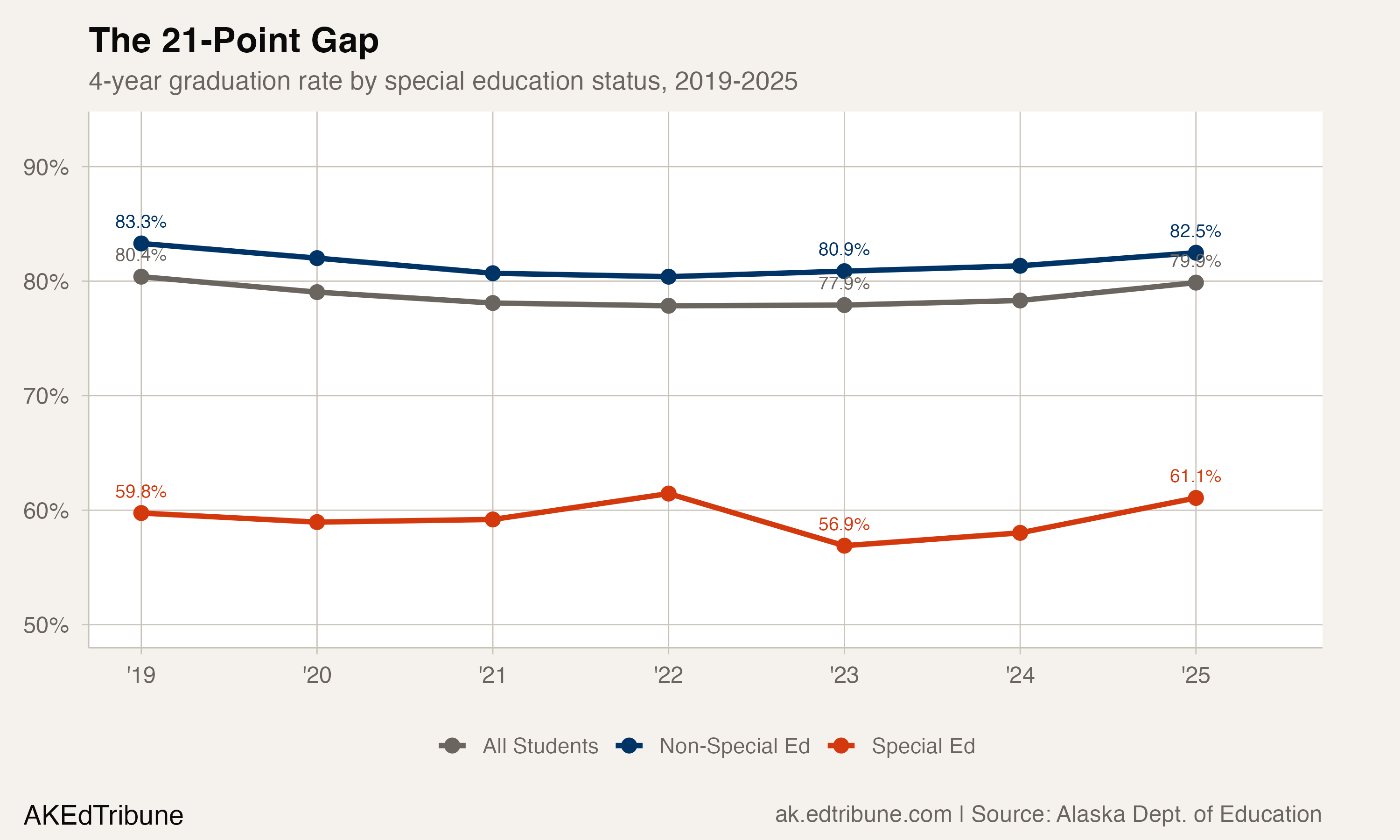
The state's overall graduation rate climbed to 79.9% in 2025, nearly matching its 2019 peak of 80.4%. Special education students saw a parallel bounce, from 58.0% to 61.1%. But the gap between them and their non-special-education peers remains 21.4 percentage points, wider than the 18.9-point low in 2022, and virtually identical to where it stood seven years ago.
The worst rate in the building
Among every student group Alaska tracks, special education has the lowest four-year graduation rate. At 61.1%, it falls below students who are currently homeless (63.4%), Alaska Native students (68.0%), English learners (68.3%), and economically disadvantaged students (74.6%). It is 24.7 percentage points below white students and 29.2 points below military-connected students, who graduate at 90.3%.
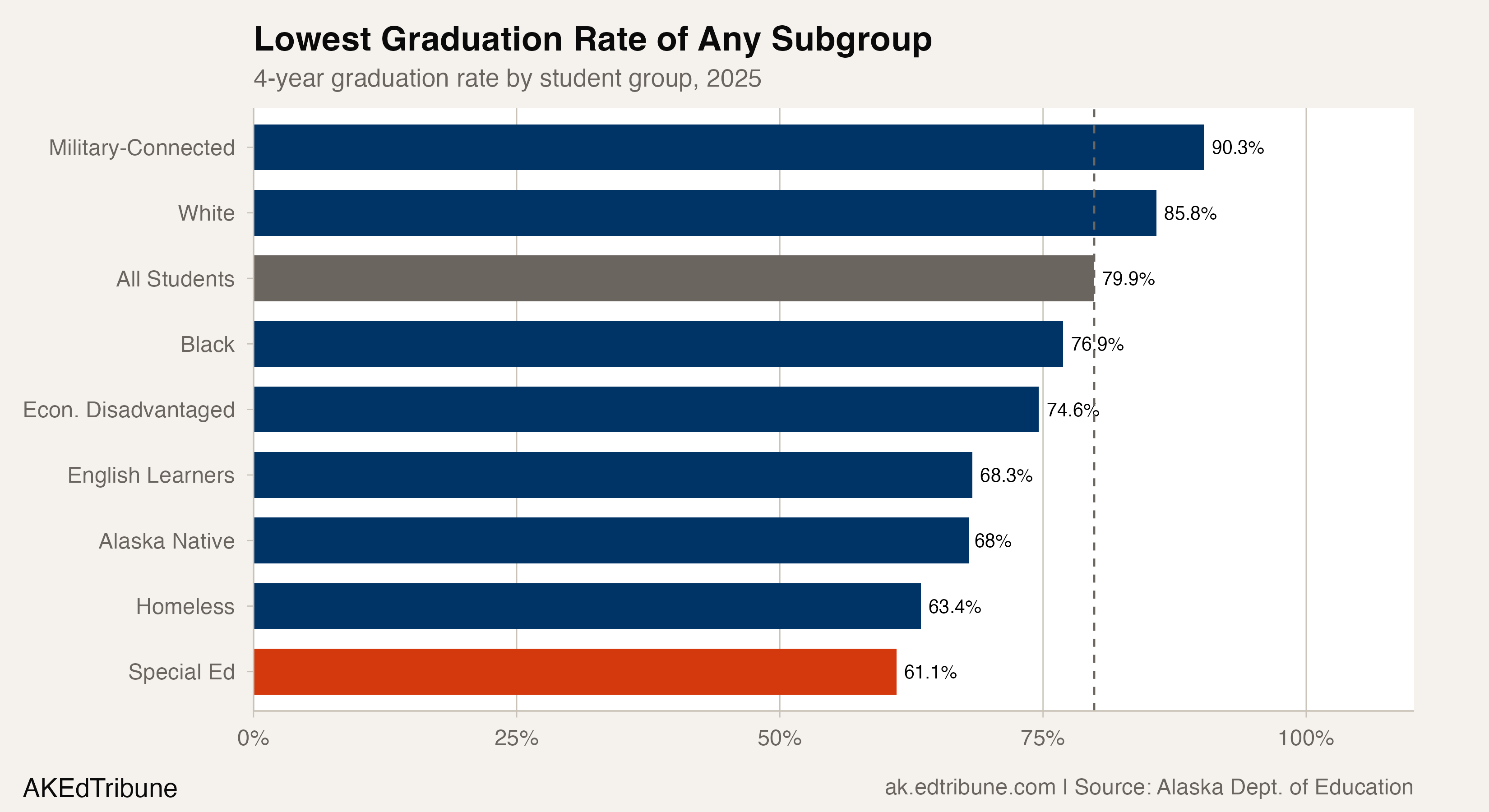
Special education students consistently rank at or near the bottom among all tracked subgroups. In 2023 and 2025, they held the lowest rate outright; in other years, only students who are currently homeless, a far smaller cohort, graduated at lower rates. The rate hit 56.9% in 2023, its worst mark in seven years, before partially recovering. Over the full 2019-to-2025 window, the rate has gained 1.3 percentage points, an improvement so small it falls within normal year-to-year fluctuation.
3,400 students in seven years
Between 2019 and 2025, a total of 3,439 special education students in Alaska did not earn a four-year diploma. That is an average of 491 per year, or 24.1% of all students statewide who failed to graduate on time.
Special education students are a little over one-tenth of the statewide graduating cohort. In 2025, they made up 1,210 of 9,929 students, or 12.2% of the cohort, but 23.6% of students who did not graduate within four years.
A gap that bounces but does not shrink
The graduation gap between special education and non-special-education students has oscillated between 18.9 and 24.0 percentage points since 2019, with no sustained trend in either direction.
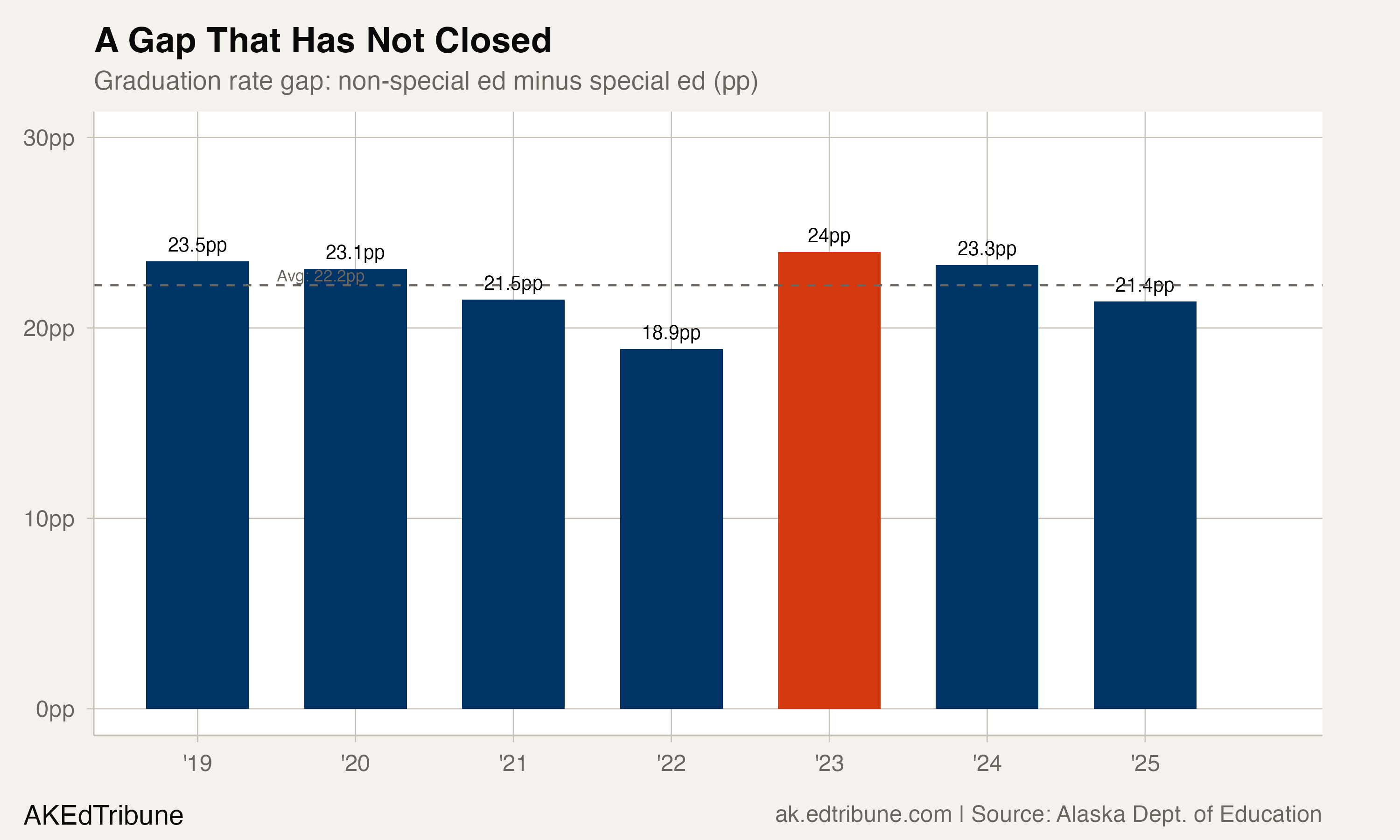
The narrowest gap, 18.9 points in 2022, came not because special education rates surged (they reached 61.5%, their seven-year high) but because non-special-education rates were at their lowest point (80.4%). The widest gap, 24.0 points in 2023, arrived when special education rates cratered to 56.9% while non-special-education students had already begun recovering.
Suggestive context, not direct evidence: the pattern looks less like a line that is steadily closing than a floor the system keeps returning to. When the overall system improves, special education students share some of the gains. When it declines, they absorb a larger share of the losses. The gap oscillates around a mean of 22.2 percentage points, and nothing in seven years of data indicates it is closing.
The staffing crisis underneath the numbers
Graduation rates are an outcome. Suggestive context from Alaska school officials points to one strained input: staffing.
In March 2026 legislative testimony reported by Alaska Public Media, school district officials said nearly 200 special education positions were vacant statewide. The number of students requiring special education services has grown 14% since 2021, while the workforce to serve them has not kept pace.
"These are not optional roles. They are federally required." — Melissa Matthews, special education administrator, testimony to the Alaska Legislature
The shortage is most acute in rural Alaska, where districts increasingly rely on itinerant staff who travel between sites rather than resident teachers. The Kuspuk School District, which serves 318 students across seven villages in western Alaska with no road connections, left 20% of its teaching positions unfilled in one recent year. Foreign educators on J-1 cultural exchange visas now make up more than half its teaching staff. Alaska's 2024 Educator of the Year, Dale Ebcas, is a Filipino special education teacher working in the village of Upper Kalskag.
Teacher turnover statewide has climbed steadily since 2013. As of 2024, 28% of teachers and 35% of principals left their districts each year, rates that Dayna DeFeo of the University of Alaska Anchorage's Center for Alaska Education Policy called "a wicked problem" in a presentation to the State Board of Education.
The connection between staffing instability and graduation outcomes is suggestive context rather than direct evidence in this dataset. The graduation data cannot isolate the effect of vacancies or itinerant staffing, but it does identify a capacity problem around the students whose outcomes are lagging.
A fifth year helps, but the benefit is shrinking
Alaska also tracks five-year graduation rates, which capture students who need additional time to complete diploma requirements. For special education students, the extra year has historically added 7 to 10 percentage points to the graduation rate, and as much as 12.2 points in the COVID-disrupted 2023 cohort.
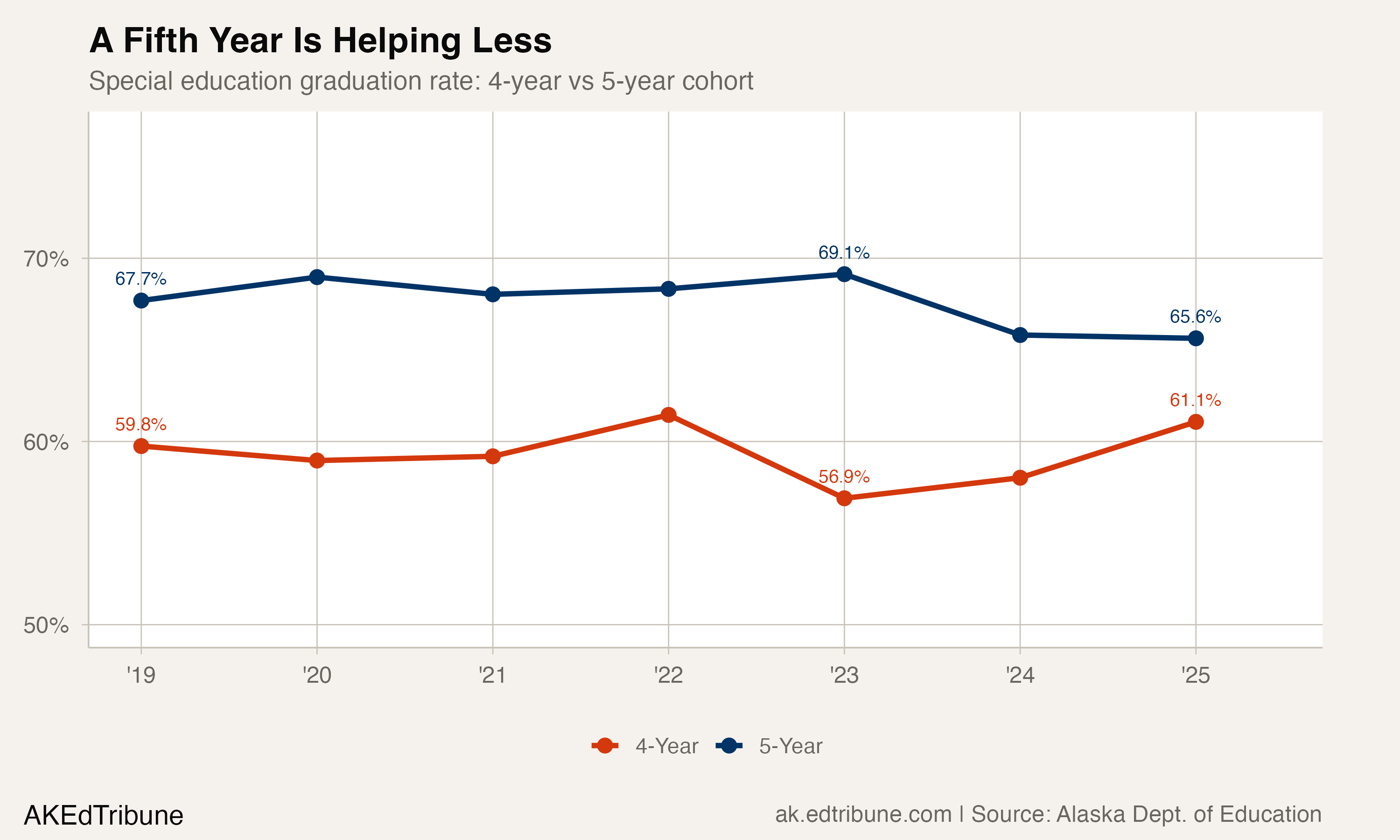
In 2023, when the four-year rate hit its trough of 56.9%, the five-year rate was 69.1%, a 12.2-point bump, the largest in the dataset. But the five-year rate has been declining even as the four-year rate has started recovering. In 2025, the five-year special education rate was 65.6%, only 4.6 points above the four-year rate. That is the smallest five-year benefit in seven years, suggesting that fewer students who miss the four-year mark are completing their diplomas in year five.
Whether this reflects a genuine decline in extended-time outcomes or a cohort-composition effect (the four-year-rate improvement pulling borderline students into the four-year window) is not distinguishable from the available data. Either explanation carries consequences for transition planning.
Volatility, not progress
Year-over-year changes in the special education graduation rate swing wildly, from a 4.6-point drop in 2023 to a 3.0-point gain in 2025.
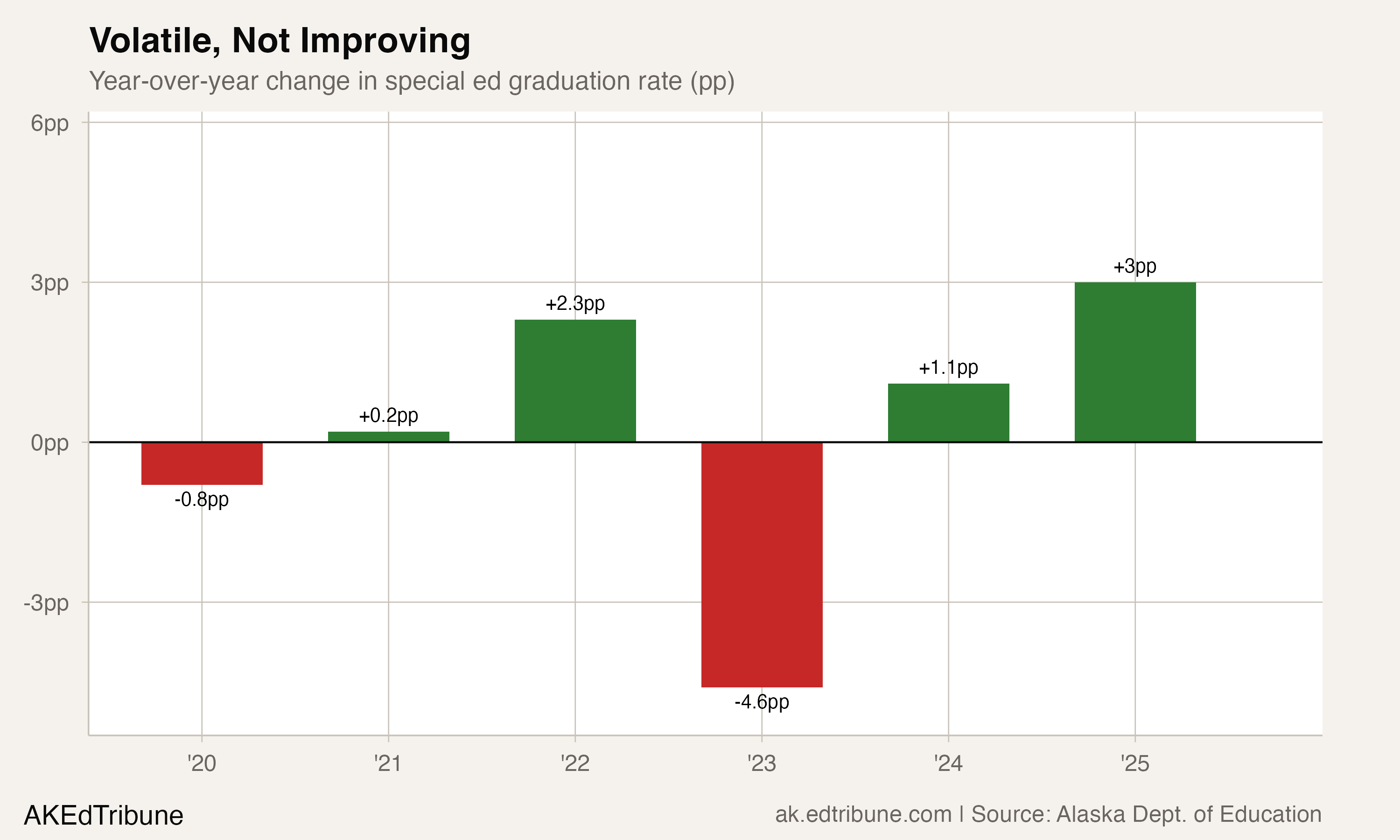
The volatility partly reflects the cohort's modest size. With roughly 1,200 students per year, a change of just 36 students crossing or missing the graduation threshold would move the rate by 3 percentage points. Statewide policy effects and individual-school outcomes can easily get tangled in a cohort this size.
But the pattern also reinforces the core finding: there is no sustained improvement trend. The 2025 rate of 61.1% is nearly identical to where it started in 2019 (59.8%). The state's overall rate followed a similar U-shaped trajectory, dipping during the pandemic years and recovering in 2025, but the special education rate recovered to roughly the same low baseline it started from.
What graduation data cannot show
This analysis tracks four-year and five-year cohort graduation rates for students classified as receiving special education services. It does not distinguish between disability categories. Nationally, NCES reports large differences in how students ages 14 to 21 served under IDEA exit school by disability type: students with hearing impairments exited with a regular high school diploma at 84%, while those with multiple disabilities did so at 40%. Alaska's 61.1% is a blended rate across all IEP classifications, and some students within that group face far steeper barriers than the aggregate suggests.
The data also cannot reveal what happens after a student exits the cohort without a diploma. Some will earn a GED. Some will receive a certificate of attendance. Some will enter the workforce. The Anchorage School District operates an Adult Community Transition program for students aged 18 to 22 who have completed core credits but need additional support for vocational skills and independent living, one pathway among several. But there is no statewide tracking of post-secondary outcomes for special education students who do not graduate on time.
The structural question
Alaska's special education graduation rate of 61.1% falls below the most recent national average for students with disabilities, which the National Center for Education Statistics reported at 71% for the 2021-22 school year. The gap between Alaska and the national benchmark is roughly 10 points.
Whether the state's position reflects its unique geographic challenges, rural staffing patterns, the composition of its special education population, or some combination of all three, the data cannot say. What the data does say is that seven years of results show no trajectory of improvement. The 2025 cohort of 1,210 special education students graduated at functionally the same rate as the 2019 cohort of 1,200. In between, 3,439 students with disabilities did not earn a four-year diploma.
The question facing Alaska's education system is not whether the gap exists. It is whether the state has the capacity to close it while nearly 200 federally mandated special education positions remain unfilled.
Detailed code that reproduces the analysis and figures in this article is available exclusively to EdTribune subscribers.
Discussion
Sign in to join the discussion.
Loading comments...