Correction: An earlier version included external numeric and causal context that the state graduation package did not establish. This revision limits its findings to the package output and treats four-year and five-year results as separate measures.
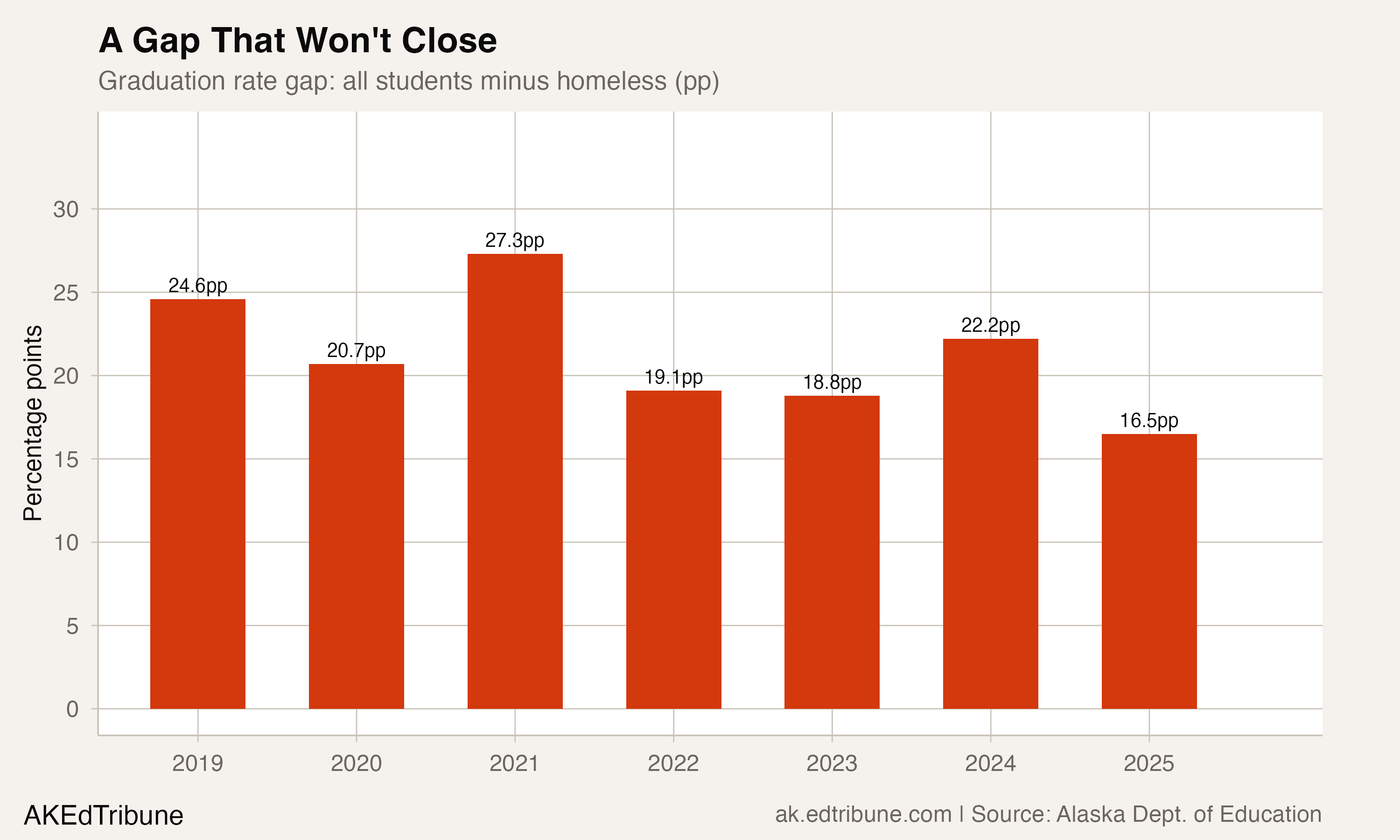
In 2024-25, Alaska's students who are currently homeless posted the highest four-year graduation rate in seven years of data: 63.4%. It still fell 16.5 percentage points short of the statewide average.
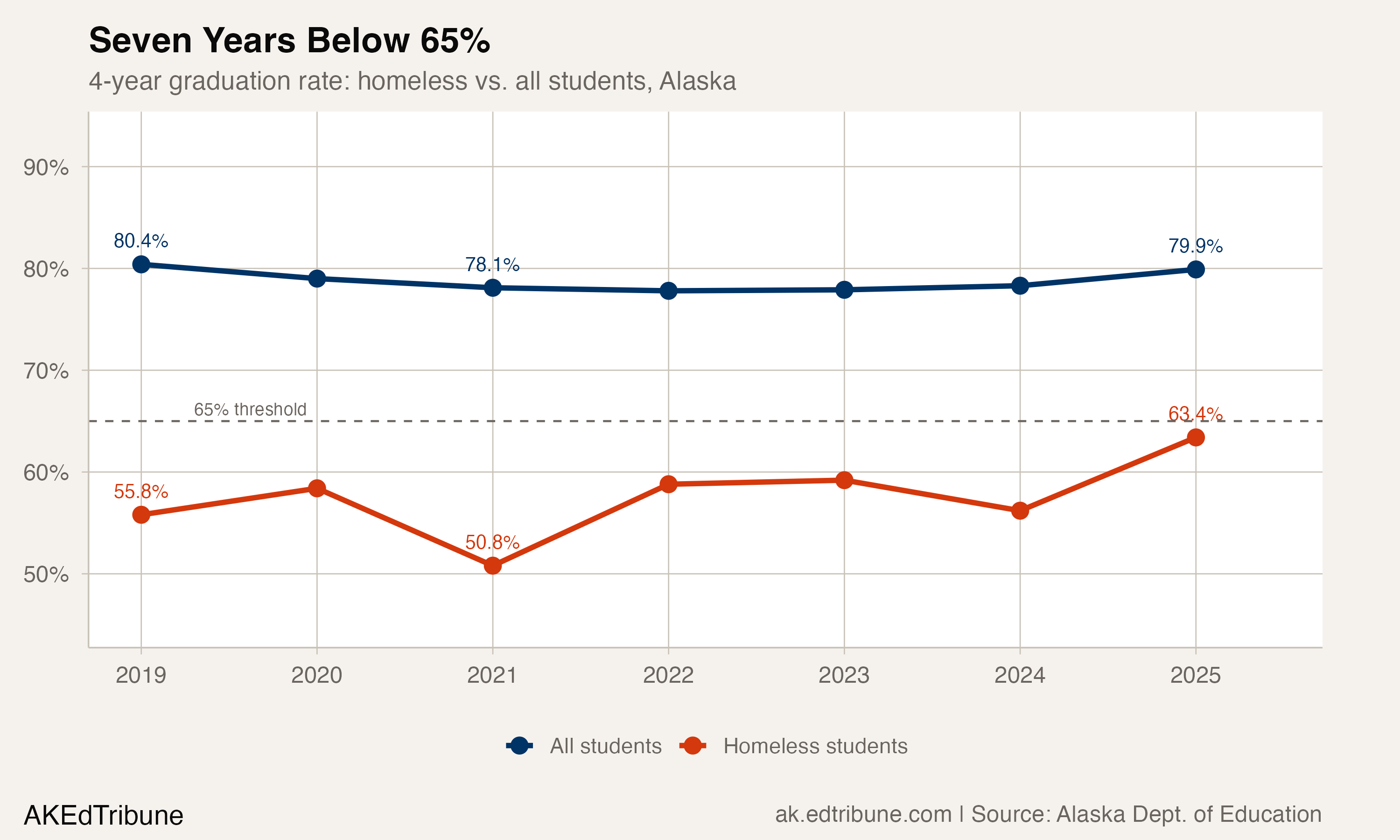
That is the contradiction at the center of this data. The best year on record for students who are currently homeless in Alaska is a year in which roughly one in three did not earn a diploma on time. Over the same seven-year window, the statewide rate ranged from 77.8% to 80.4%. For students who are currently homeless, it swung between 50.8% and 63.4%, never once clearing 65%.
The 65% ceiling
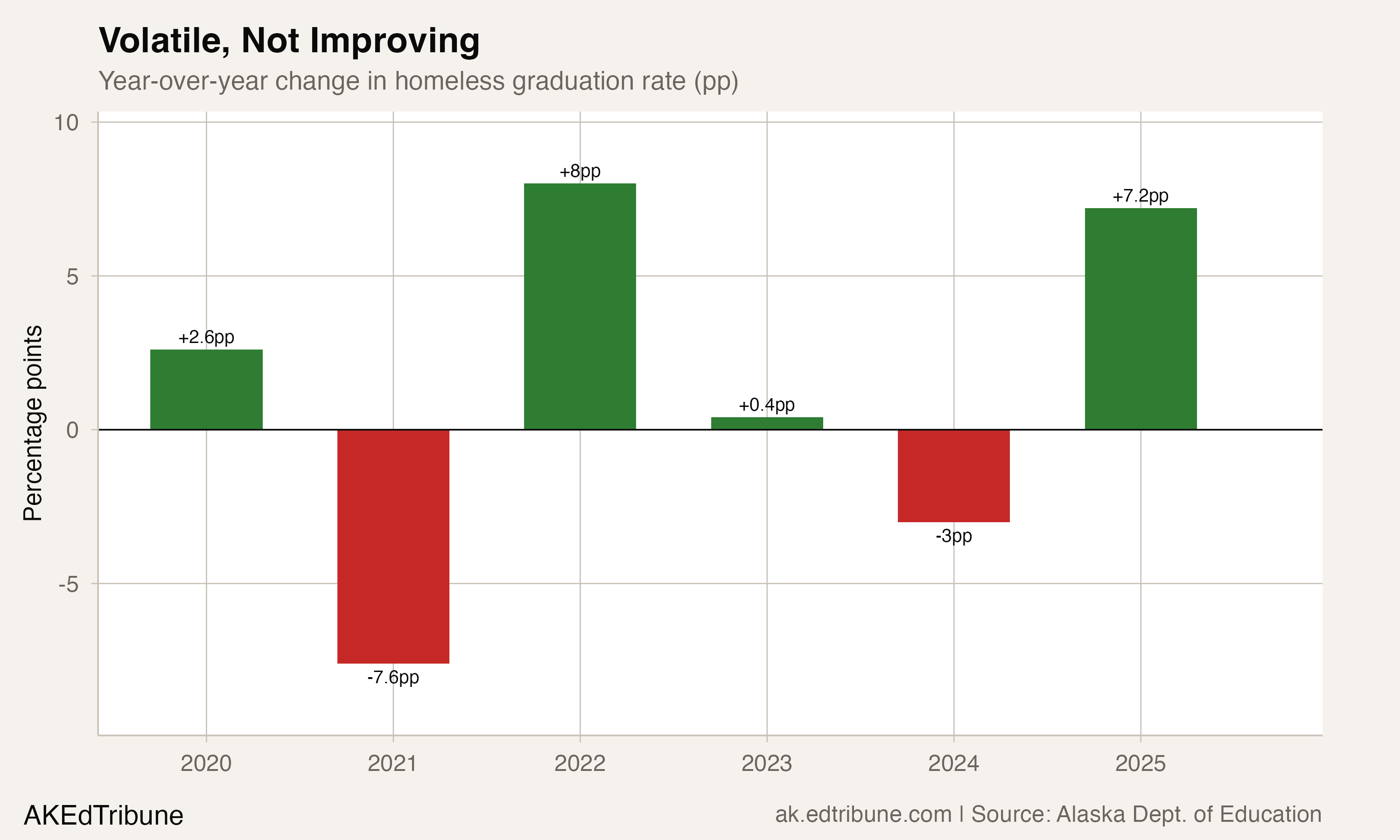
The pattern is not a steady trend. Students who are currently homeless' four-year graduation rate dropped to 55.8% in 2018-19, climbed to 58.4% in 2019-20, fell to 50.8% in 2020-21, bounced back to 58.8%, inched up to 59.2%, fell again to 56.2% in 2023-24, then jumped 7.2 points to the current 63.4%.
The seven-year average is 57.5%. Only once has the rate exceeded 60%.
That volatility matters because the cohorts are small. Alaska identified 256 to 373 homeless seniors in each graduation cohort, between 2.7% and 3.8% of the total. In a cohort of 336 students, a swing of 20 students changes the rate by six percentage points. The small sample size means individual outcomes can jolt the rate from year to year, which makes the persistence of the ceiling more striking: even when the number bounces up, it does not reach 65%.
Where students who are currently homeless rank
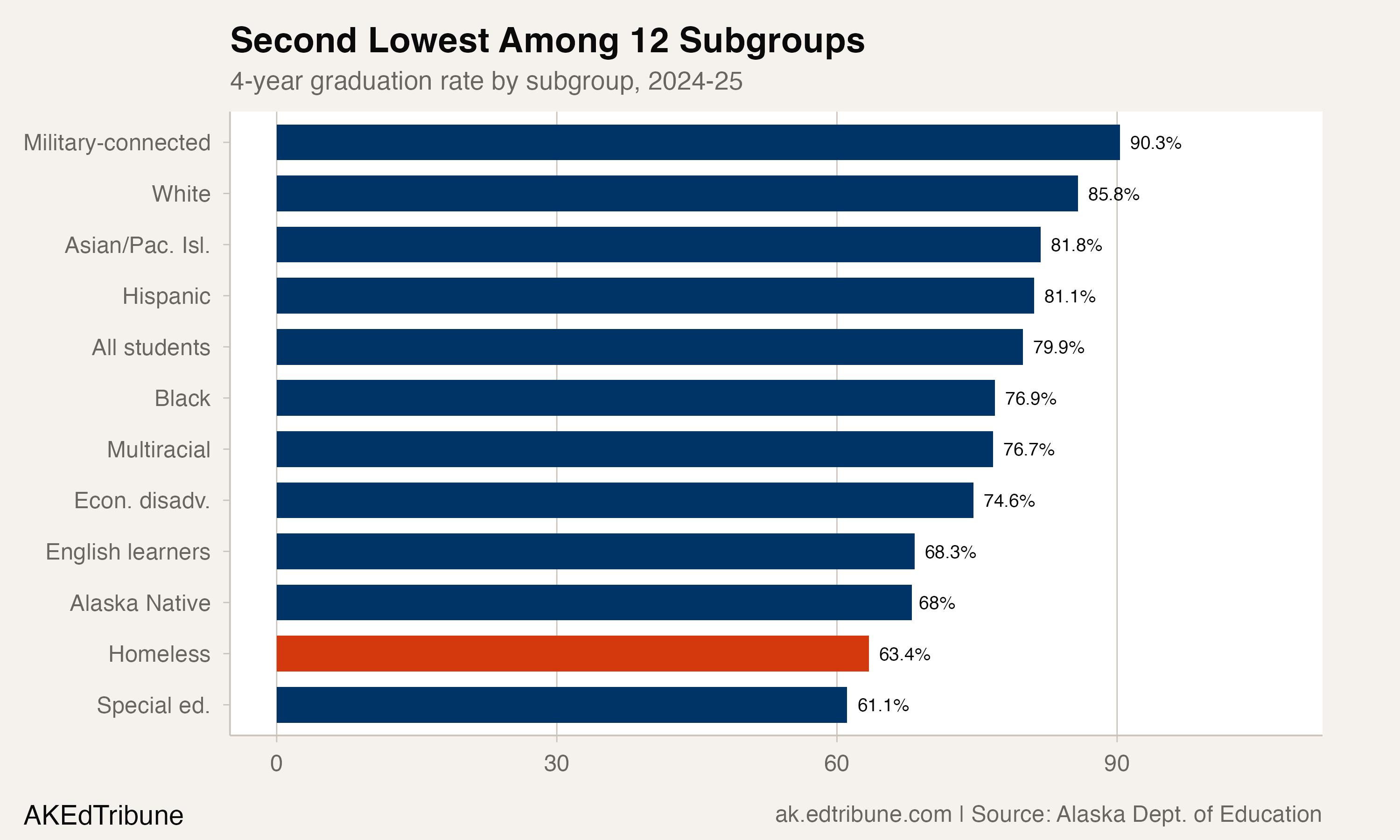
Among the 12 subgroup categories shown in this comparison, students who are currently homeless graduated at 63.4% in 2024-25. Only students receiving special education services had a lower rate, at 61.1%.
The gap between students who are currently homeless and the state average has ranged from 16.5 to 27.3 percentage points over seven years. In 2020-21, Alaska's homeless rate dropped below 51%, opening a 27.3-point chasm. That year, the homeless cohort also shrank to its smallest size in the available package data: 256 students. The graduation file does not show whether that reflected identification, mobility, actual cohort size, or some combination of those factors.
The fifth-year question
When Alaska reports a five-year cohort measure, outcomes for students who are currently homeless look materially higher. The five-year cohort graduation rate for students who are currently homeless was 72.6% in 2024-25, 9.2 points above the four-year rate. The five-year cohort count was 288, compared with 336 in the four-year measure; because the measures are separate cohort calculations, that difference should not be read as a direct count of students leaving between their fourth and fifth years.
That 9.2-point difference between the reported four-year and five-year rates is larger than the 3.1-point difference in the statewide measures. Because these are separate cohort calculations, the package does not establish how many individual students completed after an additional year.
919 students in seven years
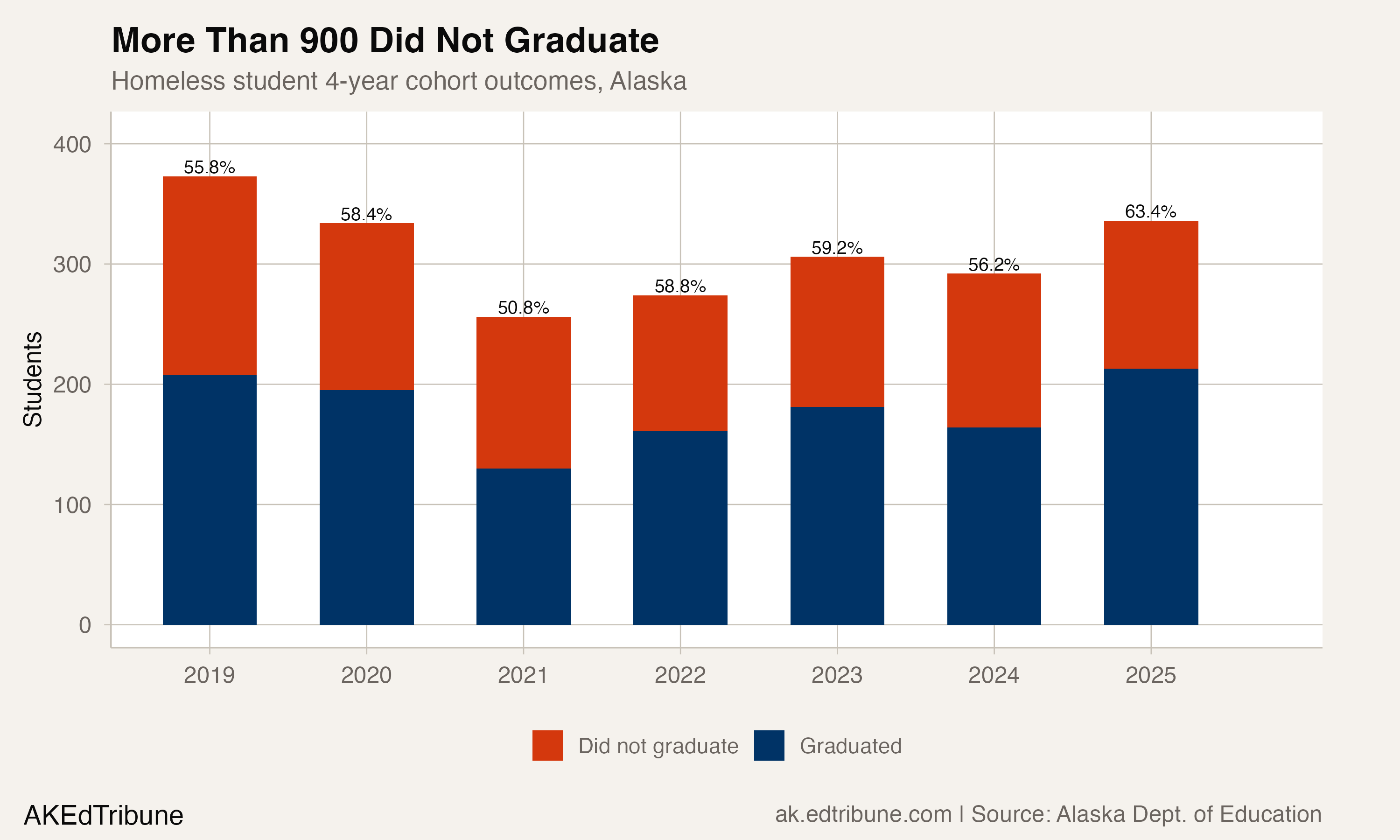
Between 2018-19 and 2024-25, 919 students who are currently homeless in Alaska did not graduate within four years. In 2024-25 alone, 123 students in the homeless cohort did not earn a diploma on time, the second-lowest non-graduate count in the seven-year window. The improvement is real but modest: in 2021-22, the non-graduate count was 113, on a much smaller cohort.
What the data cannot show
The graduation data does not report the duration or type of housing instability for individual students. It also does not track whether a student's housing status changed between identification and graduation.
What the data does show is that students identified as currently homeless posted a graduation rate 16.5 to 27.3 points below the state average in each of the seven reported years. The 2024-25 improvement to 63.4% narrowed that difference to its tightest point. The graduation file cannot show whether that improvement will hold.
Detailed code that reproduces the analysis and figures in this article is available exclusively to EdTribune subscribers.
Discussion
Sign in to join the discussion.
Loading comments...