In 2025, roughly 1,999 Alaska students who started high school four years earlier did not walk at graduation. That is one in five.
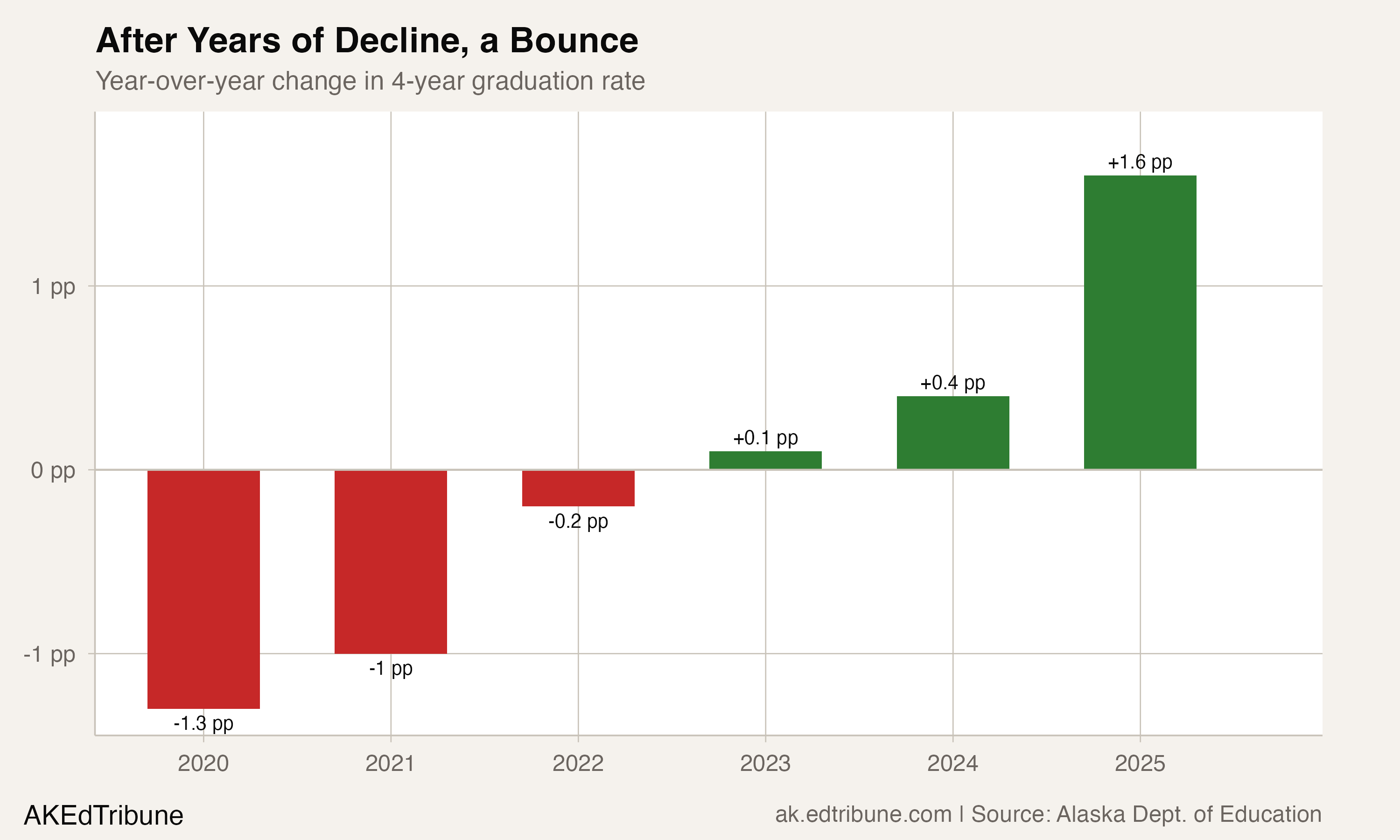
The state's 4-year adjusted cohort graduation rate hit 79.9%, its best mark since 2019 and a 1.6 percentage-point jump from the prior year. By any internal measure, 2025 was a good year. By a national one, it was not. The most recent federal data pegs the U.S. average at 87%. Alaska has not come within 6.6 points of that line in any year on record.
The 2025 bounce followed a slow slide: 80.4% in 2019, then three consecutive years of decline to a trough of 77.8% in 2022. For six of the seven years in the dataset, Alaska's rate sat below 80%. A single good year does not reverse that pattern. It raises a question: is this the start of a climb, or another oscillation around a low baseline?
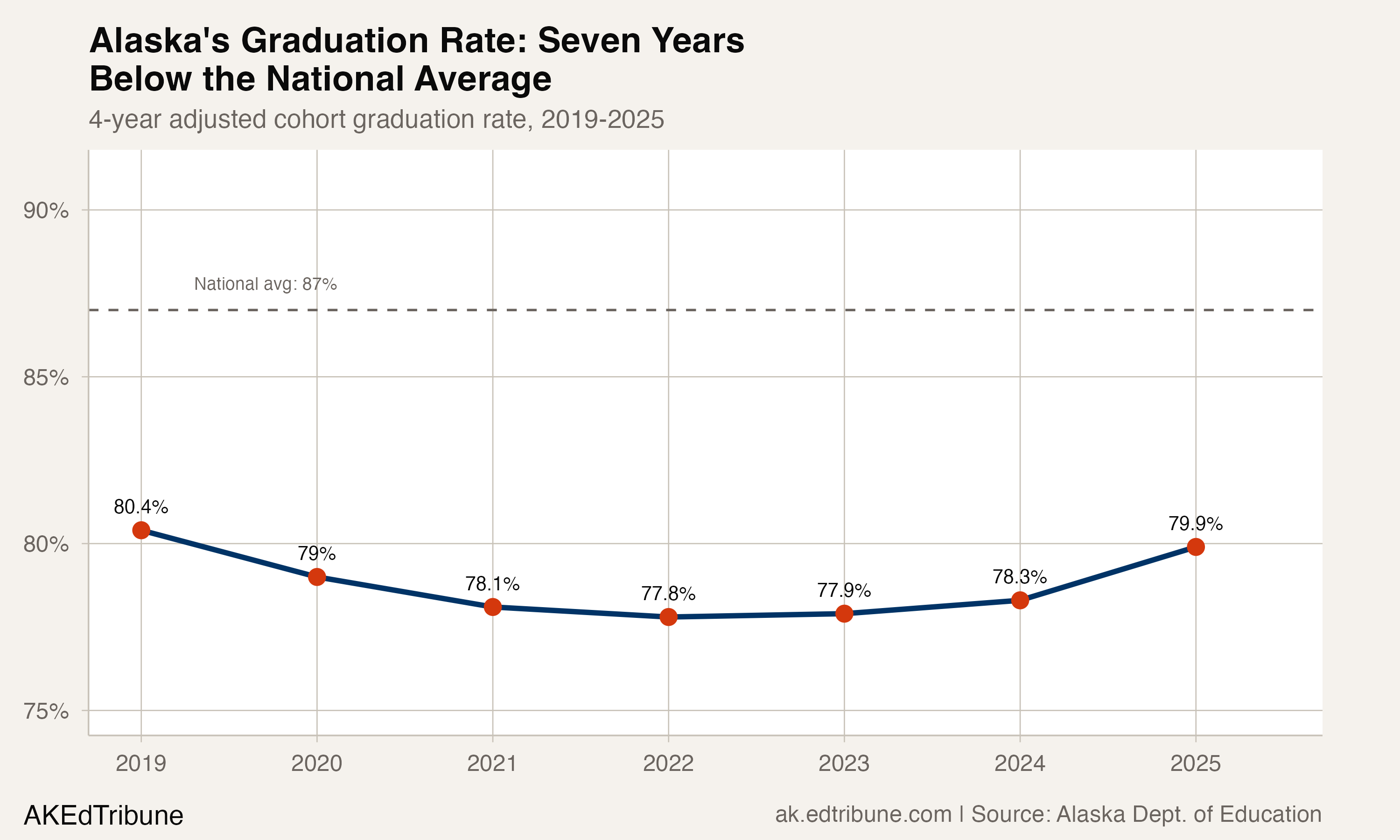
Nearly 2,000 students a year
The absolute numbers are remarkably stable. In 2022, the worst year on record, 2,082 students did not graduate on time from a cohort of 9,401. In 2025, the best year, 1,999 did not graduate from a cohort of 9,929. The cohort grew by 528 students. The number who failed to finish barely budged.
Alaska's 5-year rate, which captures students who take an extra year, reached 83.0% in 2025. That additional year recovers roughly 3.2 percentage points, meaning about 300 more students per cohort cross the finish line with one more year of schooling. But even the 5-year rate has never broken 85%.
Who is left behind
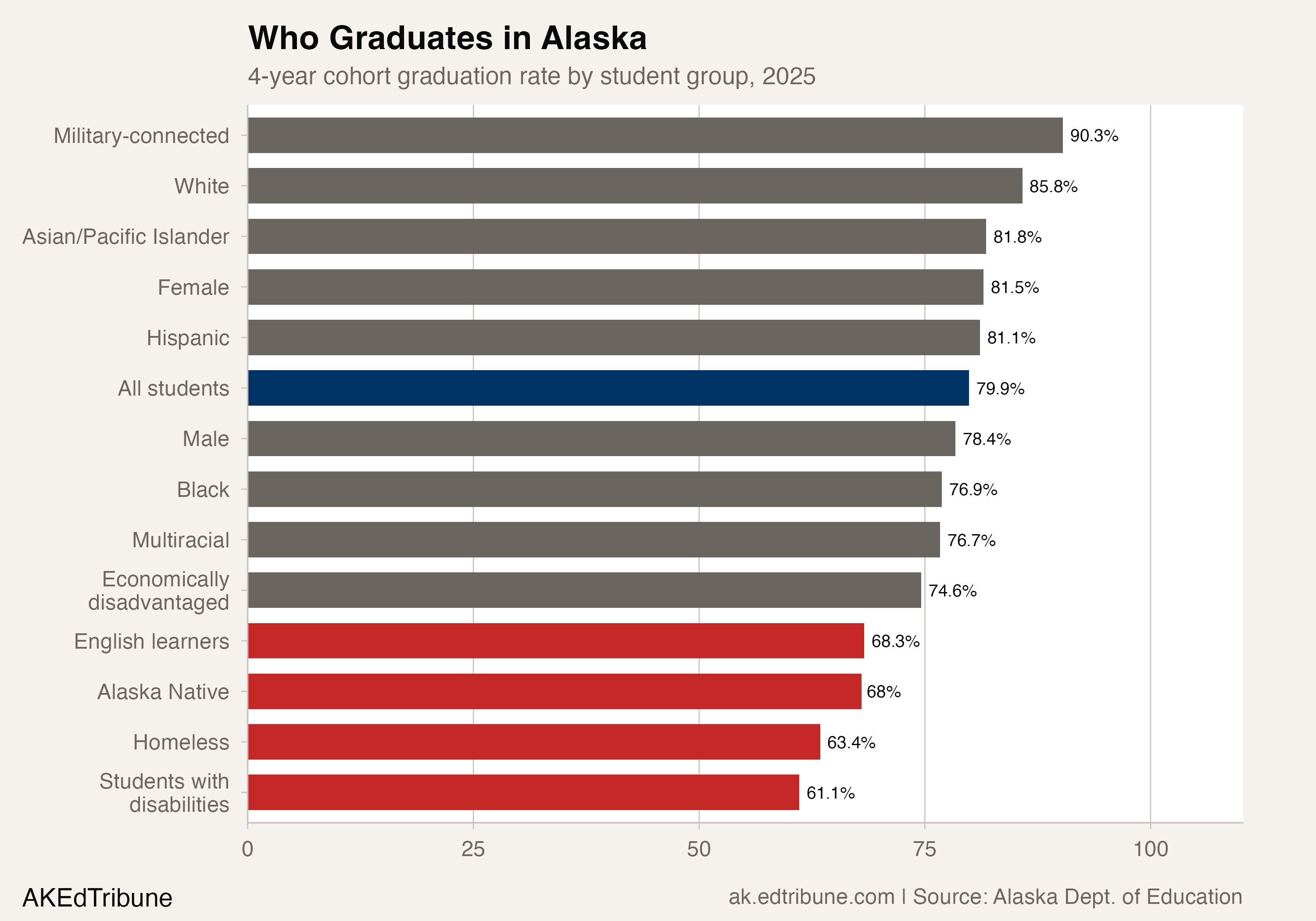
The statewide average conceals a series of compounding gaps. Students with disabilities graduate at 61.1%, a rate that has barely moved in seven years, oscillating between 56.9% and 61.4% with no clear trajectory. Homeless students fare slightly better at 63.4%, though their rate swung as low as 50.8% in 2021.
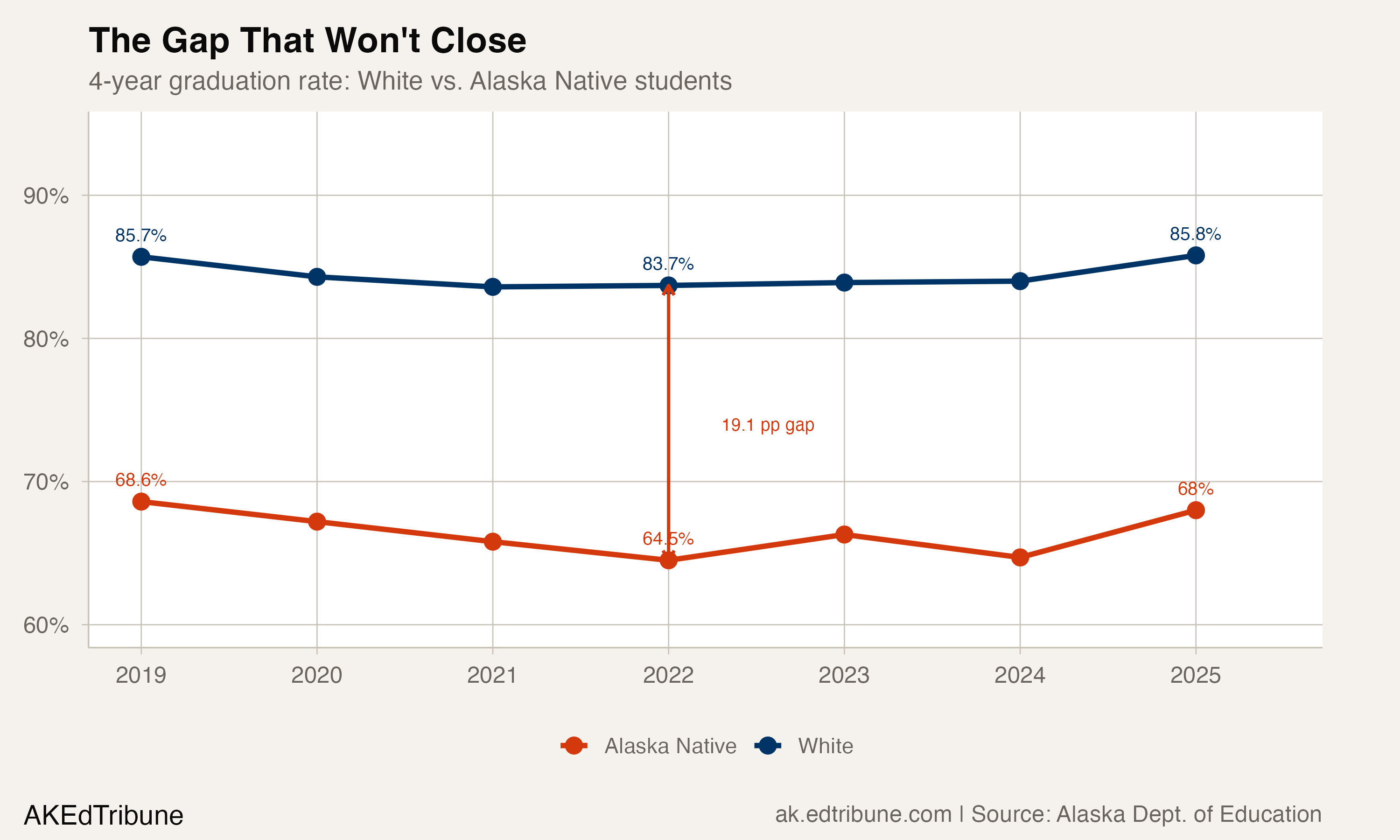
Alaska Native students, who make up roughly one in five of the state's graduation cohort, finished at 68.0%. The gap between white students (85.8%) and Alaska Native students measured 17.8 percentage points in 2025. That gap hit 19.3 points in 2024 and 19.2 in 2022. It has not shrunk in any sustained way across the seven-year window.
RELATED: Alaska Loses One in 11 Native Students in Seven YearsET
English learners graduated at 68.3%, down from 71.9% in 2019. Students from economically disadvantaged households posted 74.6%, nearly matching their 2019 rate of 74.7% after a dip to 69.8% in 2021.
The 18-point line between white and Alaska Native students
The white-Alaska Native graduation gap has persisted for the entire data window. It ranged from 17.1 points in 2019 to 19.3 points in 2024. Both groups improved in 2025, Alaska Native students by 3.4 points from 2022 and white students by 2.1 points, leaving the structural gap nearly unchanged.
That gap is not just a statistical abstraction. In districts where Alaska Native students are the majority of the cohort, the consequences are visible in the numbers. Lower Kuskokwim School District↗ET, which graduated 66.3% of its cohort, serves 273 students almost entirely from Yup'ik communities along the Kuskokwim River. North Slope Borough↗ET graduated 66.4% of 134 students in Inupiat communities above the Arctic Circle. Northwest Arctic Borough↗ET, centered on Kotzebue, managed 69.2%.
These are places where schools double as community centers, where teacher turnover runs high, and where the nearest road often doesn't exist. A WestEd report on increasing American Indian and Alaska Native graduation rates noted that culturally responsive curricula and community-based mentoring programs have shown promise in similar settings, but that chronic underfunding and staff instability remain the primary barriers.
Correspondence schools pull district rates down
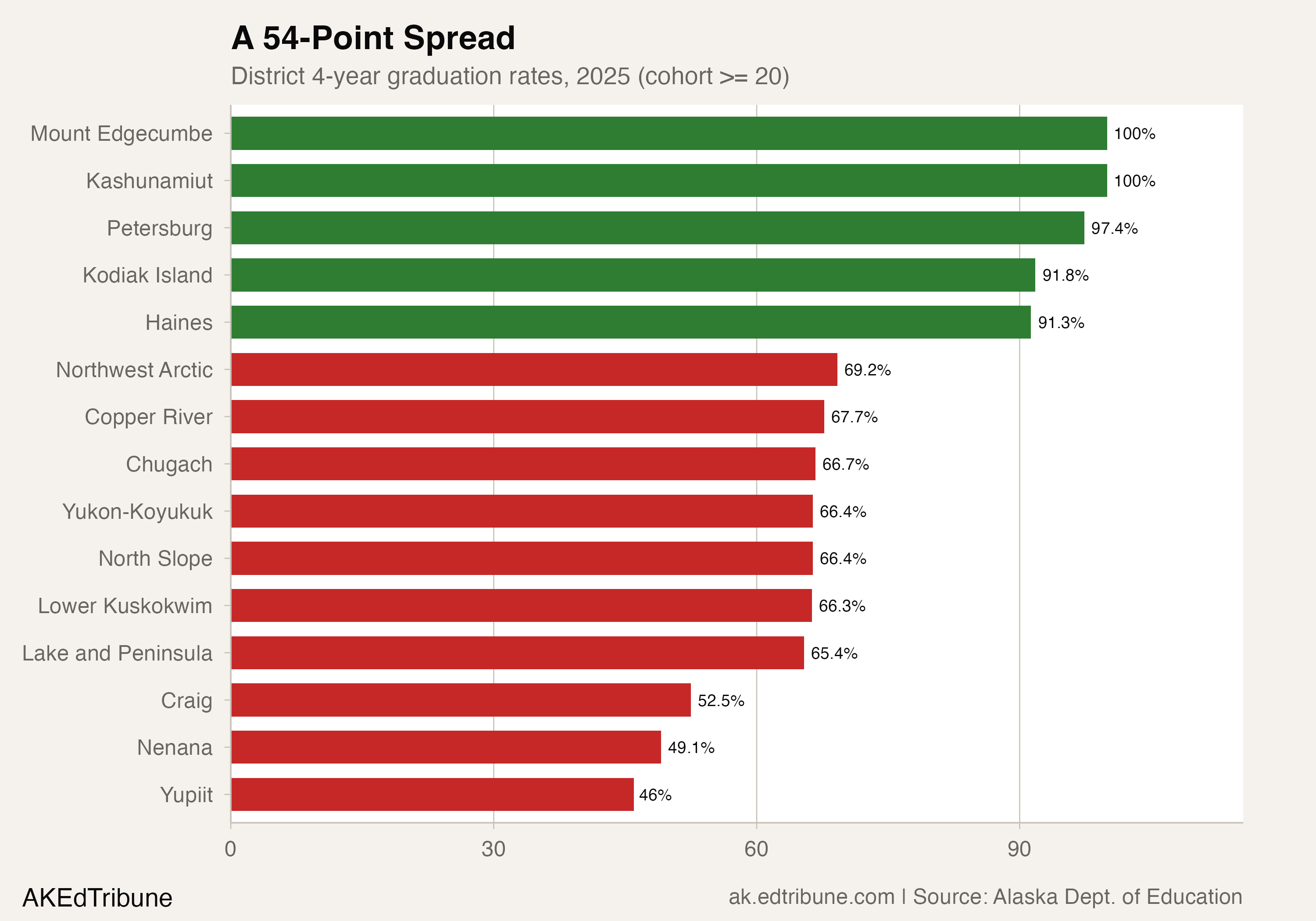
Statewide, 18 of 35 districts with reportable data graduated fewer than 80% of their students. Ten graduated fewer than 70%. Three fell below 60%.
The lowest graduation rate among districts with at least 20 students in the cohort belongs to Yupiit School District↗ET at 46.0%, but the most consequential outlier is Nenana City School District↗ET at 49.1% with a cohort of 275. The brick-and-mortar Nenana City School graduated 86.7% of its 30 students. CyberLynx Correspondence Program, a statewide homeschool-support operation housed under Nenana's district umbrella, graduated 44.5% of 245 students.
RELATED: One in Nine Alaska Students Now Learns by MailET
This is not a small-school anomaly. CyberLynx serves students across the state who have left or been pushed out of traditional classrooms. Its 44.5% rate in 2025 was actually its highest mark in seven years; it posted 29.7% in 2019. The program is designed for students who were already struggling, so a low rate is partly structural. But the cohort is large enough to drag Nenana's composite rate below 50% and to depress the statewide number.
Galena City School District↗ET, another correspondence-heavy district, graduated 78.1% of 652 students in 2025. Galena's IDEA correspondence program operates similarly to CyberLynx but with a larger cohort and a graduation rate 34 points higher, suggesting that program design matters even within the correspondence model.
Where the improvement came from
The 1.6 percentage-point jump in 2025 was the largest single-year gain in the seven-year dataset. It arrived broadly: Anchorage↗ET rose from 82.2% to 83.3%, Fairbanks North Star↗ET from 80.1% to 81.2%, and Kenai Peninsula↗ET posted the sharpest recovery, climbing from 78.8% to 85.0% after falling as low as 77.0% in 2022.
Kodiak Island↗ET hit 91.8%, its second-best mark in the dataset. Matanuska-Susitna↗ET, the state's second-largest district by cohort size at 1,360 students, held steady at 84.3%.
The gains were uneven across student groups. Male students gained 3.6 points from the 2022 trough, closing the gender gap from 6.3 points to 3.1. Alaska Native students gained 3.4 points. Economically disadvantaged students gained 4.3 points.
Students with disabilities gained almost nothing: 61.1% in 2025 versus 61.5% in 2022. Their rate has been stuck in a narrow band between 56.9% and 61.5% for seven years, disconnected from the broader improvement.
A budget crisis threatens the gains
Alaska's school districts are not in a position to build on the 2025 improvement. The Anchorage School District, which educates roughly a third of the state's graduation cohort, faces a $90 million structural deficit that has already triggered the closure of three elementary schools, the elimination of 500 staff positions including over 300 teachers, and cuts to counselors and nurses.
"Even once this $90 million structural deficit is closed, the work begins to find $40 million on top of that, and $30 million on top of that." -- Alaska Public Media, Feb. 2026
RELATED: Anchorage Lost More Students Than All of AlaskaET
The fiscal pressure is statewide. Nearly 80% of Alaska's school districts face deficits, according to Alaska Public Media, even after the legislature approved a $700 increase to the base student allocation last year. That increase amounted to only $20 per student in genuinely new money after a prior one-time allocation expired. Mat-Su is considering school closures. Kodiak needs $1 million in cuts. Galena, the correspondence district that serves 652 students in its graduation cohort, is weighing whether it can keep its doors open.
Counselors, interventionists, and support staff are typically the first positions cut. Those are also the positions most directly connected to keeping at-risk students on track to graduate.
What this rate does not capture
The 4-year cohort rate is a specific metric with specific blind spots. It tracks students who entered ninth grade four years earlier and checks whether they received a diploma. It does not count students who dropped out before ninth grade, students who left the state, or students who earned a GED instead. Alaska's transient military population (military-connected students graduate at 90.3%, the highest rate of any subgroup) inflates the statewide number. Remove that group, and the civilian rate would sit lower.
The rate also cannot distinguish between a district that graduates 80% because its programs work and one that graduates 80% because students who were going to drop out transferred to a correspondence program in another district first. The correspondence school question, explored in a separate articleET, complicates every district comparison in the state.
Alaska's 79.9% is the best number in seven years. It is still a state where one in five students does not finish high school on time, where the gap between white and Alaska Native students has not closed in any meaningful way, and where the budget conditions that might sustain improvement are deteriorating. The 2026 cohort entered high school during the pandemic's worst disruptions. Their results arrive next year.
Detailed code that reproduces the analysis and figures in this article is available exclusively to EdTribune subscribers.
Discussion
Sign in to join the discussion.
Loading comments...