Alaska's chronic absence rate fell again in 2024-25, but the annual improvement was smaller than in either of the preceding reporting years. The statewide rate remained well above its pre-pandemic baseline.
The most recent published attendance data put the rate at 42.8%, compared with 22.7% in 2018-19. That leaves a gap of 20.1 percentage points.
The figures come from the Alaska Department of Education and Early Development's COMPASS reports.
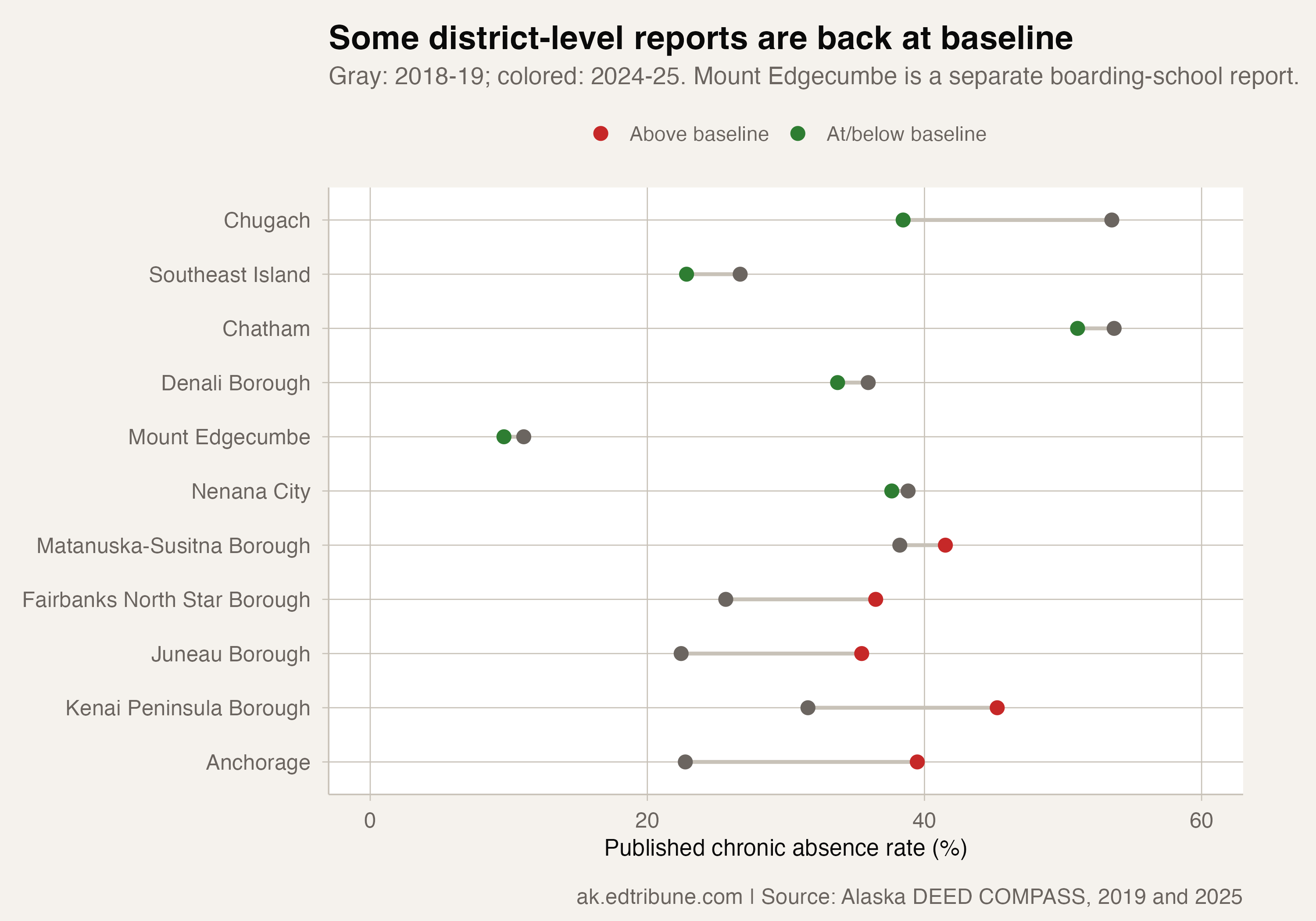
The district picture offers some exceptions. Of 52 district-level reports with comparable rates at both endpoints, six were at or below their baseline. That reporting universe includes Mount Edgecumbe, the separately reported state boarding school, alongside geographic school districts. Excluding that report leaves five recovered districts out of 51 with comparable endpoints.
Smaller annual gains
The statewide rate peaked at 48.6% in 2021-22. It subsequently fell by 3.6 percentage points in 2022-23, by 1.5 points in 2023-24, and by 0.6 points in 2024-25.
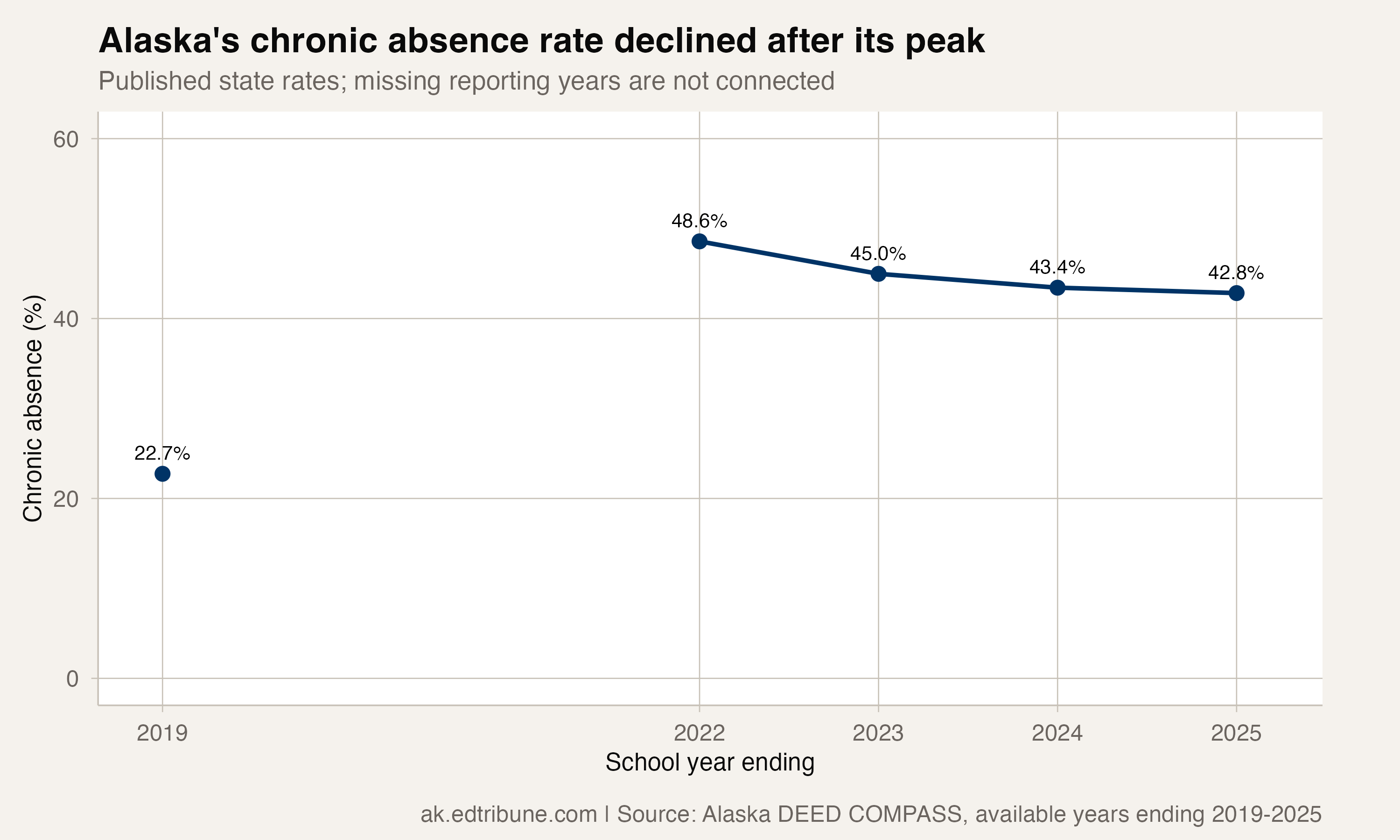
Those are consecutive annual changes after the peak. The earlier comparison is different: the published series has a gap between its pre-pandemic baseline and its next available reporting year. It cannot establish what happened in each missing year.
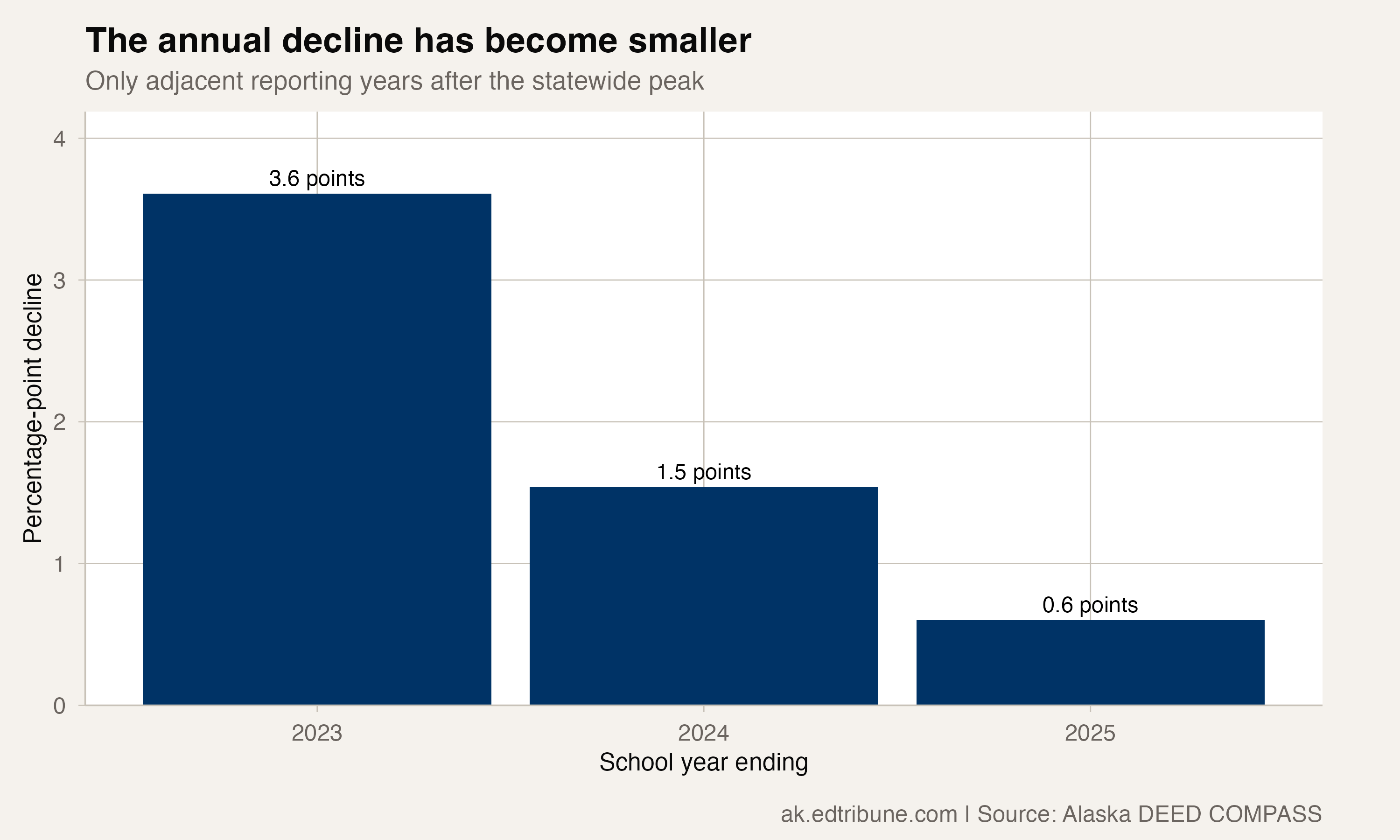
The shrinking gains describe the recent trajectory. They do not establish a future recovery date, or explain why attendance changed. The statewide rate has improved by 5.8 percentage points from its peak, while remaining far above its earlier level.
The reports back at baseline
Chugach↗ET had the largest decline among the comparable reports: from 53.5% to 38.5%. Southeast Island fell from 26.7% to 22.8%, and Chatham from 53.7% to 51.0%.
Denali Borough↗ET fell from 35.9% to 33.7%. Nenana City fell from 38.8% to 37.6%. Mount Edgecumbe↗ET fell from 11.1% to 9.7%.
Returning to baseline does not necessarily mean a low absence rate. Chatham's most recent rate, for example, remained above half of students even though it was below its own pre-pandemic figure. Recovery in this comparison measures direction relative to an earlier rate, rather than meeting a common attendance target.
Larger districts remain above their earlier rates
Anchorage↗ET rose from 22.7% to 39.5%. Fairbanks North Star Borough↗ET rose from 25.7% to 36.5%, and Juneau↗ET from 22.4% to 35.5%.
Mat-Su↗ET had a smaller increase, from 38.2% to 41.5%. Kenai Peninsula↗ET rose from 31.6% to 45.2%.
These comparisons identify where rates stand relative to the baseline. They do not rank districts by enrollment, measure the number of absent students, or show that a particular attendance strategy succeeded or failed.
The statewide average hides different gaps
English learners had a chronic absence rate of 50.9% in 2024-25, up from 23.1% at baseline. The increase was 27.8 percentage points, compared with the statewide gap of 20.1 points.
Alaska Native students had a rate of 56.6%, a gap of 23.5 points above baseline. White students were at 34.8%, or 15.9 points above baseline. Black students were at 36.2%, or 14.0 points above baseline.
These are published subgroup rates, not estimates obtained by multiplying rounded percentages by statewide enrollment. The attendance files do not provide the matching statewide numerator and denominator needed to report an exact count of chronically absent students.
Alaska's most recent reports therefore show improvement with clear limits: the statewide decline has slowed, and returning to a district's own baseline remains uncommon. The files record that pattern. They do not record why it persists.
Detailed code that reproduces the analysis and figures in this article is available exclusively to EdTribune subscribers.
Discussion
Sign in to join the discussion.
Loading comments...