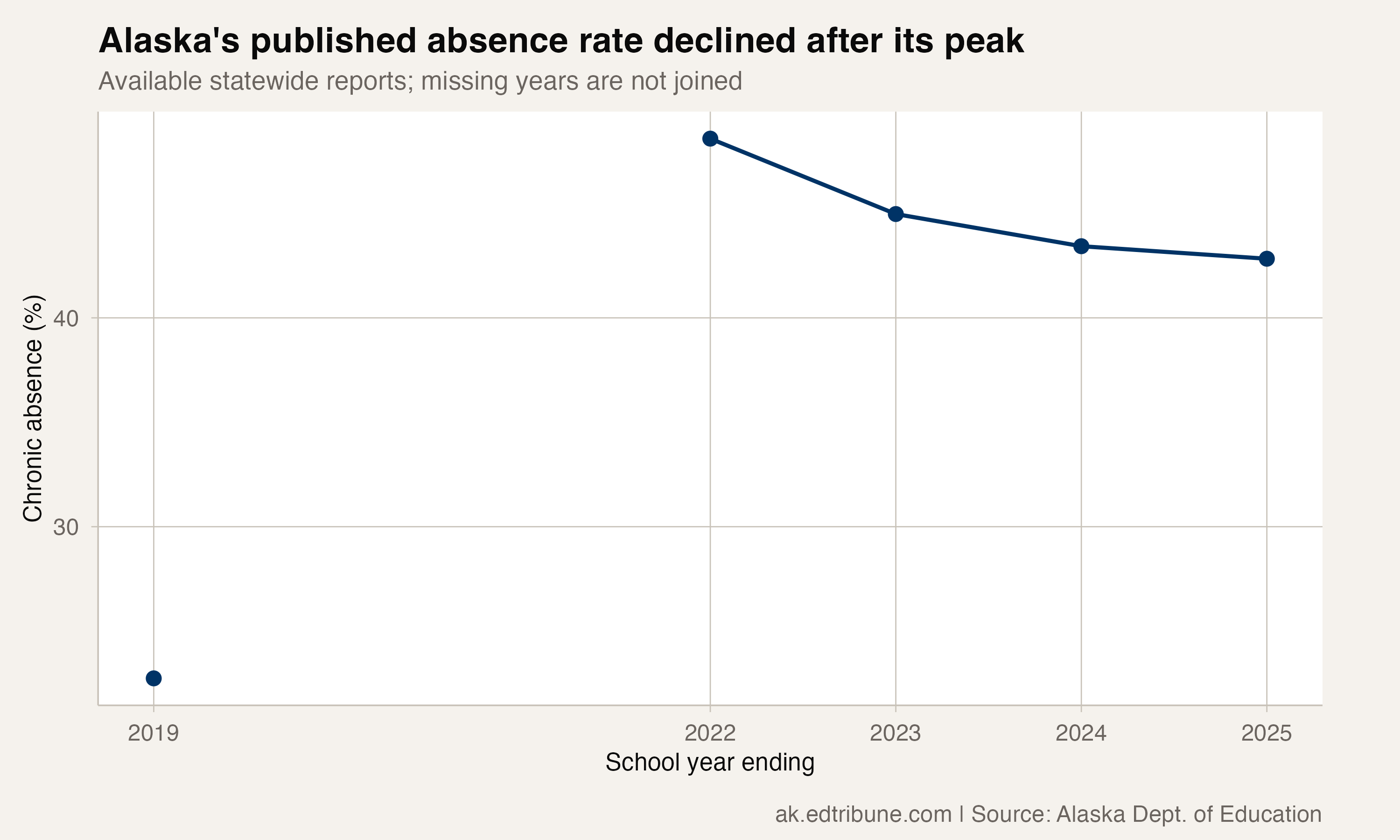
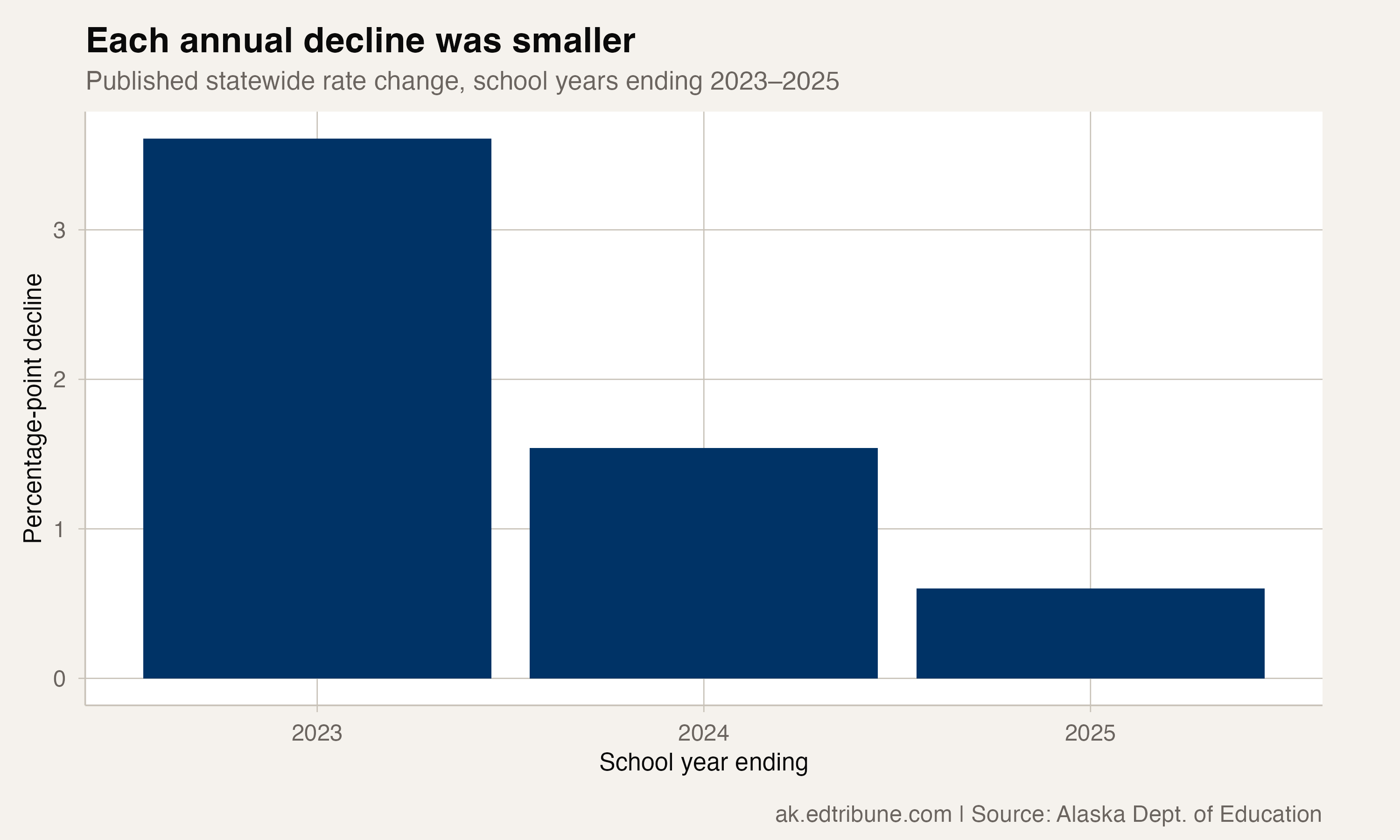
Alaska's published chronic-absence rate fell for three consecutive school years after its recorded high, but each decline was smaller than the last. The rate went from 48.6% in 2021-22 to 42.8% in 2024-25.
The final annual improvement was 0.6 percentage points. That is progress, with a different pace from the 3.6-point decline in 2022-23. The available reports show slowing improvement, rather than a complete stop.
Three declines, different sizes
The Alaska Department of Education and Early Development's COMPASS reports put the statewide rate at 45.0% in 2022-23 and 43.4% in 2023-24. The decline between those reports was 1.5 points. The following year's smaller decline left the state 5.8 points below its available-history high.
Calling that path a plateau would hide the annual improvements. Calling it a return to earlier attendance levels would overstate them. Alaska's published rate was 22.7% in 2018-19, and the 2024-25 rate remained 20.1 points higher.
The comparison separates two questions: whether the rate is coming down, and whether it has returned to its earlier level. The answer to the first is yes over the consecutive post-peak reporting years. The answer to the second is no. The missing reporting years between the earlier observation and the post-pandemic observations are not filled in or treated as a continuous measured path.
A larger gap than the earlier baseline
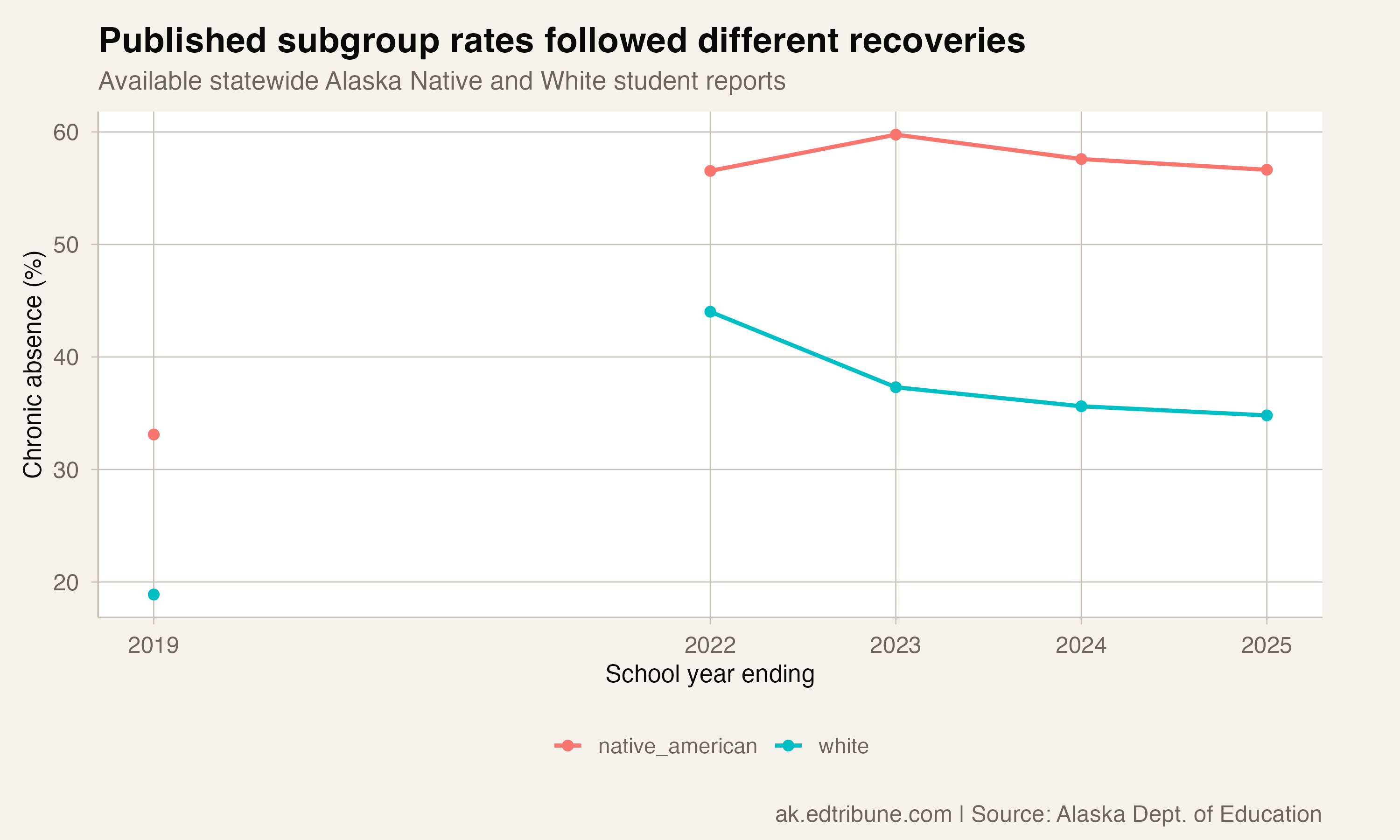
Published statewide subgroup rates also remain different. Alaska Native students had a chronic-absence rate of 56.6% in 2024-25, compared with 34.8% for White students. The difference was 21.8 points.
In 2018-19, the corresponding rates were 33.1% and 18.9%. The gap was 14.2 points. By 2024-25 it was 7.6 points wider than that earlier comparison.
That longer comparison should not be described as a gap widening every year. The post-peak gap reached 22.4 points in 2022-23, then narrowed to 22.0 points in 2023-24 before its further narrowing in 2024-25. The endpoint remains wider than the earlier baseline even though the latest annual movement went in the other direction.
These are published aggregate rates, rather than a count of how many individual students changed their attendance. Students' reported group membership and the population covered can change between years. The figures cannot show whether the same students attended more regularly, or identify which local programs explain the change.
Nor do the state files support a date by which Alaska will return to its earlier rate. Extending the latest annual change into the future would assume that the pace stays fixed, even though the measured pace has changed each year. The reported annual declines are the evidence available here; a forecast would require a separate basis.
Detailed code that reproduces the analysis and figures in this article is available exclusively to EdTribune subscribers.
Discussion
Sign in to join the discussion.
Loading comments...