Correction, August 1, 2026: An earlier draft misstated Fairbanks' 2019 districtwide rate, treated the Black-total gap as positive that year, used unsupported low-income figures, and called Fairbanks Alaska's second-largest district. The corrected package output shows a 25.7% districtwide rate and a 3.0-point Black-student advantage in 2019; the published 2025-26 enrollment total ranks third among Alaska districts.
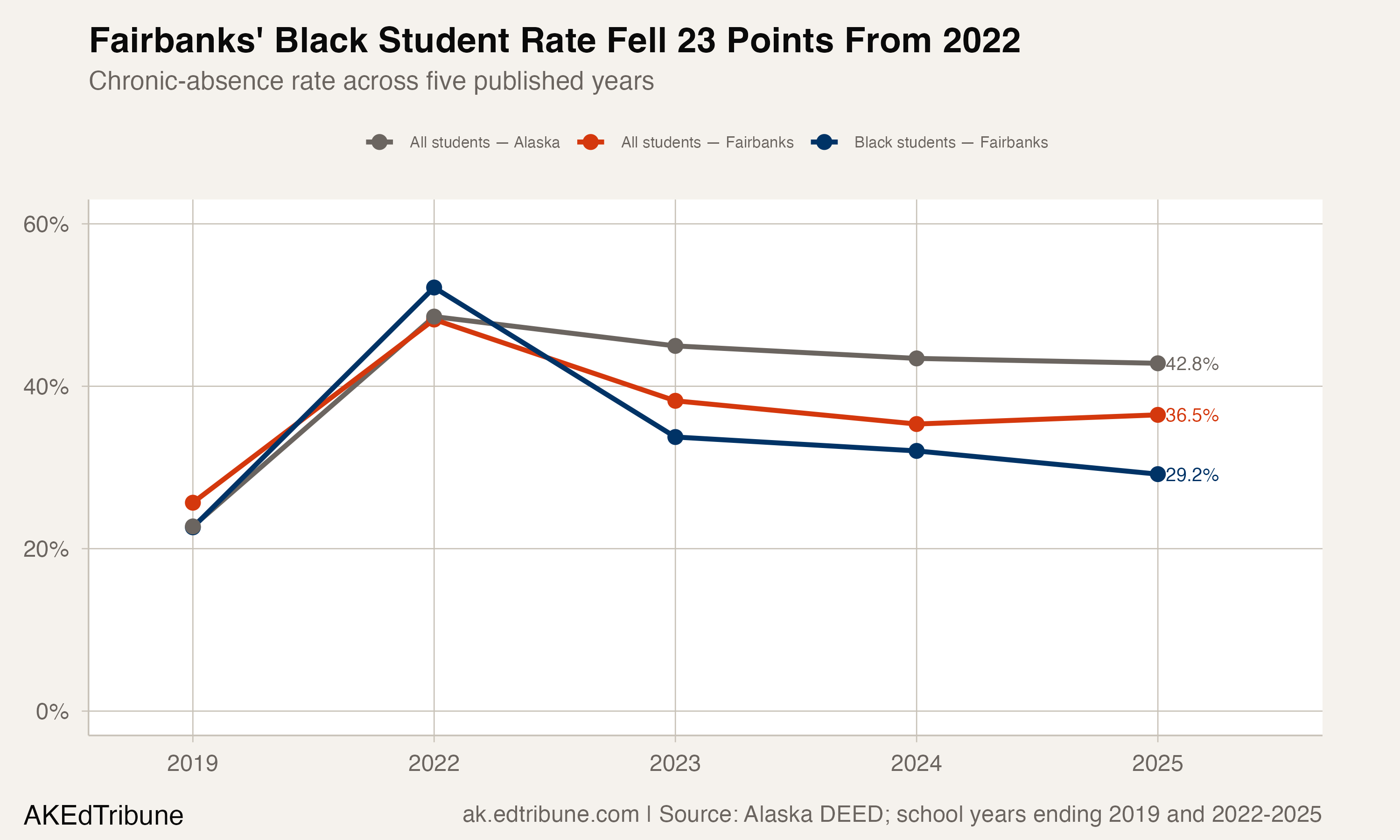
Black students in Fairbanks North Star Borough School District↗ET had a 29.2% chronic-absence rate in 2025. That was down from 52.2% in 2022, a 23.0-point improvement.
The 2025 Black student rate was also 7.3 points below Fairbanks' 36.5% districtwide rate and 13.6 points below Alaska's 42.8% statewide rate for all students.
A pandemic gap that reversed
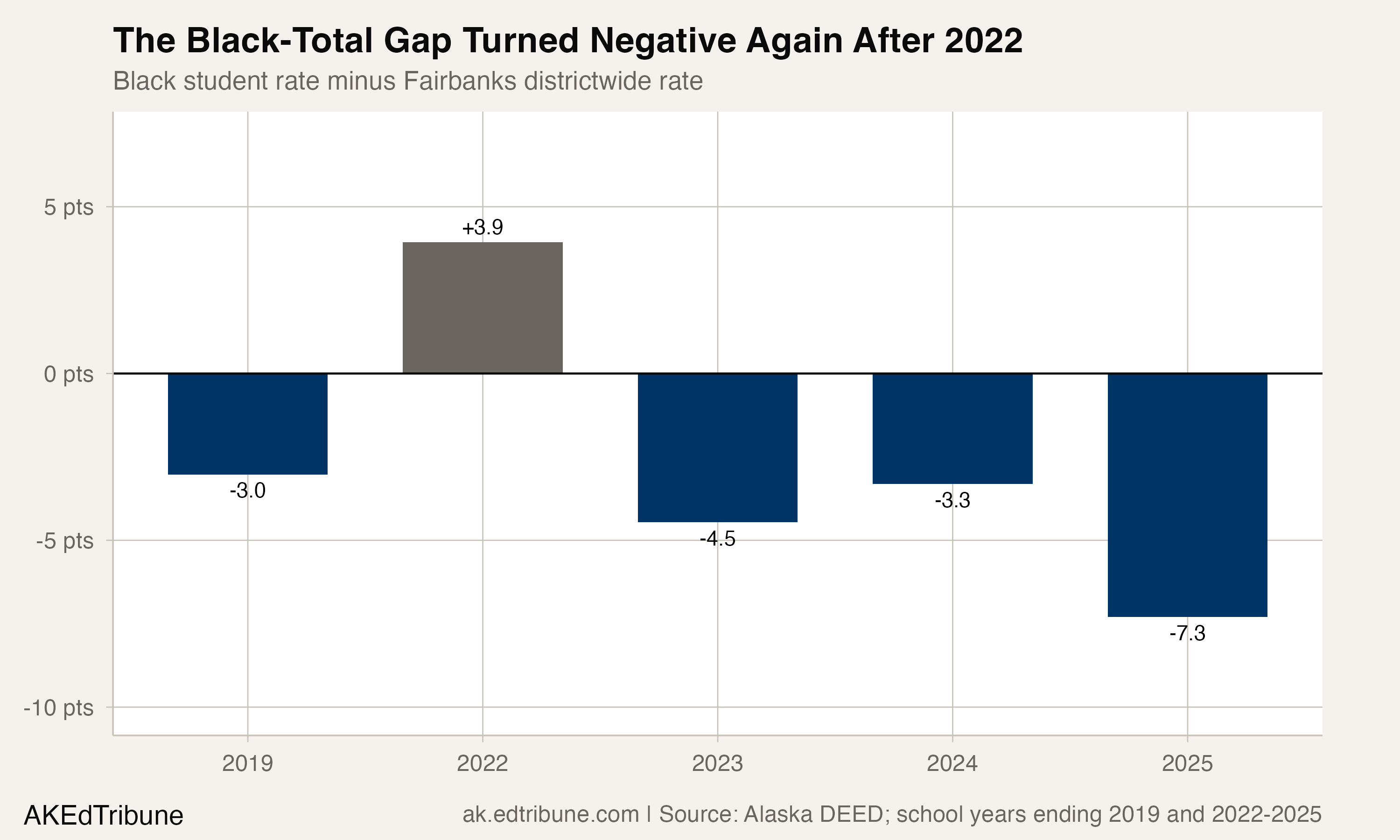
The Black student rate was 22.6% in 2019, 3.0 points below the district's 25.7% rate. In 2022, it reached 52.2%, 3.9 points above the district's 48.2% rate.
That positive gap did not persist. In 2023, the Black student rate fell to 33.8%, 4.5 points below the district total. By 2025, the gap had widened to 7.3 points below the district total.
The largest peak-to-2025 decline among five reported groups
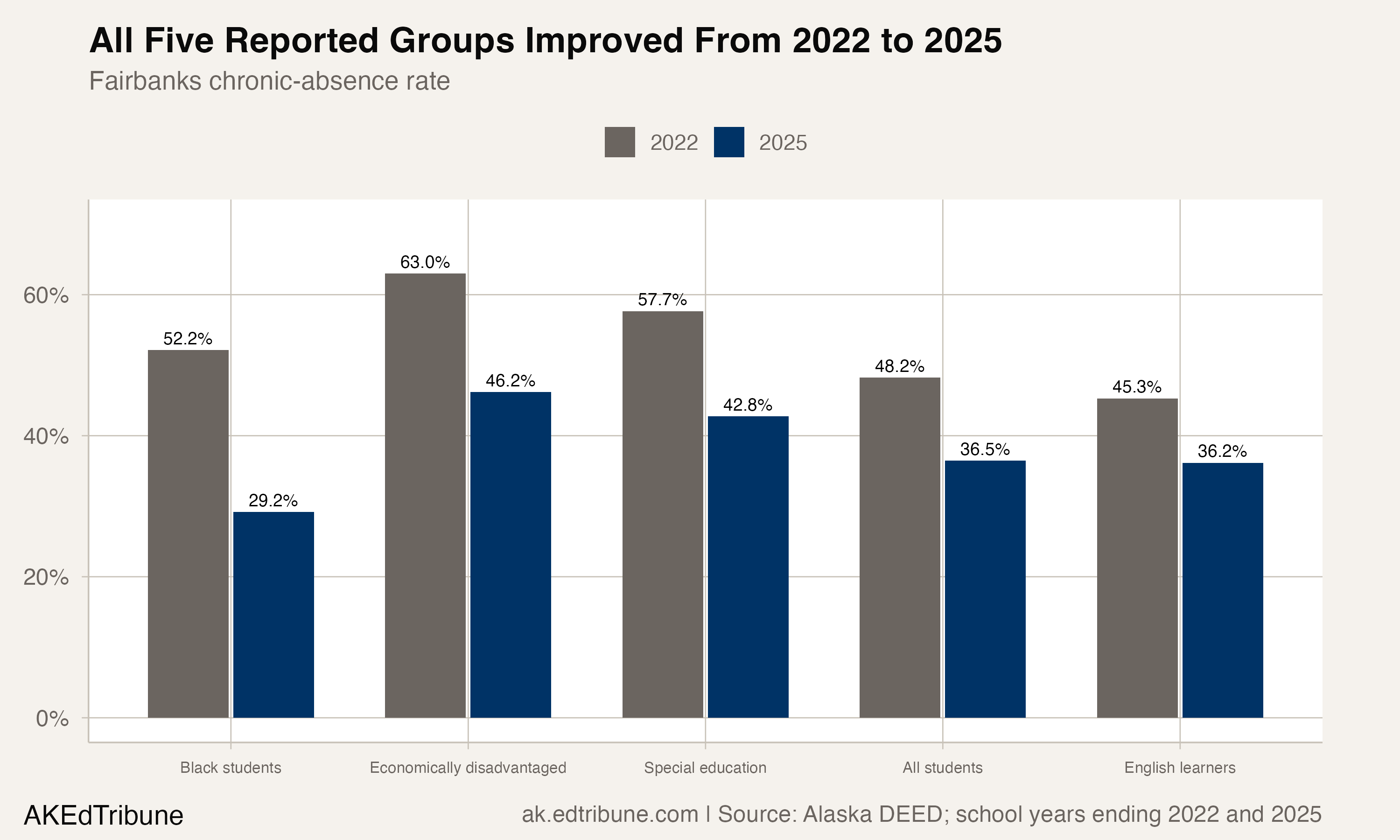
Fairbanks improved from its 2022 peak across each of the five groups compared here:
- Black students: 52.2% to 29.2%, down 23.0 points
- Students who are economically disadvantaged: 63.0% to 46.2%, down 16.8 points
- Students in special education: 57.7% to 42.8%, down 14.9 points
- All students: 48.2% to 36.5%, down 11.7 points
- English learners: 45.3% to 36.2%, down 9.1 points
The Black student decline was the largest of those five comparisons. Each comparison uses the same published 2022 and 2025 endpoints.
Superintendent Luke Meinert said none of that was aimed at one group. "We have not targeted attendance improvements for specific student subgroups," he wrote in answer to written questions, pointing instead to "districtwide progress driven by holistic, proactive measures built in collaboration with our students and families."
The district's published total enrollment was 11,122 students in 2025-26, third among Alaska districts in the package data.
Three years of a different approach
In his response, Meinert dated the shift to the past three years and described its premise as "grounding our efforts in the understanding that attendance is closely tied to academic achievement, graduation rates, school climate, and student belonging." He put the working method plainly: "Rather than treating attendance as a compliance issue, we focus on identifying why students miss school and helping families overcome those specific barriers."
The steps he described are familiar ones, listed as a set rather than a single initiative. Every school carries an attendance goal in its School Improvement Action Plan and tracks its own data against it. Schools call families when absences start, with the weight on the conversation rather than the notice. Student Support Services staff work on the barriers themselves, helping families with laundry, transportation, food and connections to behavioral health care, and calling families before the school year opens to reconnect students with their schools. At the secondary level the district has widened the set of places a student can finish, among them the Career Education Center, Star of the North, BEST, Saturday School, summer credit recovery and online courses.
The remaining question was whether a gain like this one survives the turnover of military families that Fairbanks lives with. Meinert wrote that he expects it to: "We believe these improvements are sustainable, even with the high transiency rate among our military-connected students and staff."
The data establish the change and the comparisons. They do not test the district's account of it, and they cannot separate a change in practice from a change in who was enrolled to be counted.
Detailed code that reproduces the analysis and figures in this article is available exclusively to EdTribune subscribers.
Discussion
Sign in to join the discussion.
Loading comments...