Correction, August 1, 2026: An earlier draft incorrectly described Kodiak as having Alaska's smallest pandemic-era increase, lowest five-year variability, and a rate below the state in every measured year. Among the 18 districts in the comparison, Kodiak ranked sixth on the first measure and fourth on the second; its 2019 rate was 0.6 points above the state. A later verification corrected the reported 2025 multiracial rate to 27.9% after identifying an inconsistent rounding rule.
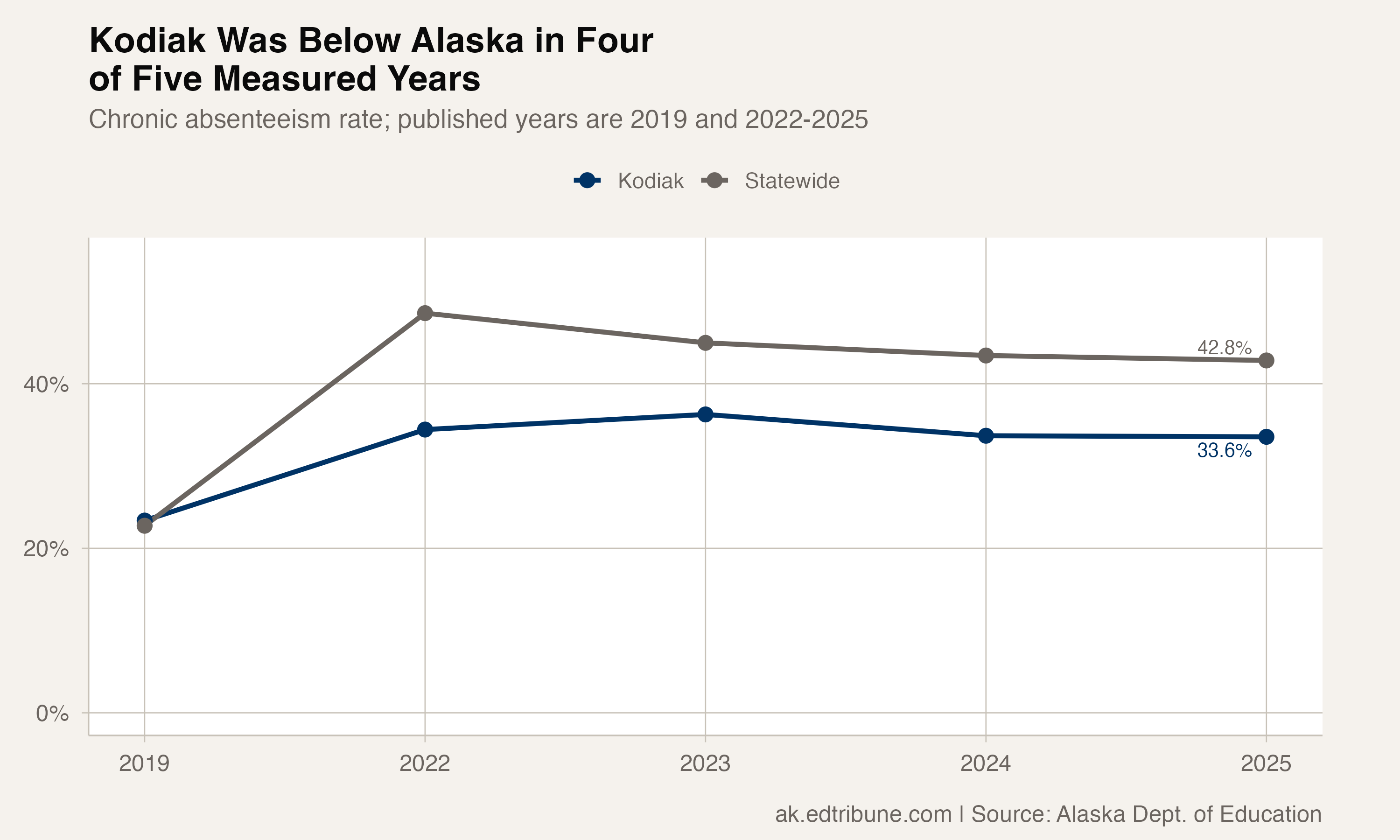
Kodiak Island Borough School District↗ET has had a steadier chronic-absence record than most of Alaska's larger districts, but not the steadiest. Its published rate rose from 23.4% in 2019 to 34.4% in 2022, peaked at 36.3% in 2023, then eased to 33.7% and 33.6% in the next two years.
Steadier than most
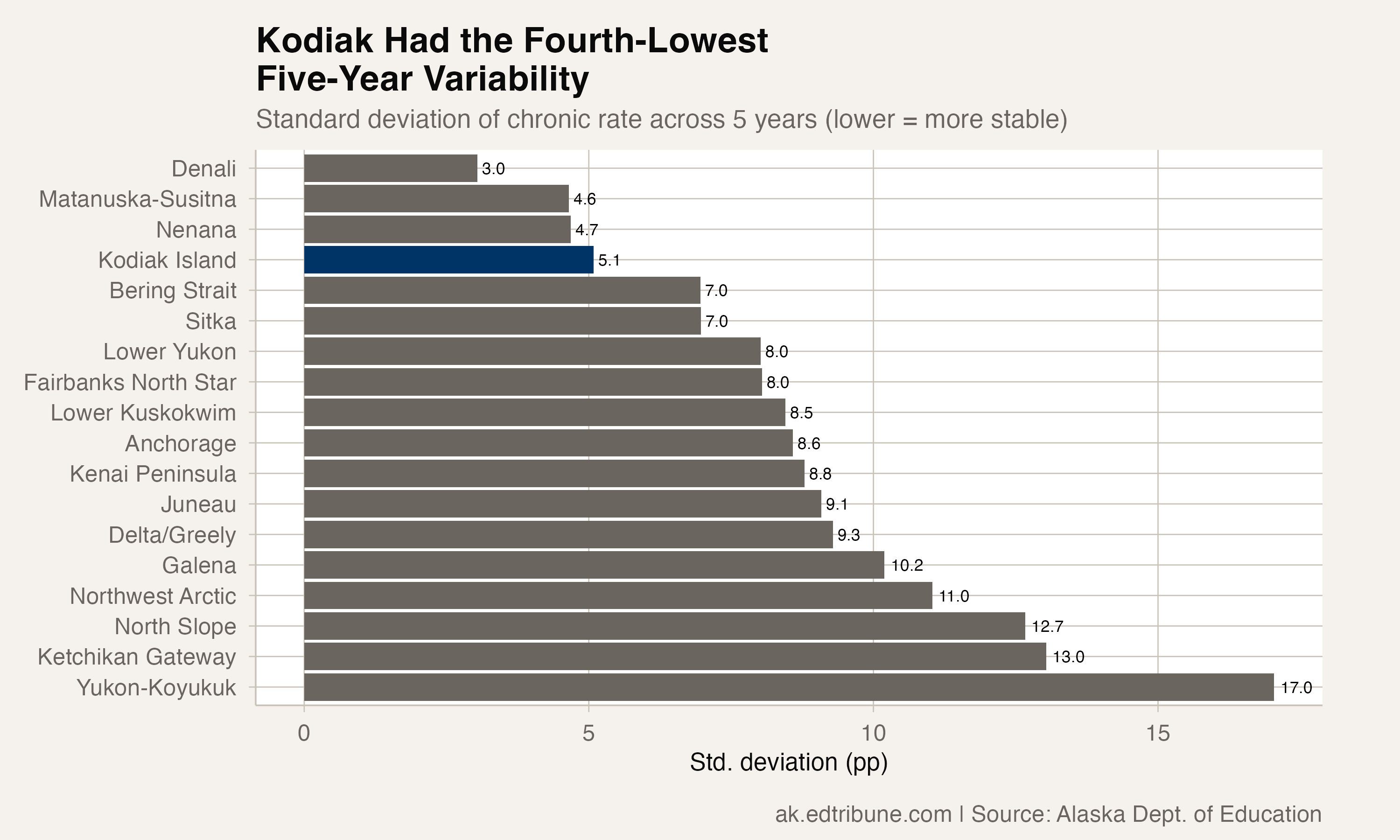
Among the 18 Alaska districts with at least 1,000 students in the 2025-26 enrollment file and four or more reported chronic-absence years, Kodiak's five-year standard deviation was 5.09 percentage points. That was the fourth-lowest, behind Denali Borough, Matanuska-Susitna Borough and Nenana City.
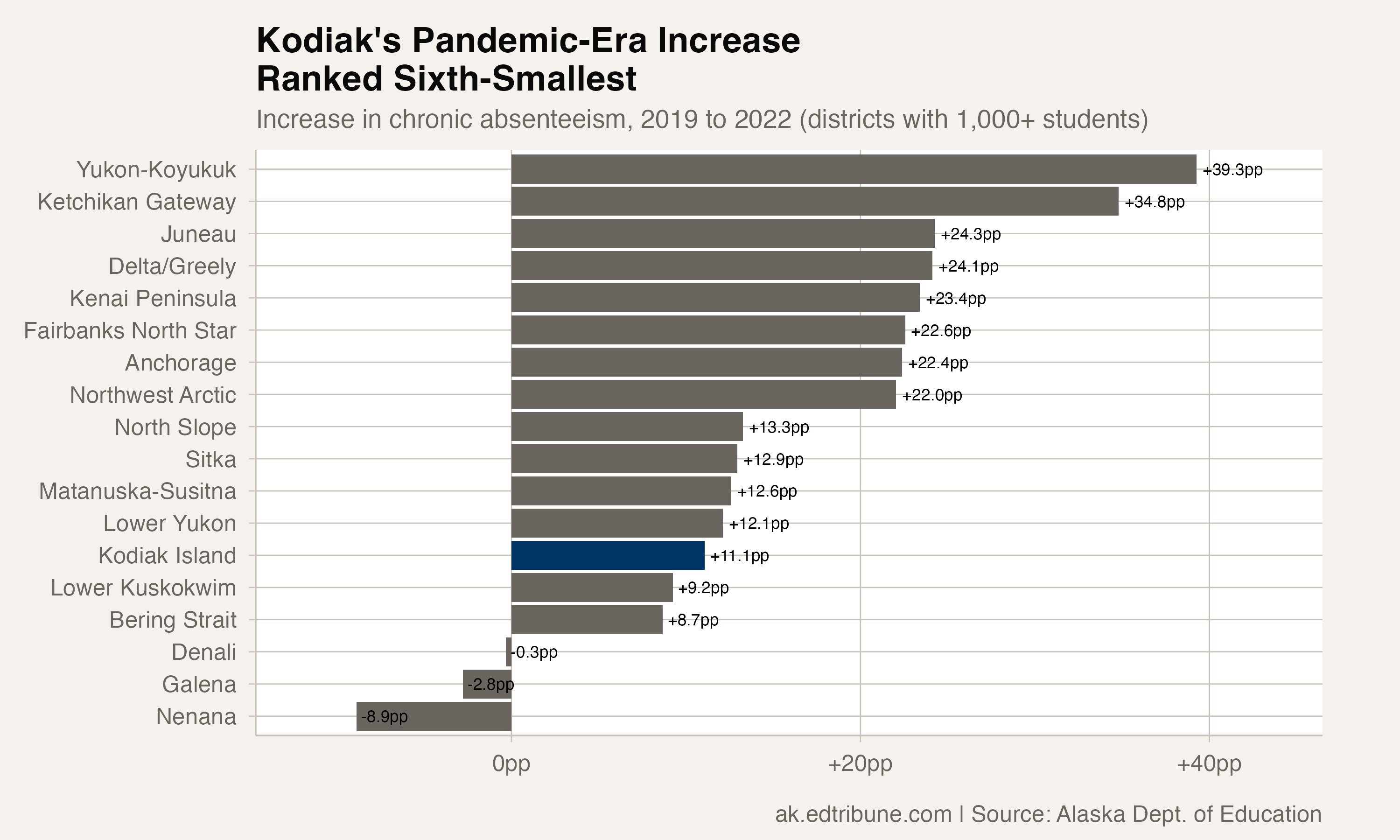
Kodiak's 2019-to-2022 increase was 11.1 points, the sixth-smallest in the same 18-district comparison. Three districts recorded no increase at all, and two others had smaller increases than Kodiak.
In 2024-25, Kodiak's 33.6% rate was 9.3 points below Alaska's 42.8%. Kodiak was below the state in four of the five measured years. The exception was 2019, when Kodiak's 23.4% rate was 0.6 points above the statewide 22.7%.
A mixed subgroup record
The district's 2022-to-2025 subgroup results do not support a claim that every group improved. White students moved from 34.4% to 29.2%, a 5.2-point decline. Multiracial students moved from 34.6% to 27.9%, a 6.7-point decline. Alaska Native students improved from 49.1% to 43.9%, while Hispanic students moved in the other direction, from 41.1% to 43.1%.
Stability is not recovery
Kodiak enrolled 1,983 students in 2025-26. Its latest chronic-absence rate was almost unchanged from the prior year, improving by just 0.1 point, and it remained 10.2 points above 2019. The package data support a relative-stability finding, not a turnaround claim and not an explanation for why Kodiak's pattern differs from other districts.
Detailed code that reproduces the analysis and figures in this article is available exclusively to EdTribune subscribers.
Discussion
Sign in to join the discussion.
Loading comments...