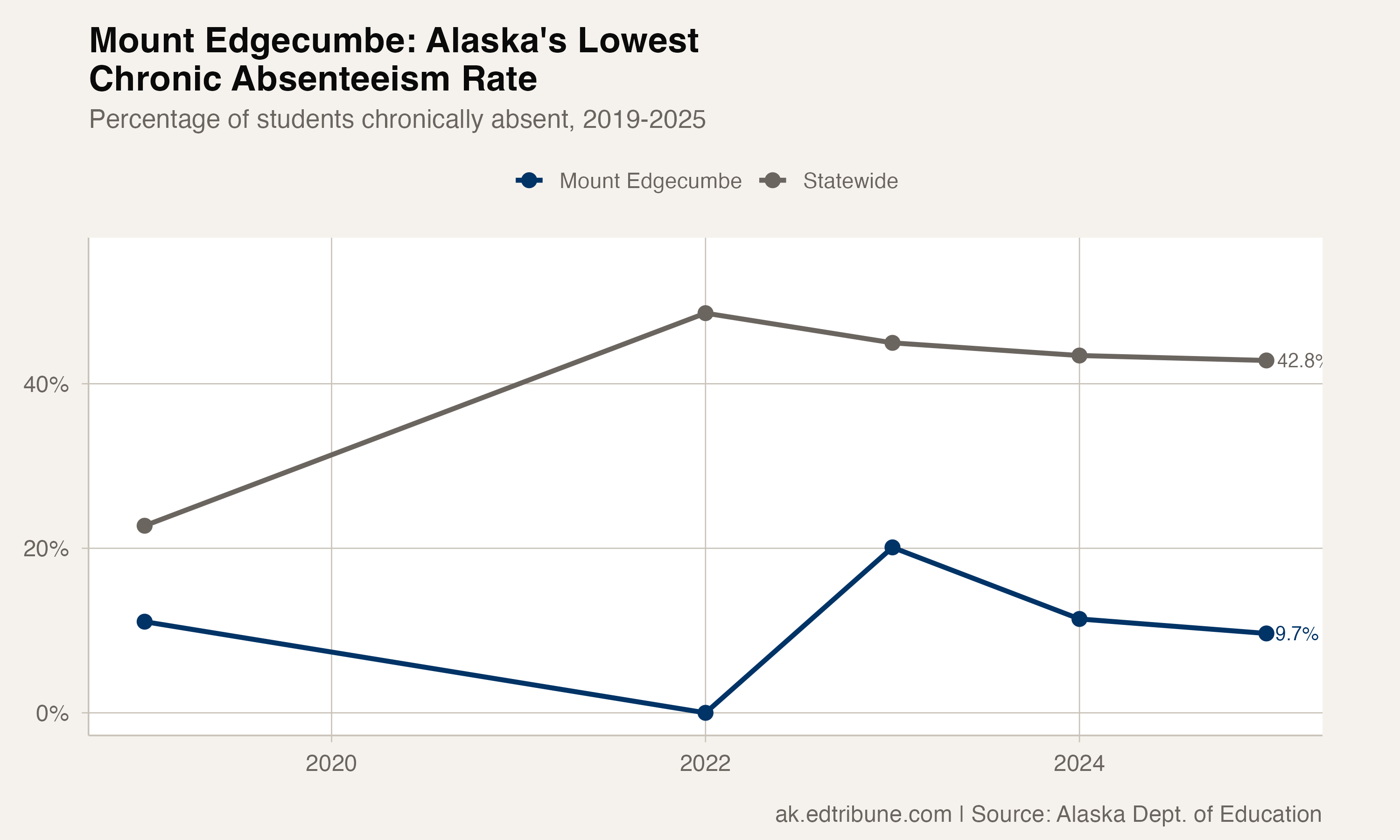
The numbers from Mount Edgecumbe↗ET read like a typo. In 2024-2025, the state-run boarding school in Sitka posted a chronic absenteeism rate of 9.65% -- the lowest of any district in Alaska. Its Native American students, who make up the majority of the school's 388 students, had a rate of 9.55%.
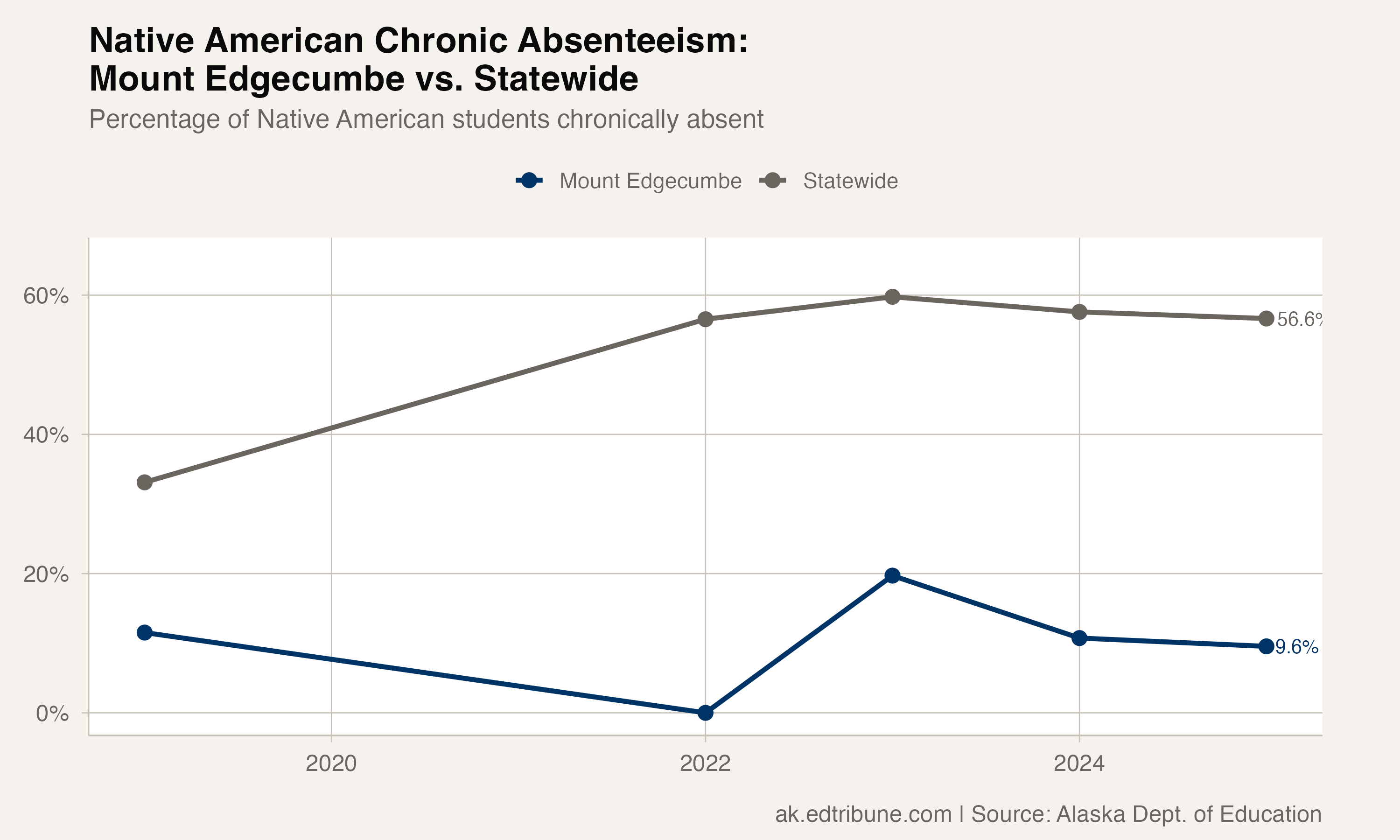
Statewide, 56.6% of Alaska Native students are chronically absent.
That 47-point gap between Mount Edgecumbe's Native American students and the statewide Native American average is the single starkest illustration of what the boarding model can achieve -- and what it means that most Alaska Native students don't have access to it.
The structural advantage
Mount Edgecumbe draws students from rural villages across Alaska, communities where chronic absenteeism rates often exceed 50%. Many of these students come from the same families and villages that produce the state's worst attendance statistics. The difference is that at Mount Edgecumbe, the barriers that drive rural absenteeism -- long distances, unreliable transportation, winter weather, limited family resources -- are eliminated by the boarding model itself.
Students live at school. The commute is a walk down the hallway.
Asked what the residential model actually does for attendance, Superintendent David Langford put accountability first. "We know where all the students are 24/7," he said in a written response to The AKEdTribune. "Students are either in sick bay or they are in school. There is no option to take a day off and just be in your dormitory room. If a student is not in either of those locations there is an all out search until we find them." The school also employs full-time counselors to help students make the transition to academic and residential life.
That transition is real, Langford said, because many students arrive from schools where showing up was treated as nobody's concern. New arrivals are often surprised to find the school expects them in every class, on time, every day. "Many tell us in their old schools either no one cared if they were there or in some cases students have thought that people were glad when they didn't come to school," he said.
The results extend across every vulnerable population the school serves:
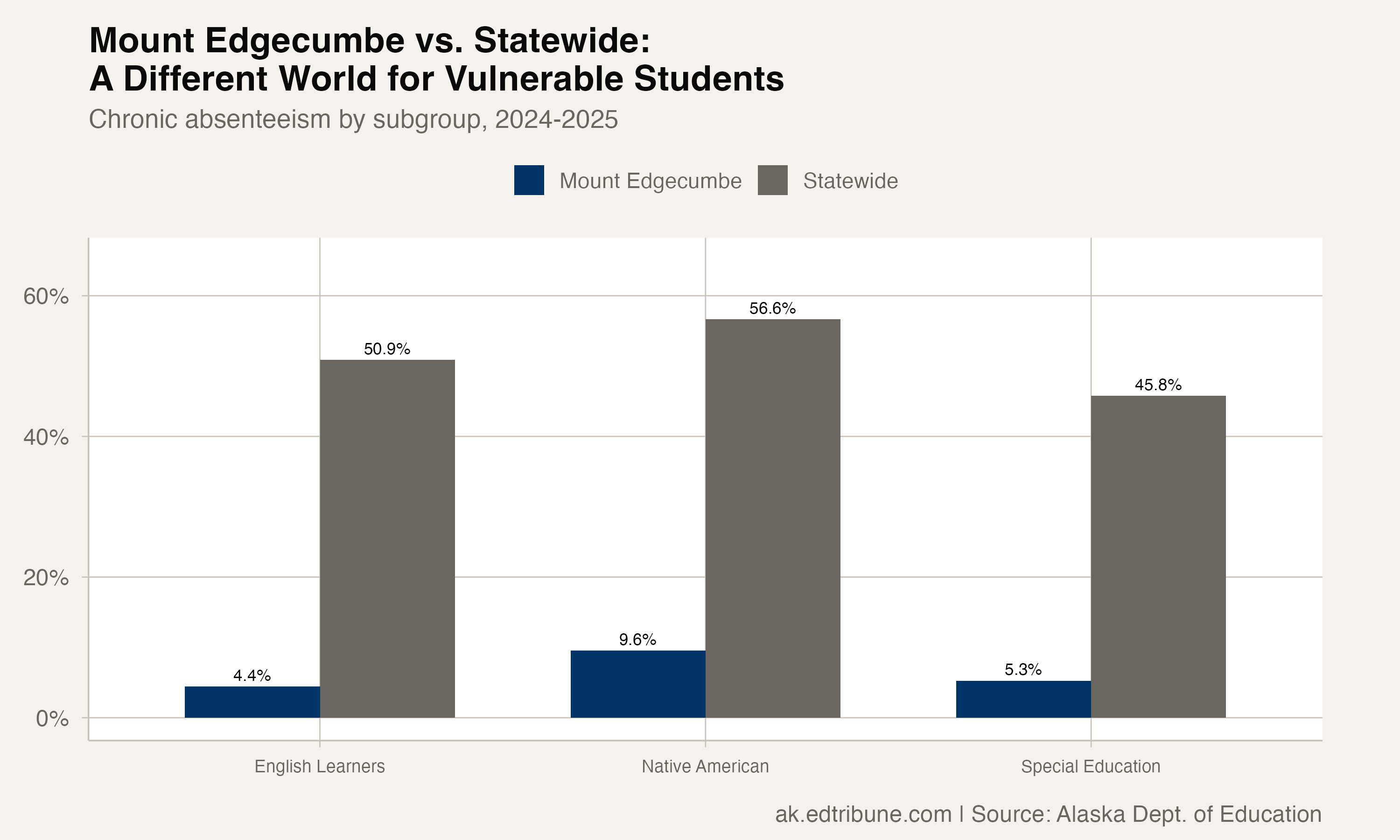
- Economically disadvantaged students: 9.61% at Mount Edgecumbe vs. 50.2% statewide
- Special education students: 5.26% vs. 45.8% statewide
- English learners: 4.44% vs. 50.9% statewide
The special education and English learner rates are particularly notable. These populations face the highest attendance barriers in most districts, yet at Mount Edgecumbe they have the lowest chronic rates among the groups shown here.
A complicated trajectory
Mount Edgecumbe's path through the pandemic was unusual. In 2021-2022, the school reported 0% chronic absenteeism -- a number that likely reflects COVID-era data reporting anomalies rather than literally perfect attendance at a boarding school managing pandemic protocols.
The following year, the rate jumped to 20.1%, suggesting the 2022 figure was masking real disruption. Since then, the school has improved steadily: 11.4% in 2023-24, 9.65% in 2024-25, the most recent year in the state's published data. That put the school back below its own pre-COVID baseline of 11.1%.
The policy question
Mount Edgecumbe is a single school serving 388 students in a state where more than 120,000 students attend regular day schools. It cannot be replicated at scale, and it would be wrong to suggest that boarding is the solution to Alaska's attendance crisis.
But the data raises questions that school leaders across the state should be asking: Which elements of the boarding model -- residential supports, structured schedules, wraparound services, consistent adult presence -- can be adapted for day schools? What would it cost to bring even a fraction of these supports to the rural districts where chronic absenteeism exceeds 50%?
Langford himself is skeptical that the model transfers cleanly. "I think it is very difficult to offer what we have at a boarding school in a rural school without the significant support of parents and family members," he said. What Mount Edgecumbe does instead is make its staff the family. "At Mt. Edgecumbe we train all staff that we are the parents and all staff are to support and encourage students every chance they get," he said. "We tell all students we are their family and supporters while they are with us."
The school also does not wait for annual numbers to know where it stands. "We track attendance data daily and also watch health data," Langford said. Absences rise only with flu season and ordinary sickness, he said, and even students who are out sick are expected to keep up their schoolwork.
The gap between 9.55% and 56.6% is not a measurement error. It is the distance between a model that eliminates barriers and a system that has not yet figured out how to reduce them.
Detailed code that reproduces the analysis and figures in this article is available exclusively to EdTribune subscribers.
Discussion
Sign in to join the discussion.
Loading comments...