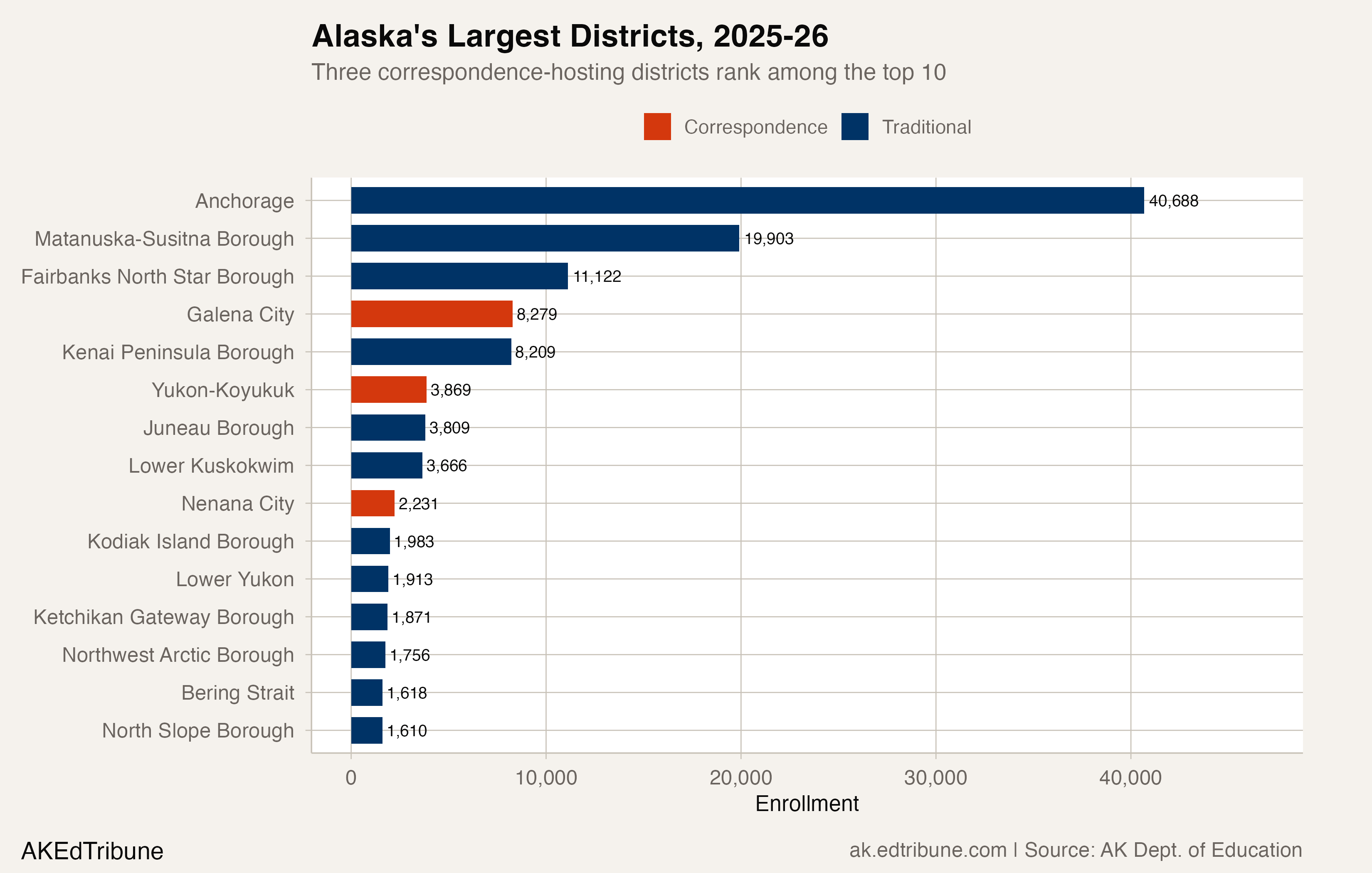
Galena is a village of roughly 500 people on the Yukon River, 270 air miles west of Fairbanks. It has no road access. Its school district enrolls 8,279 students.
That is not a typo. Galena City School District↗ET is Alaska's fourth-largest district because it operates the Interior Distance Education of Alaska, known as IDEA, a correspondence program that enrolled 8,011 students statewide in 2025-26. Only one of those students lives in Galena. The rest are scattered across every borough in the state, learning from home with curriculum and materials funded by public allotments that flow through Galena's books.
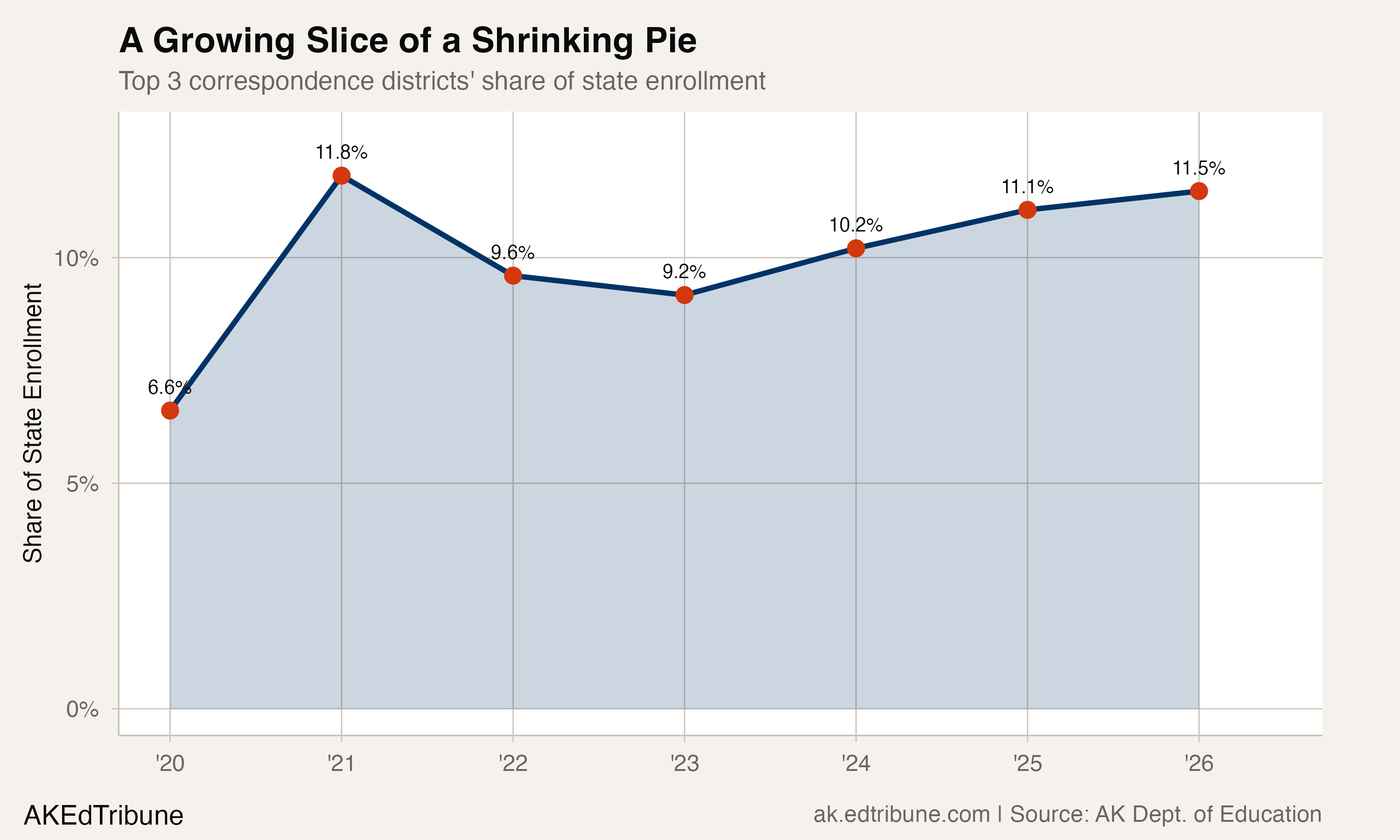
IDEA is the single largest school in Alaska, and it is not an anomaly. It is the flagship of a parallel education system that has been growing for two decades while the state's brick-and-mortar schools shrink. Three districts that host the biggest correspondence programs now account for 14,379 students, or 11.5% of Alaska's total enrollment, up from 6.6% just seven years ago.
The geography of a paradox
The three correspondence-hosting districts rank 4th, 6th, and 9th among Alaska's largest by enrollment, and all three are based in communities with fewer than 1,000 residents.
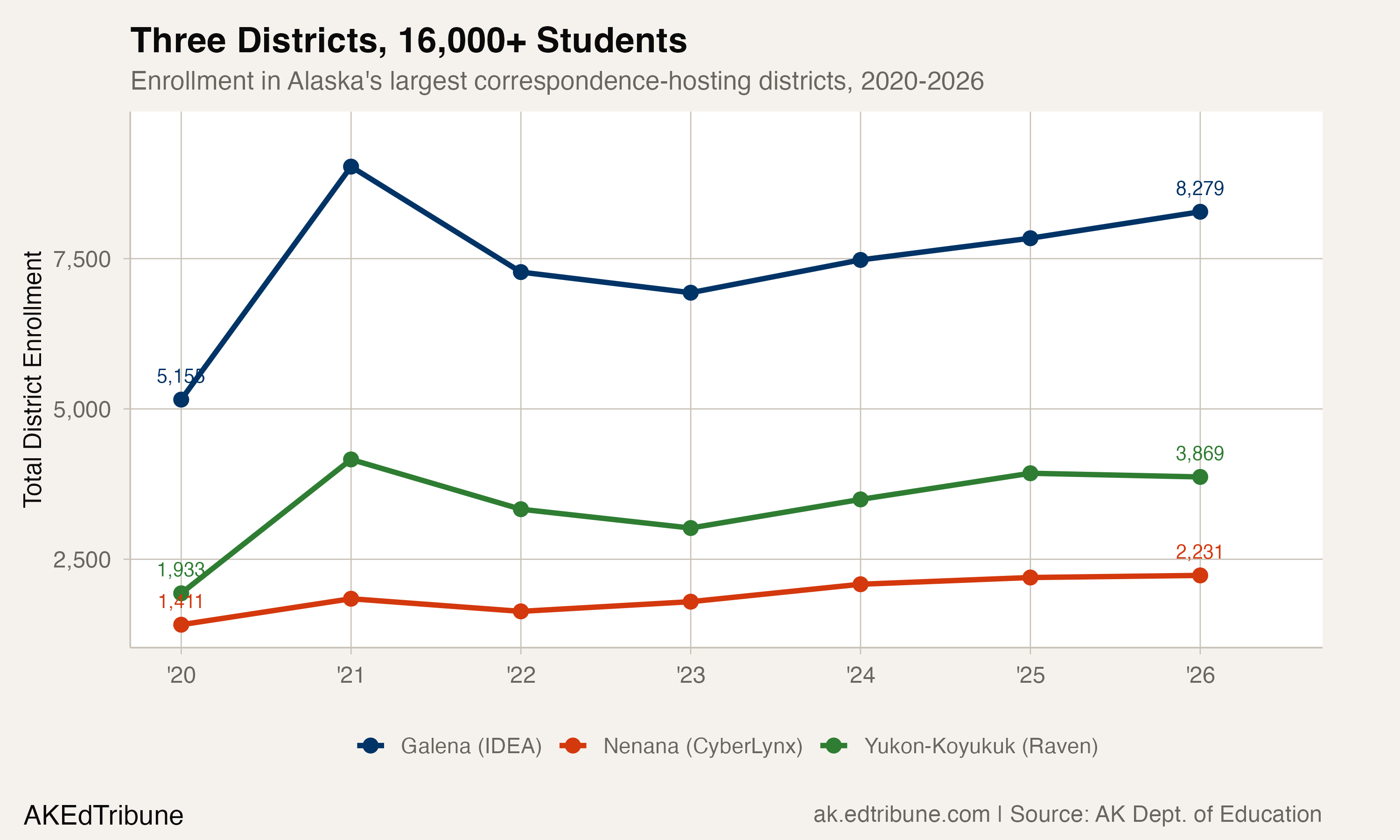
Yukon-Koyukuk School District↗ET, headquartered in Fairbanks but administered from a territory larger than any state east of the Mississippi, operates Raven Homeschool. Raven enrolled 3,559 students in 2025-26, making up 92% of the district's 3,869-student total. The district's enrollment has doubled since 2020, from 1,933 to 3,869, a gain of 100.1%.
Nenana City School District↗ET runs CyberLynx, with 2,026 correspondence students alongside 205 in its brick-and-mortar school. The district grew 58.1% over the same period, from 1,411 to 2,231.
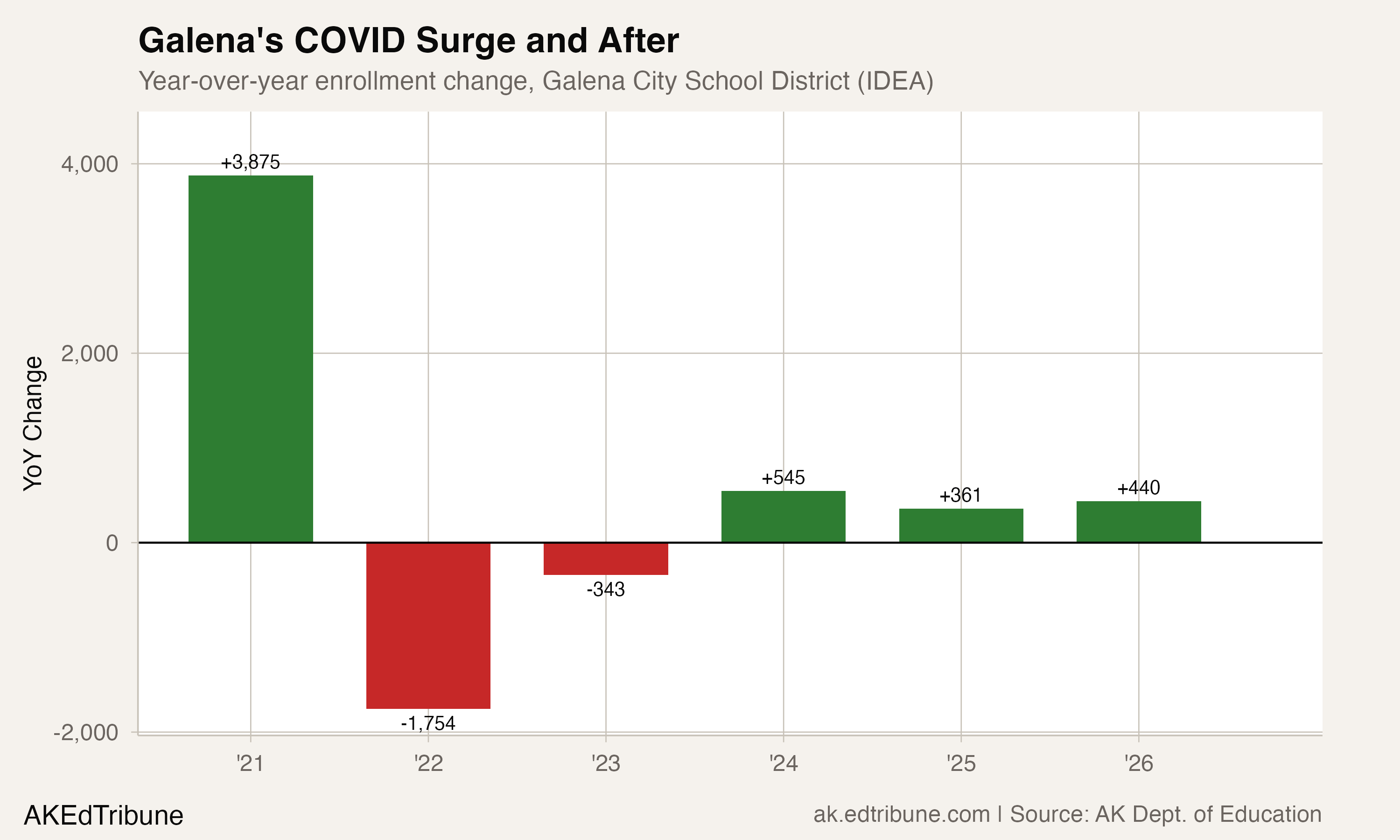
Galena's growth was the most volatile. In the first pandemic year, enrollment surged 75.2%, from 5,155 to 9,030, as families pulled children from in-person classrooms and sought structured alternatives. It dropped back by 1,754 students the following year, then by 343 more, before climbing steadily since 2023-24. At 8,279, Galena has not returned to its COVID peak but sits 60.6% above its pre-pandemic baseline.
These three districts account for only the largest correspondence programs. Alaska has at least 34 correspondence programs across the state, enrolling roughly 24,000 students by the Alaska Department of Education and Early Development's count. Mat-Su Central School (3,034 students), Anchorage's Family Partnership Correspondence School (1,148), and Denali Borough's PEAK program (916) are among the others that appear in the top 20 schools statewide.
Two systems, opposite trajectories
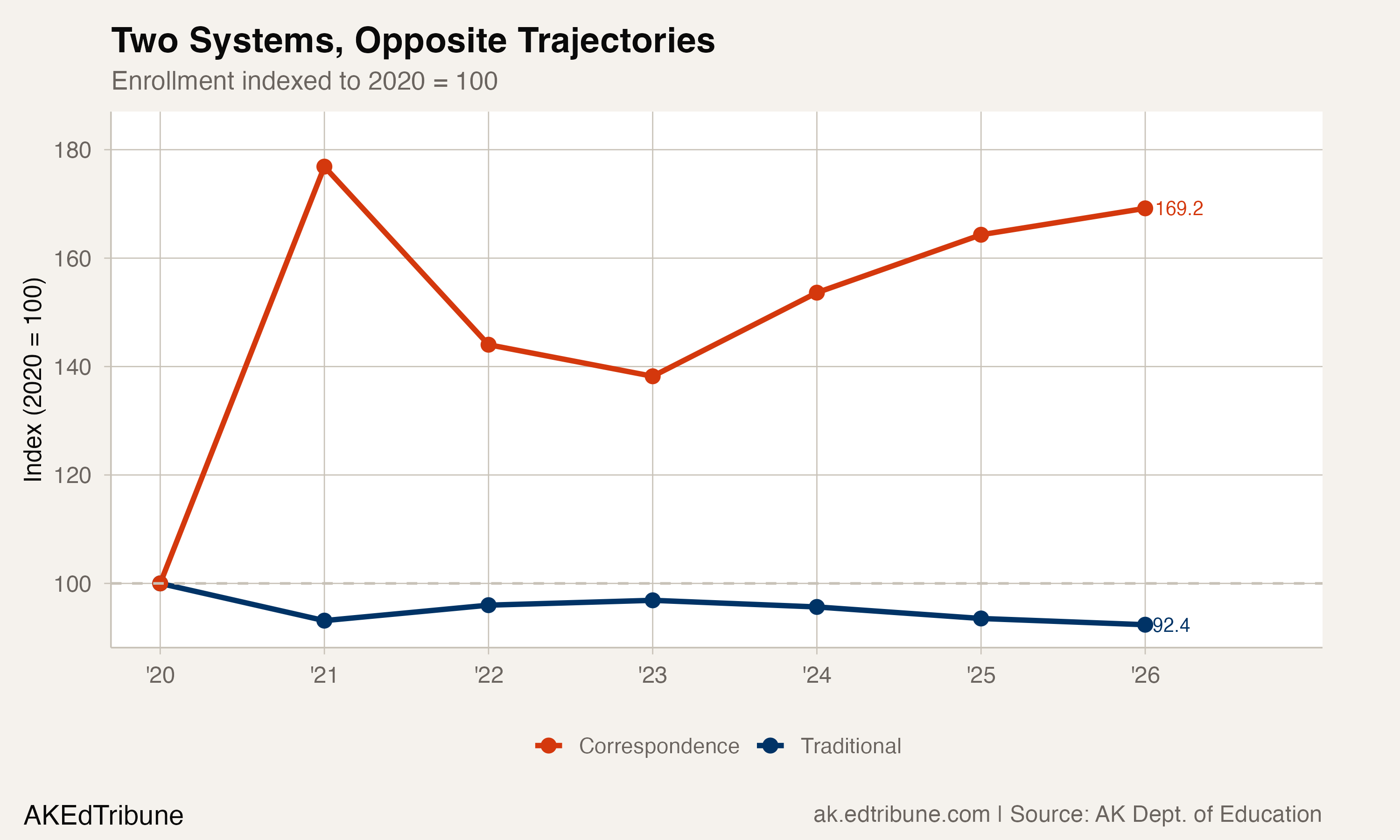
The divergence between correspondence and traditional enrollment is stark. Since 2019-20, the three largest correspondence districts added 5,880 students, a gain of 69.2%. Every other district in the state combined lost 9,152 students, a decline of 7.6%.
The state as a whole lost 3,272 students over the period, a 2.5% decline, from 128,589 to 125,317. But that aggregate obscures a structural shift: correspondence growth did not offset traditional losses. It absorbed some of them. Nearly 16,000 correspondence students are enrolled in programs outside their home districts, meaning their funding flows to the administering district rather than the one where they live.
Anchorage School District↗ET lost 4,530 students since 2019-20, a 10.0% decline. Fairbanks North Star Borough↗ET lost 2,017, or 15.4%. The Anchorage School Board voted in February to close three elementary schools and cut more than 500 staff positions to address a $90 million deficit. Nearly 80% of Alaska school districts face deficits in 2025-26.
Statewide, 29 of 53 districts hit all-time enrollment lows in 2025-26.
How the money moves
Correspondence programs receive state funding through the Base Student Allocation, the same formula that funds brick-and-mortar schools. On top of that, each correspondence student receives an annual allotment, ranging from $1,600 to $3,953 depending on the program, for curriculum, materials, and services. In fiscal year 2024, the state spent $47.2 million on correspondence allotments across 34 programs, out of nearly $64 million offered.
The spending breakdown, according to that same DEED report: 55% went to supplies, materials, and media ($26 million), 30% to professional and technical services ($14 million), and the rest to internet, utilities, and travel.
The financial model that makes this work is simple but consequential. When a student in Anchorage enrolls in IDEA, the BSA funding that would have gone to Anchorage instead goes to Galena. The student counts against Galena's enrollment for formula purposes. Galena gets the revenue; Anchorage loses it. Multiply that by thousands of students, and the fiscal impact on sending districts is substantial.
"Most Alaskan statewide correspondence programs will sink and Alaskan families will suffer." — Galena superintendent Jason Johnson, on proposed funding changes, Anchorage Daily News, March 2026
The legislature takes aim
Senate Bill 277, introduced in the current legislative session, would restructure how correspondence funding flows. Under the bill, funding for correspondence students would go first to students' home districts, which would then negotiate cooperative agreements with administering districts. Home districts would retain a percentage for administrative costs and student services.
The change would directly affect Galena, Yukon-Koyukuk, and Nenana, whose financial models depend on counting students from across the state.
"SB 277 shifts funding and control back towards the very districts that many families like mine have chosen to leave." — Kendra Piper, correspondence parent, Anchorage Daily News, March 2026
The bill's supporters argue that home districts bear costs for correspondence students, including transportation, special services, and oversight, without receiving funding to cover them. Its opponents say the bill would dismantle programs that families chose precisely because their local districts were not meeting their needs.
What the enrollment data cannot show
The data confirms that correspondence programs are growing while traditional schools shrink, but it cannot distinguish between families who left brick-and-mortar schools and families who were never going to attend them. Alaska has the nation's highest rate of homeschooling, and correspondence programs occupy a space between full homeschooling and traditional public education. Some families use them as a homeschool support structure. Others use them as full-time virtual schools. The distinction matters for policy, but enrollment records do not capture it.
Alaska is in its 13th consecutive year of net outmigration, the longest streak since 1945. The number of children from birth to age 17 fell 0.8% between 2024 and 2025, and there are roughly 1,000 more 17-year-olds in the state than 4-year-olds. The pipeline is shrinking, which means the fight over how to fund a declining student population will intensify regardless of how SB 277 plays out.
The question ahead
Galena's COVID-era surge proved that correspondence demand can spike suddenly. The three-year recovery since then suggests the demand is structural, not just pandemic-driven. Galena added 440 students in 2025-26. Yukon-Koyukuk's Raven program dipped by 61 for the first time since 2023, a potential sign of saturation or a statistical wobble.
If SB 277 passes, the financial model that allowed a village of 500 to become Alaska's fourth-largest school district will be fundamentally altered. If it fails, the gap between correspondence enrollment and traditional enrollment will likely continue to widen. Either outcome reshapes the state's education landscape. The open question is whether Alaska's funding formula can serve both systems simultaneously, or whether it will be forced to choose.
Detailed code that reproduces the analysis and figures in this article is available exclusively to EdTribune subscribers.
Discussion
Sign in to join the discussion.
Loading comments...