Correction: An earlier draft used an incorrect rate conversion, compared four- and five-year rates from different cohorts, and presented unsupported geographic and causal explanations.
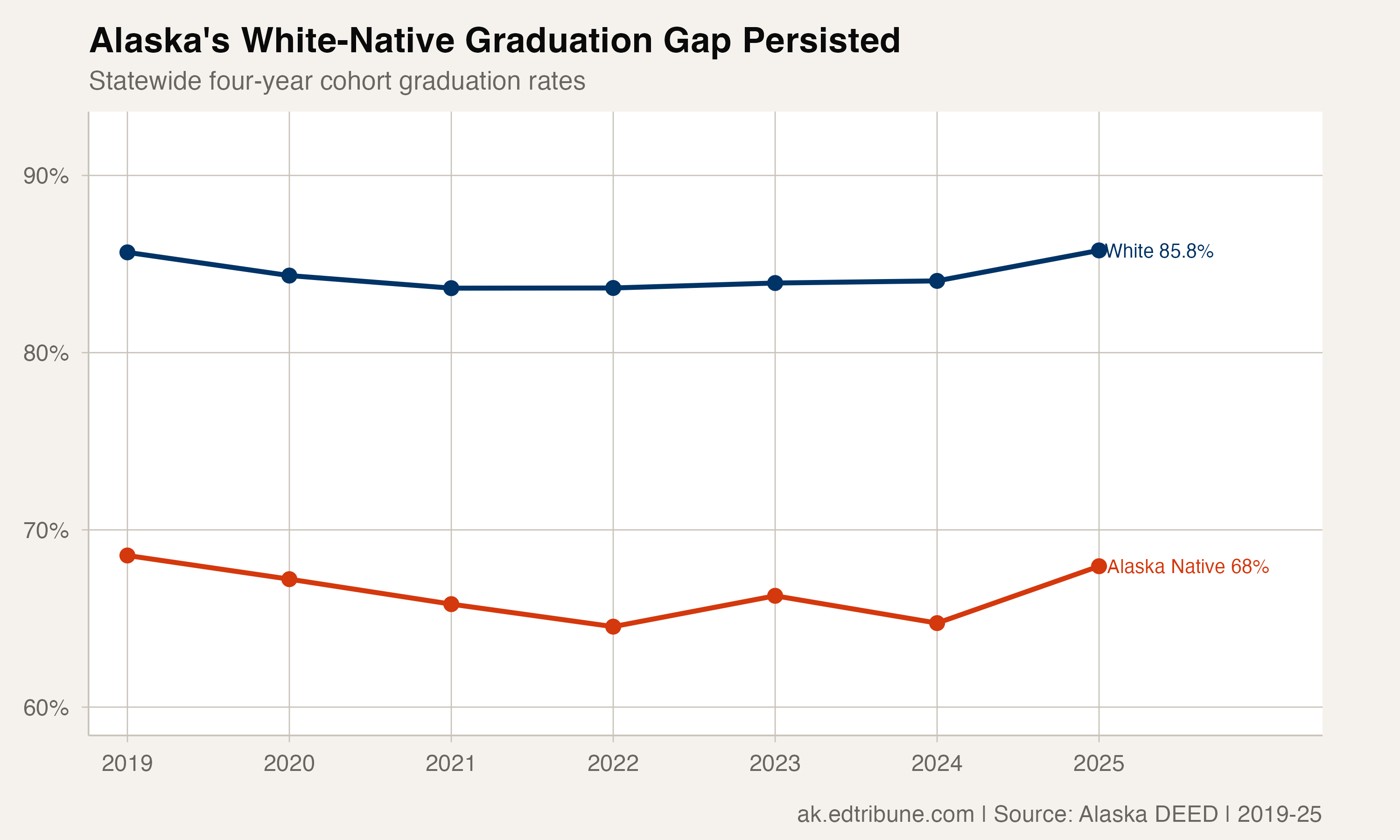
White students in Alaska posted an 85.8% four-year graduation rate in 2025. The Alaska Native rate was 68.0%, leaving a 17.8-percentage-point gap. The reported cohorts included 4,652 White students and 2,081 Alaska Native students.
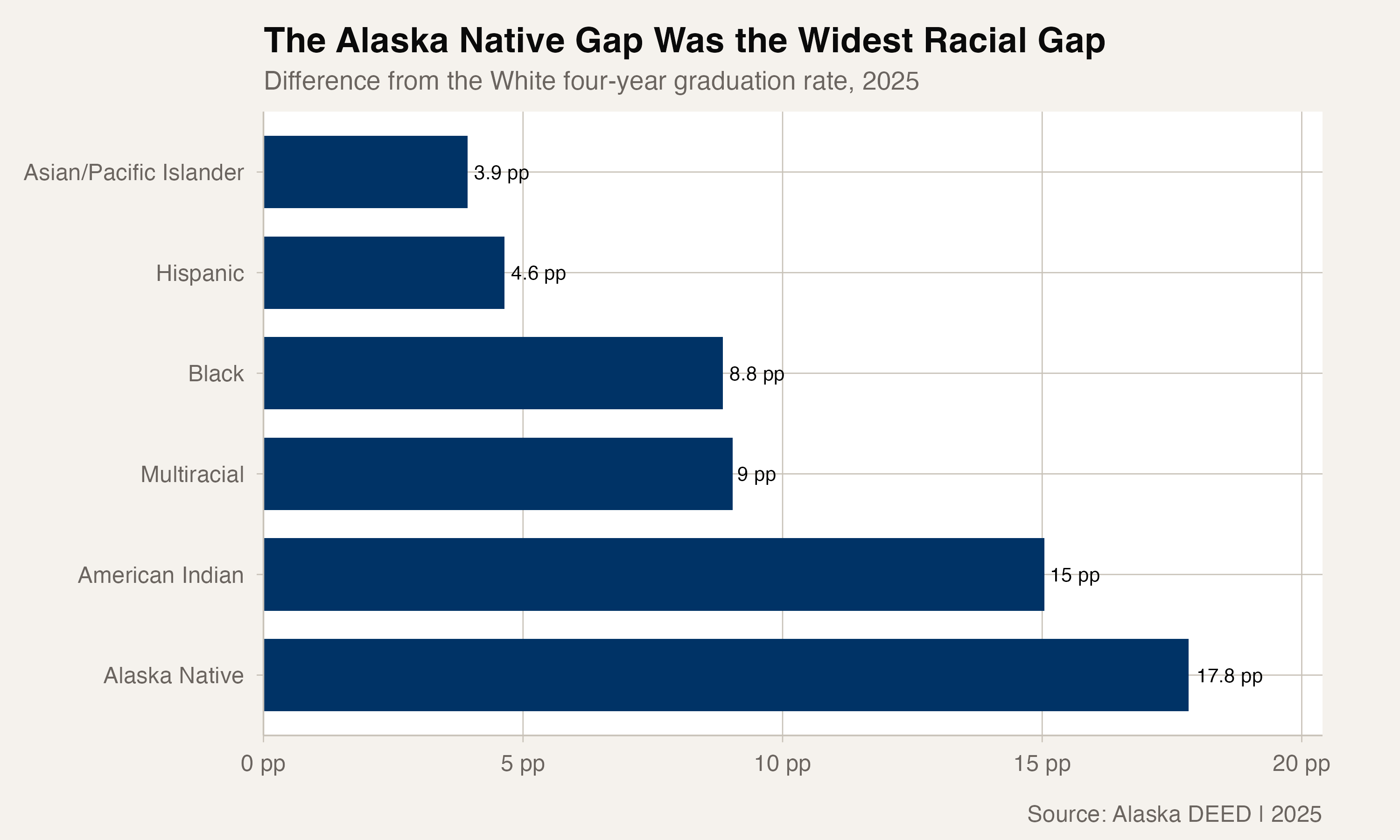
Among the six other mutually exclusive race groups in the state data, Alaska Native students had the widest gap from the White rate.
Seven annual gaps above 17 points
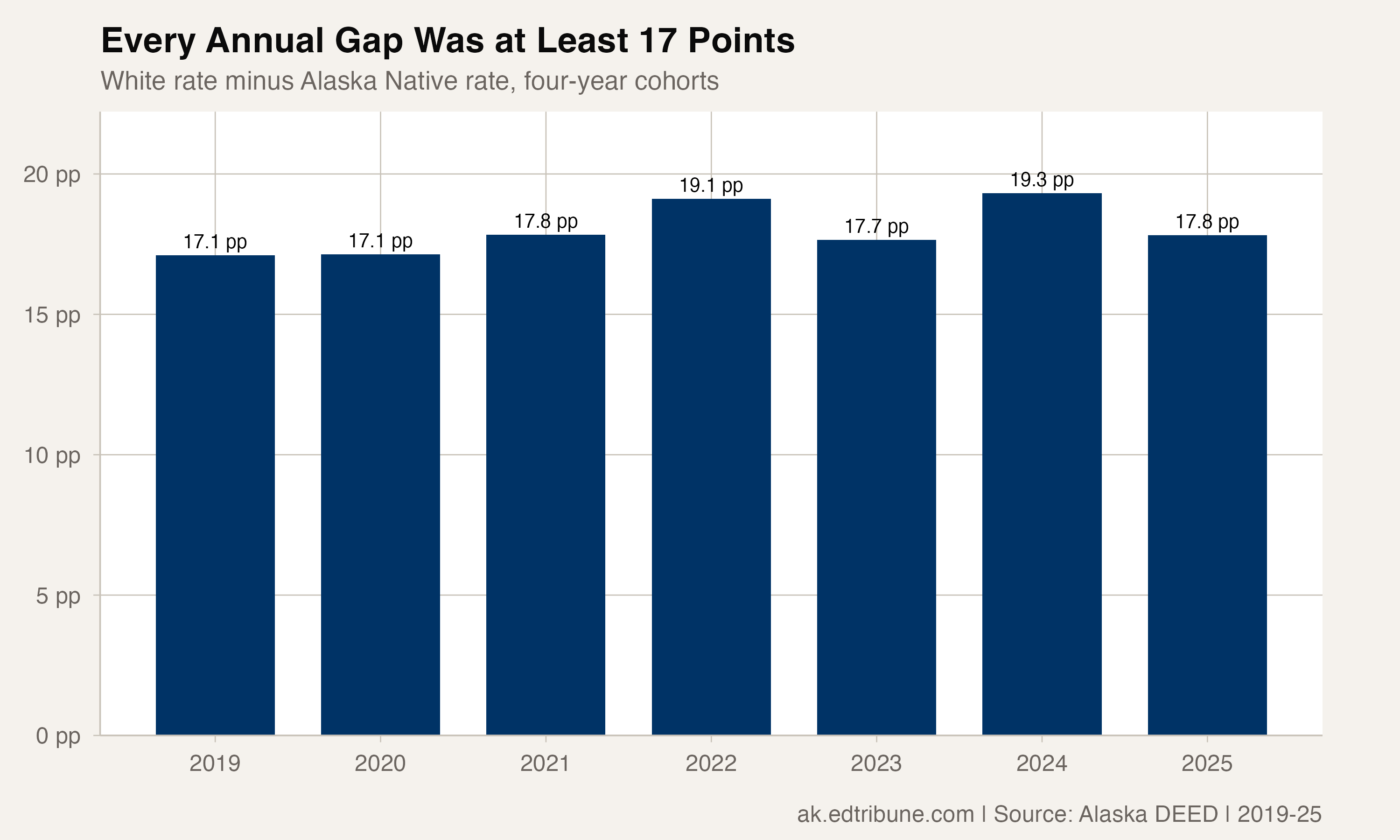
The White-Alaska Native gap remained between 17.1 and 19.3 points across all seven annual four-year reports from 2019 through 2025. It averaged 18.0 points over that period.
The narrowest reported gap was 17.1 points in 2019. The widest was 19.3 points in 2024. The 2025 gap was 17.8 points.
The widest reported racial gap
The 2025 Alaska Native gap from the White rate was 17.8 points. The American Indian gap was 15.0 points, followed by 9.0 points for multiracial students, 8.9 points for Black students, 4.6 points for Hispanic students, and 3.9 points for Asian/Pacific Islander students.
This comparison uses seven mutually exclusive race categories. It excludes the separately reported combined Alaska Native/American Indian row because that category overlaps two of the component groups.
A larger share of on-time non-graduates
Alaska Native students accounted for 2,081 of Alaska's 9,929 students in the 2025 four-year cohort, or 21.0%. They accounted for 667 of the state's 1,999 students not reported as on-time graduates, or 33.4%.
The Alaska Native share of on-time non-graduates was therefore 12.4 percentage points larger than the group's share of the statewide cohort. The statewide counts reconcile to the sum of district counts, and the seven mutually exclusive race categories reconcile to the statewide total.
The gap after a fifth year
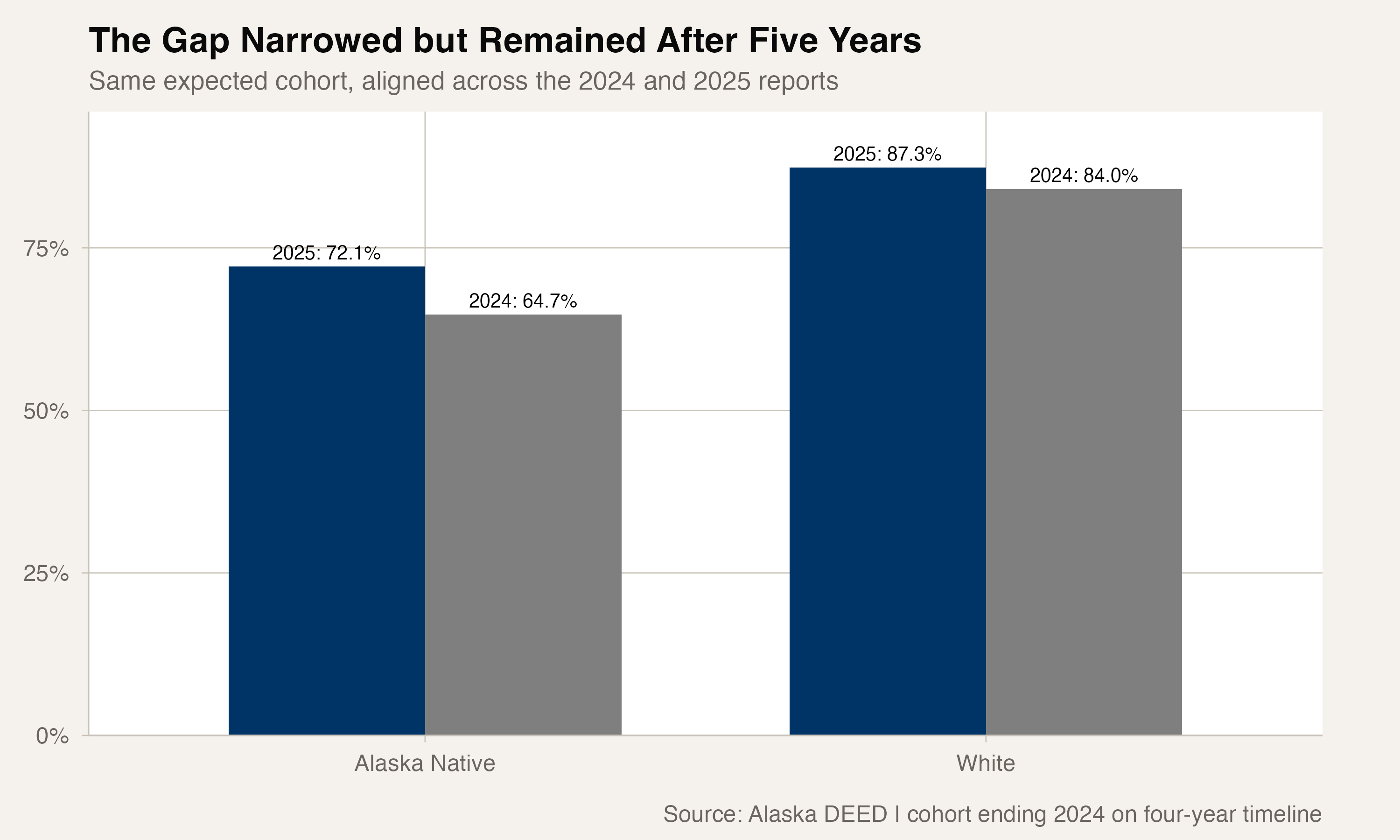
A valid four- versus five-year comparison must align reporting years. The cohort represented on the four-year timeline in 2024 is represented on the five-year timeline in 2025.
For that aligned cohort, the reported Alaska Native rate rose from 64.7% after four years to 72.1% after five years, an increase of 7.4 points. The White rate rose from 84.0% to 87.3%, an increase of 3.3 points.
The gap narrowed from 19.3 points on the four-year timeline to 15.2 points on the five-year timeline, a reduction of 4.1 points. Across all six complete cohort alignments from 2019 through 2024, the reported Alaska Native increase was larger than the White increase.
What the data cannot explain
The graduation records establish the size, duration, and cohort timing of the statewide disparity. They do not identify why the gap exists.
Geography, school funding, teacher turnover, subsistence schedules, and governance are unresourced as explanations in this analysis. The state race rows do not support attributing the gap to any one of those mechanisms, and the data provide no structural classification of districts as Bush or road-system communities.
The aligned four- and five-year rows also have slightly different cohort counts. Their rate pattern is direct evidence that the reported gap was smaller on the five-year timeline, but it does not prove that every change came from the same individual students.
Detailed code that reproduces the analysis and figures in this article is available exclusively to EdTribune subscribers.
Discussion
Sign in to join the discussion.
Loading comments...