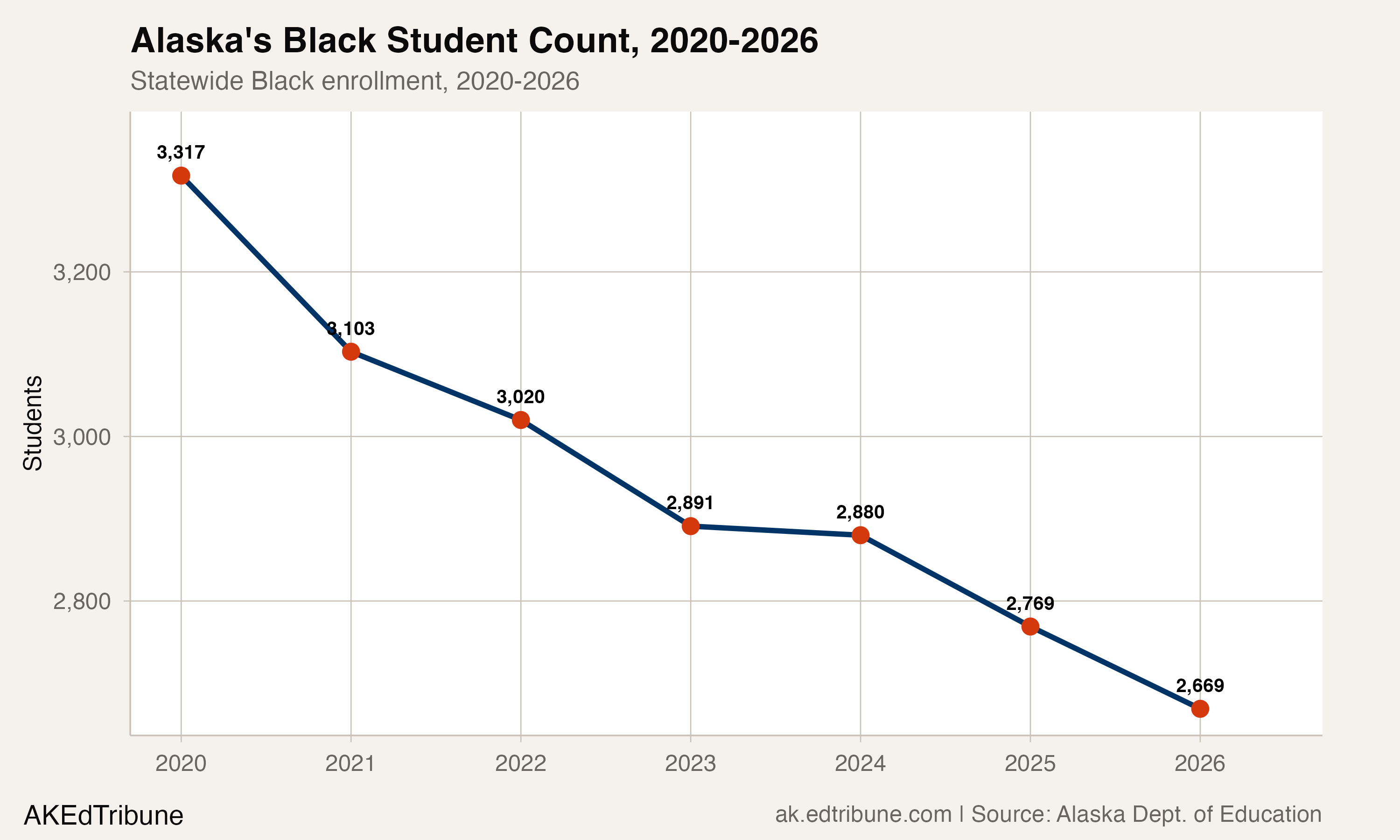
In 2020, 3,317 Black students were enrolled in Alaska's public schools. By 2026, that number had fallen to 2,669. The decline of 648 students, 19.5%, makes Black students the fastest-shrinking racial group in the state by a wide margin. Asian enrollment fell 16.2% over the same period. White enrollment, the largest category, dropped 3.1%.
The statewide enrollment decline was 2.5%. Black students lost ground at 7.7 times that rate.
What makes the pattern notable is where it is concentrated. Two districts, Anchorage↗ET and Fairbanks North Star↗ET, account for roughly four out of every five Black students in Alaska's public school system. Both are home to major military installations. Both districts' Black enrollment fell sharply from 2020 to 2026, with only a brief uptick in 2022.
Two Districts, Four-Fifths of the Story
Anchorage enrolled 2,179 Black students in 2020. By 2026 that count had fallen to 1,782, a loss of 397 students, or 18.2%. Fairbanks, home to Fort Wainwright and nearby Eielson Air Force Base, lost at an even steeper rate: 538 Black students in 2020, 331 in 2026, a 38.5% decline.
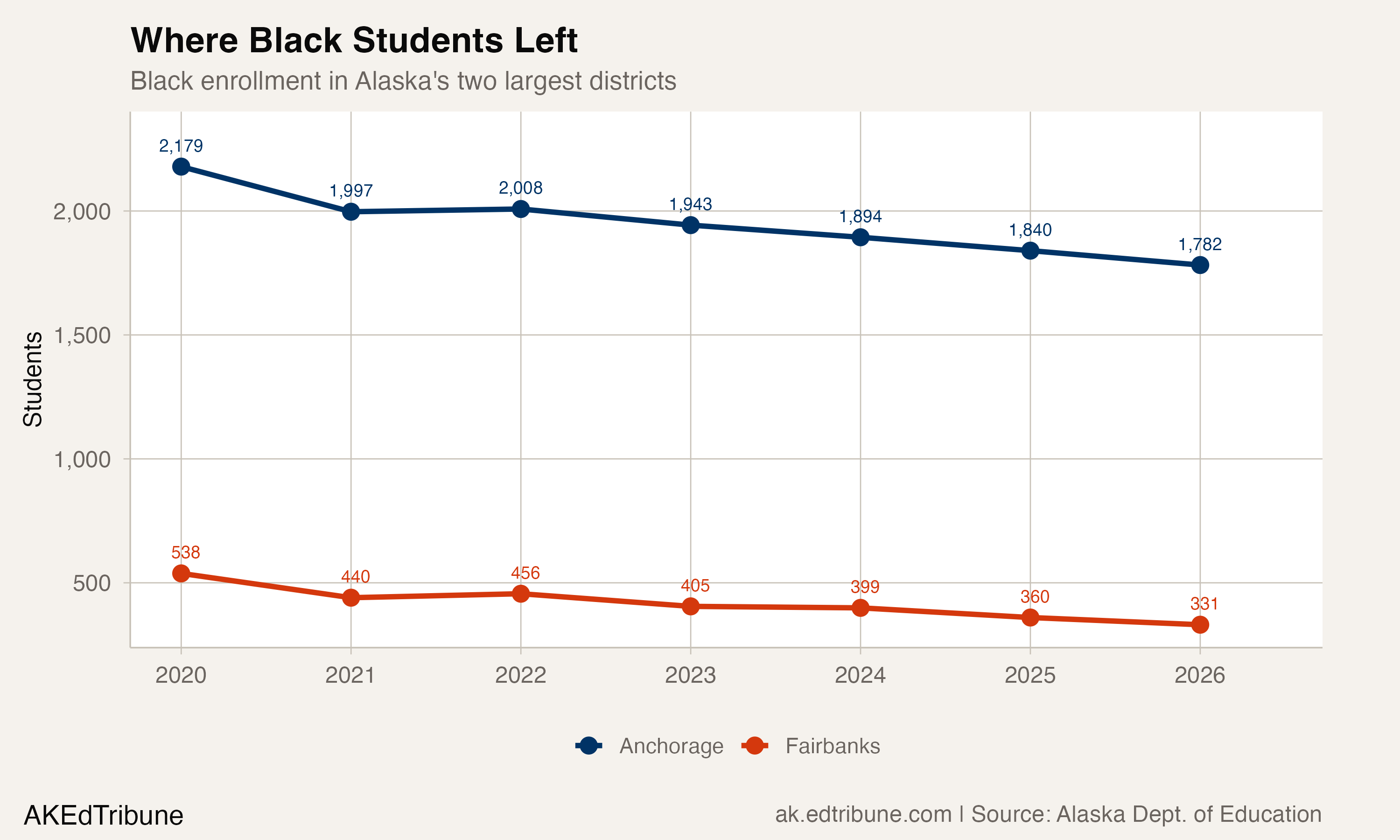
Together, the two districts accounted for 81.9% of Alaska's Black enrollment in 2020 and 79.2% in 2026. Their combined loss of 604 Black students represents 93.2% of the statewide decline. The rest of Alaska's districts collectively lost 44 Black students over six years.
Fairbanks presents the sharper picture. Fort Wainwright alone serves roughly 5,900 soldiers and 9,000 family members, and nearby Eielson Air Force Base adds thousands more. Black students' share of Fairbanks district enrollment fell from 4.1% in 2020 to 3.0% in 2026. Rotation cycles for military families typically run two to three years, meaning the district's student body is partly a function of which units happen to be stationed there in any given year.
The Parallel Asian Decline
Black students are not alone in this trajectory. Asian enrollment fell from 7,267 to 6,087 over the same period, a loss of 1,180 students (16.2%). When indexed to 2020, the two groups trace nearly identical downward paths.
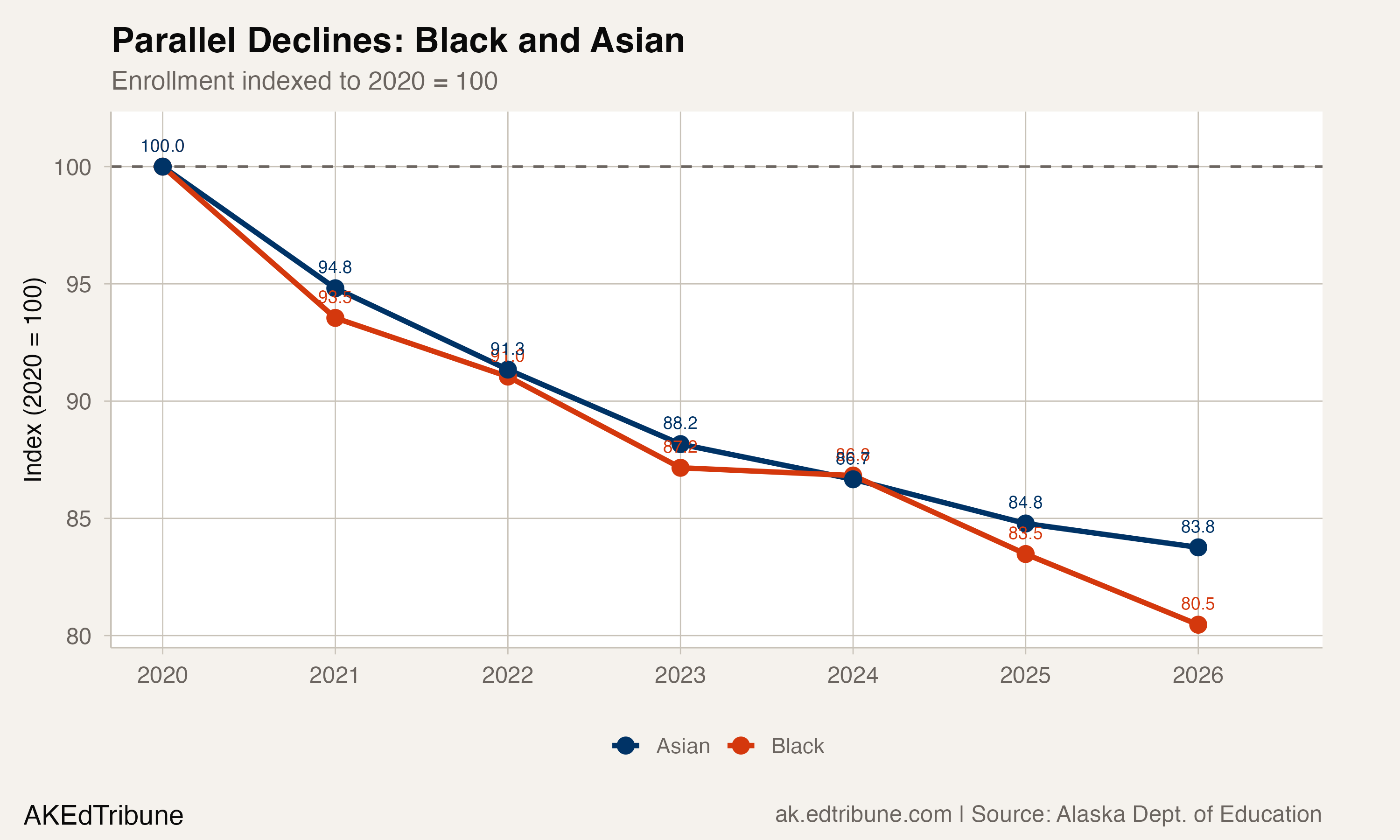
Anchorage accounts for the bulk of the Asian decline as well: the district's Asian enrollment fell from 4,792 to 3,956, a loss of 836 students (17.4%). In a state where military, federal civilian, and contractor positions drive much of the non-Native workforce, the shared trajectory of Black and Asian enrollment suggests a common structural force: the rotation and attrition of federally connected families rather than dynamics specific to any single racial community.
The two groups diverge in scale. Asian students still number 6,087 statewide, more than twice the Black count. But both are shrinking faster than every other group.
Everyone Lost, Almost No One Gained
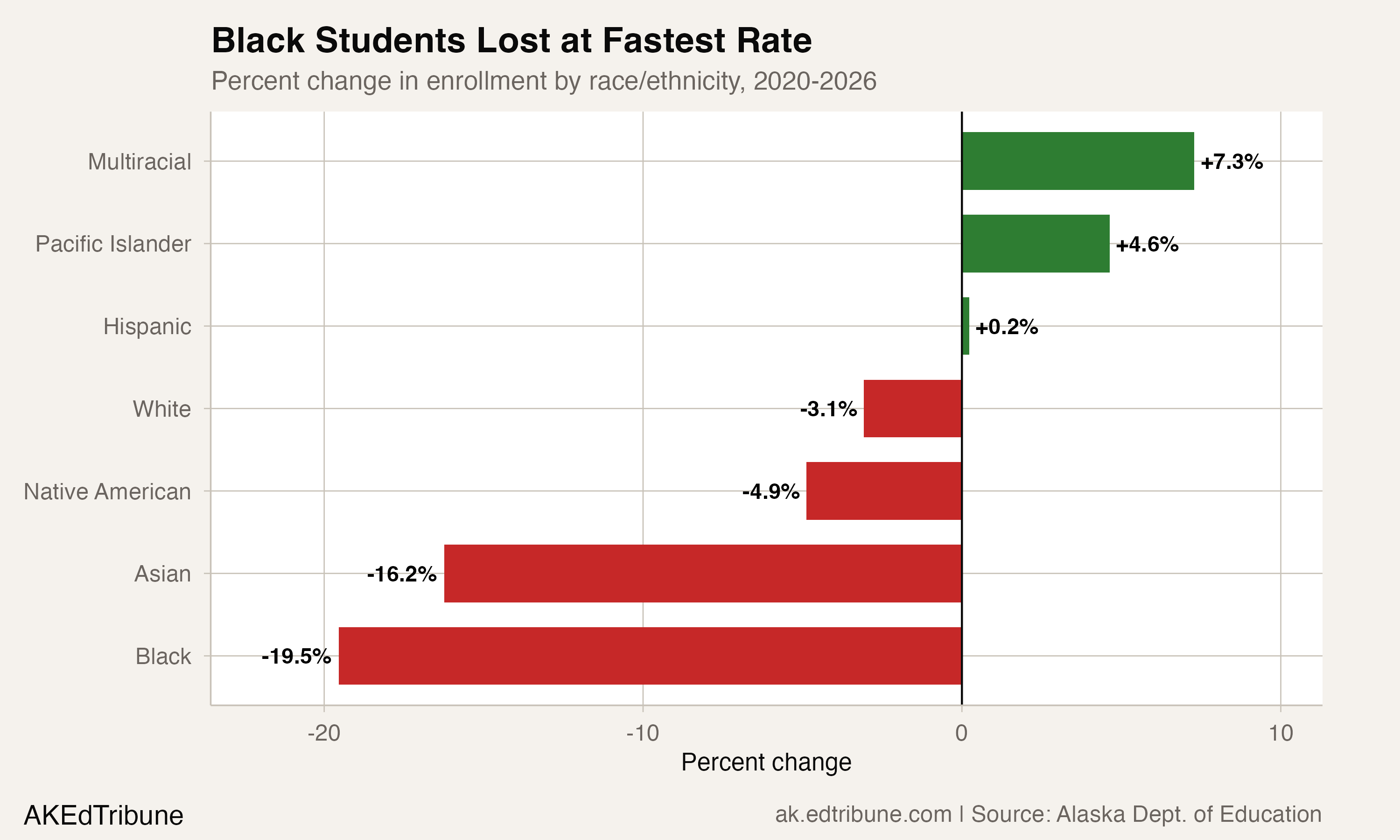
Alaska's racial composition is not simply getting whiter. White enrollment dropped by 1,880 students (3.1%). Native American enrollment, the state's second-largest group at 21% of students, fell 4.9%, a loss of 1,353 students. Hispanic enrollment is essentially flat, gaining 22 students over six years.
Only two groups grew: Pacific Islander students, up 4.6% (186 students), and multiracial students, up 7.3% (1,170 students). Multiracial is now the state's third-largest racial category at 13.7% of enrollment, up from 12.5% in 2020. Part of that growth may reflect reclassification as families increasingly identify children as belonging to more than one race rather than a single category.
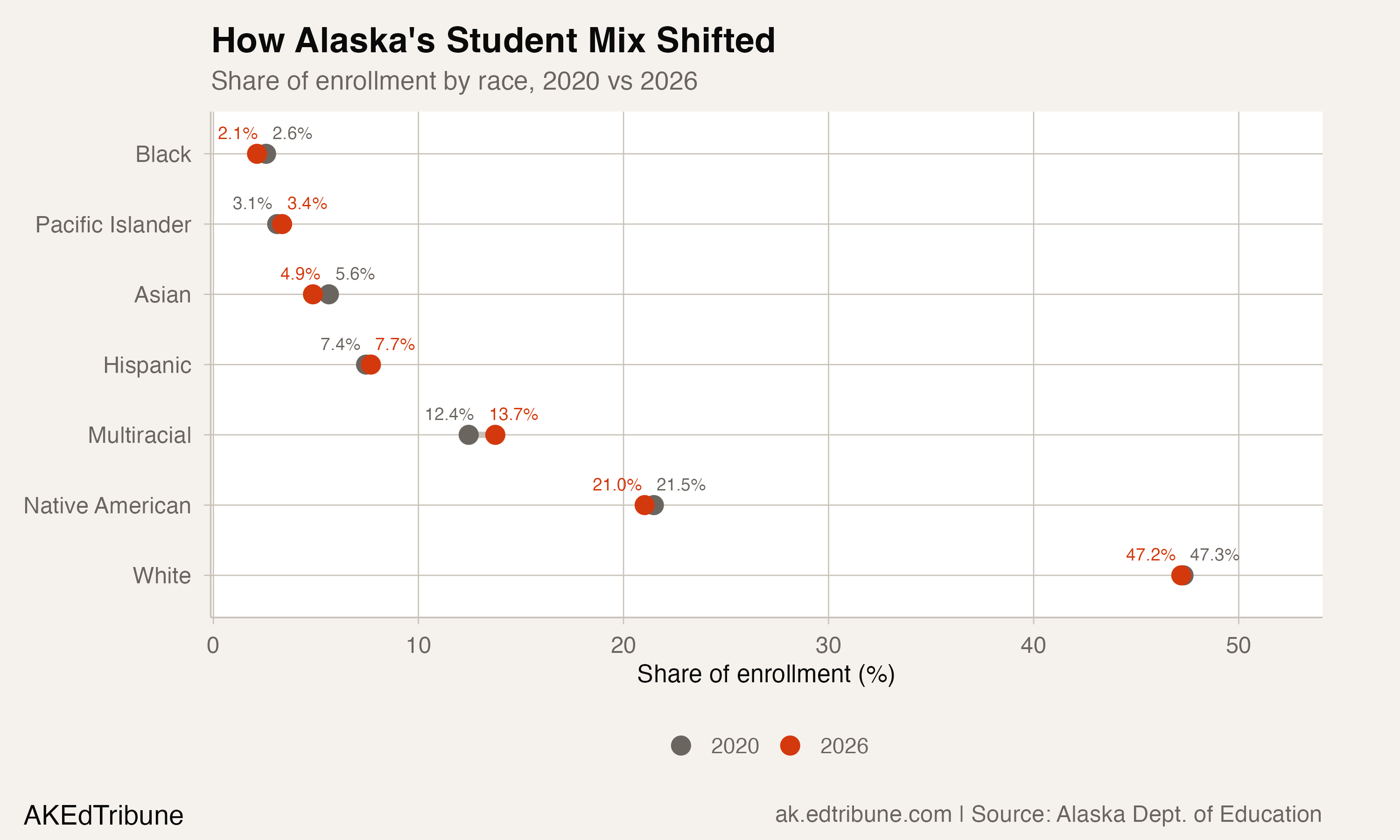
Black students' share of enrollment fell from 2.6% to 2.1%. At this rate, they will fall below 2% within two years.
The Outmigration Engine
Alaska has experienced 12 consecutive years of net outmigration, with more people leaving the state than arriving every year since 2012. In 2023-24 alone, 1,163 more people left than moved in. The state's overall population has grown slightly only because births exceed deaths.
But the enrollment data suggests this outmigration is not evenly distributed across racial groups. If Black and Asian families are leaving at three to four times the rate implied by overall population trends, the most likely explanation involves the federal workforce. Active-duty military, civilian Department of Defense employees, and defense contractors are disproportionately represented among Black and Asian Alaskans compared to their share of the general population. When those positions rotate or contract, the enrollment impact is immediate and concentrated.
The fiscal environment may accelerate the pattern. Anchorage is closing three elementary schools, Fire Lake, Lake Otis, and Campbell STEM, after the 2025-26 school year and cutting more than 500 staff positions to address a $90 million budget deficit. Enrollment has dropped by approximately 5,000 students since the district's recent peak. The district's chief financial officer, Andy Ratliff, described the outlook in blunt terms: "Not a very uplifting picture at this point."
Across the state, the budget pressures are widespread. Nearly 80% of Alaska school districts face deficits, and one parent told state lawmakers: "You need to raise the base student allocation, or else you'll force me and every parent like me... to move away."
What the Data Cannot Show
A methodological note: Alaska's 2020 race/ethnicity counts sum to 0.3% more than the published total enrollment; the source does not explain the discrepancy. All shares in this analysis divide by the applicable published statewide or district total rather than rescaling the category rows.
The enrollment figures do not distinguish between families who left Alaska entirely and those who moved to private, charter, or home-school options within the state. They also cannot separate military PCS (permanent change of station) rotations from families who chose to leave for economic or quality-of-life reasons.
What the data does show is an unbroken six-year trend, consistent across both military-connected districts, and concentrated in the same two racial groups most likely to be represented in federally connected employment. The trend held through COVID recovery, through Eielson's F-35 expansion that brought roughly 3,300 people, and through modest statewide population growth. The F-35 buildup may have partially offset what would otherwise be an even steeper Fairbanks decline, but it was not enough to reverse the direction.
The question for Anchorage and Fairbanks is whether the loss of Black and Asian students is a temporary artifact of military rotation schedules or a structural feature of a state where the cost of living, school budget cuts, and limited economic diversification are pushing federally connected families toward assignments elsewhere. If the next round of PCS orders does not bring replacements at the same rate, Alaska's already-small Black student population will continue to contract toward a statistical footnote.
Correction (August 20, 2026; updated August 22): The enrollment figures in this article were recomputed against Alaska's current record after publication, and most of them moved. The state enrolled 3,317 Black students in 2020, not 3,406, and the decline through 2026 is 648 students, 19.5%, not 737 students, 21.6%. Anchorage's 2020 count is 2,179, not 2,235, and its loss is 397 students, 18.2%, not 453 students, 20.3%. Fairbanks enrolled 538 Black students in 2020, not 548, a 38.5% decline rather than 39.6%. Black students lost ground at 7.7 times the statewide rate, not 8.5. On August 22, we also corrected the 2020 multiracial share from 12.4% to 12.5% after applying the published statewide total as the denominator. The finding is unchanged: Black enrollment fell faster than that of any other group, and two districts account for nearly all of the statewide loss.
Detailed code that reproduces the analysis and figures in this article is available exclusively to EdTribune subscribers.
Discussion
Sign in to join the discussion.
Loading comments...