In Sleetmute, a village of 80 people on the Kuskokwim River, an architect declared the school building unsafe for occupancy in 2021. The foundation had deteriorated to rubble. The Kuspuk↗ET School District had been requesting roof repairs since 2005. The estimated cost rose from $411,000 to $1.6 million over 17 years of waiting. Half the building is now closed.
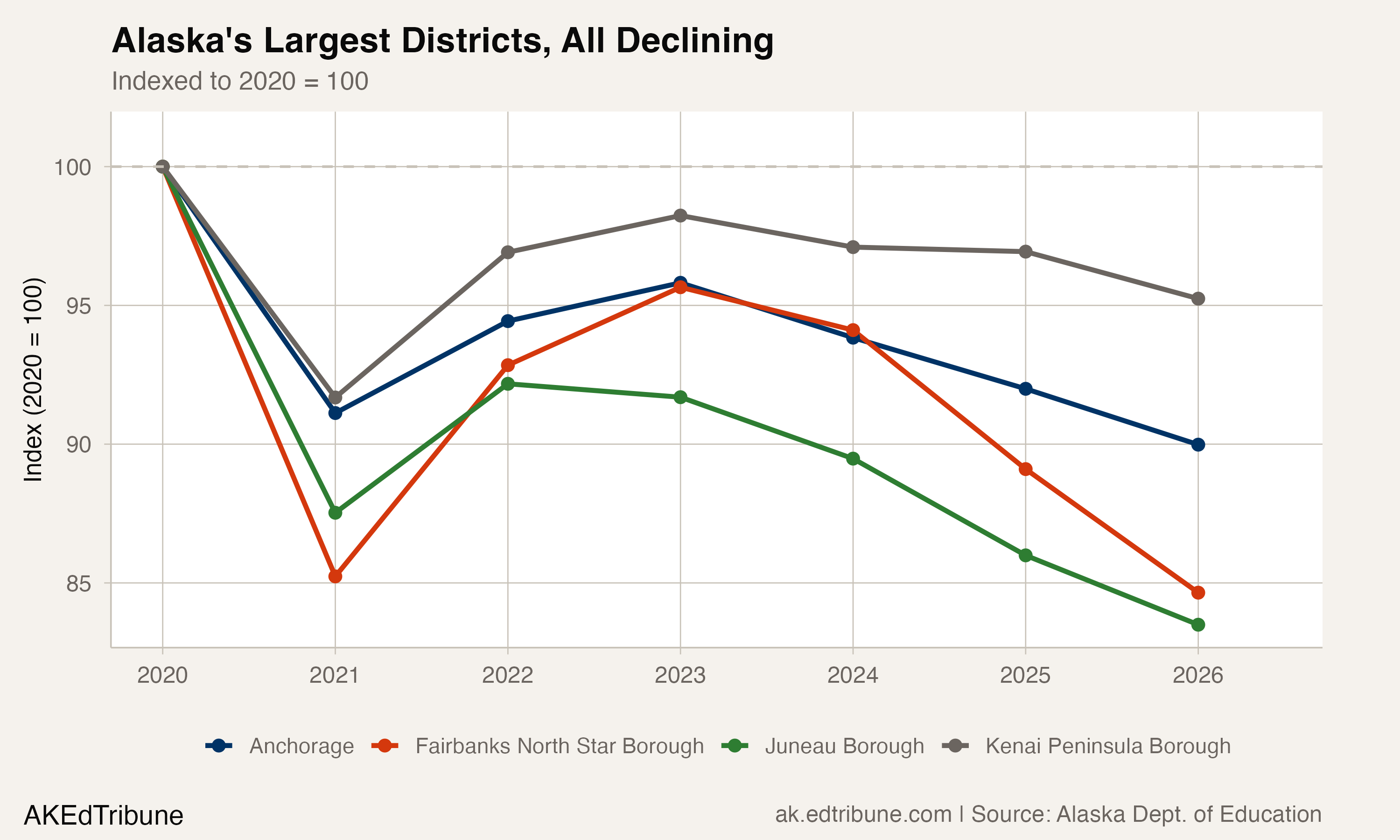
Kuspuk is one of 29 Alaska school districts currently at their lowest enrollment ever recorded. The district enrolled 272 students in 2025-26, down 26.1% from its peak of 368. It is not alone. Half of Alaska's districts are now at record lows, and the list includes the state's largest: Anchorage↗ET at 40,688, Fairbanks North Star↗ET at 11,122, Juneau↗ET at 3,809, and Lower Kuskokwim↗ET at 3,666.
The districts at their smallest enrollment hold 82,810 students, 66.1% of Alaska's total. Two-thirds of the state's public school students attend a district that has never been smaller.
Ten districts fell to new lows in 2025-26
The 2026 count did not just confirm existing declines. It created new ones. Ten districts dropped to all-time lows for the first time in 2025-26, including Anchorage and Fairbanks, the state's two largest traditional districts.
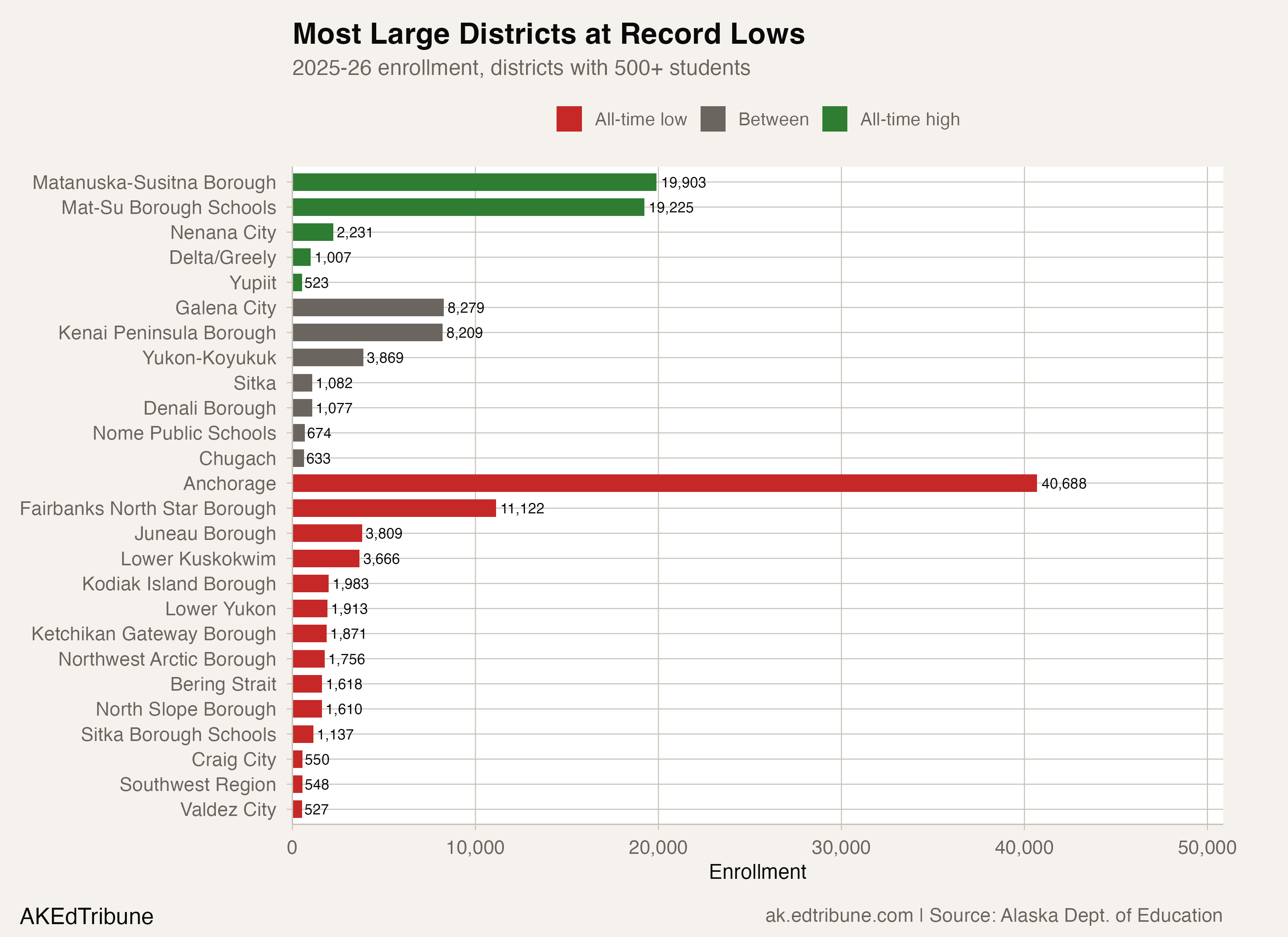
Anchorage fell to 40,688 students, 10.0% below its seven-year peak of 45,218. That decline, 4,530 students, exceeds the entire state's net loss of 3,272 over the same period. Fairbanks dropped to 11,122, down 15.4% from its 2020 level of 13,139. In February 2025, the Fairbanks school board voted to close three elementary schools: Midnight Sun, Pearl Creek, and Two Rivers. Students in Two Rivers now bus over 30 miles into Fairbanks.
The smaller districts on the newly-at-low list paint a geography of retreat. Craig↗ET on Prince of Wales Island: 550 students, down 37.1% from 874. Valdez: 527, down 23.2%. Hoonah: 104, down 17.5%. Hydaburg↗ET, a Haida village of 300 people on the southern tip of Prince of Wales Island, enrolled 62 students, down 63.3% from 169.
The other half
A handful of districts are at all-time highs, but the composition tells its own story.
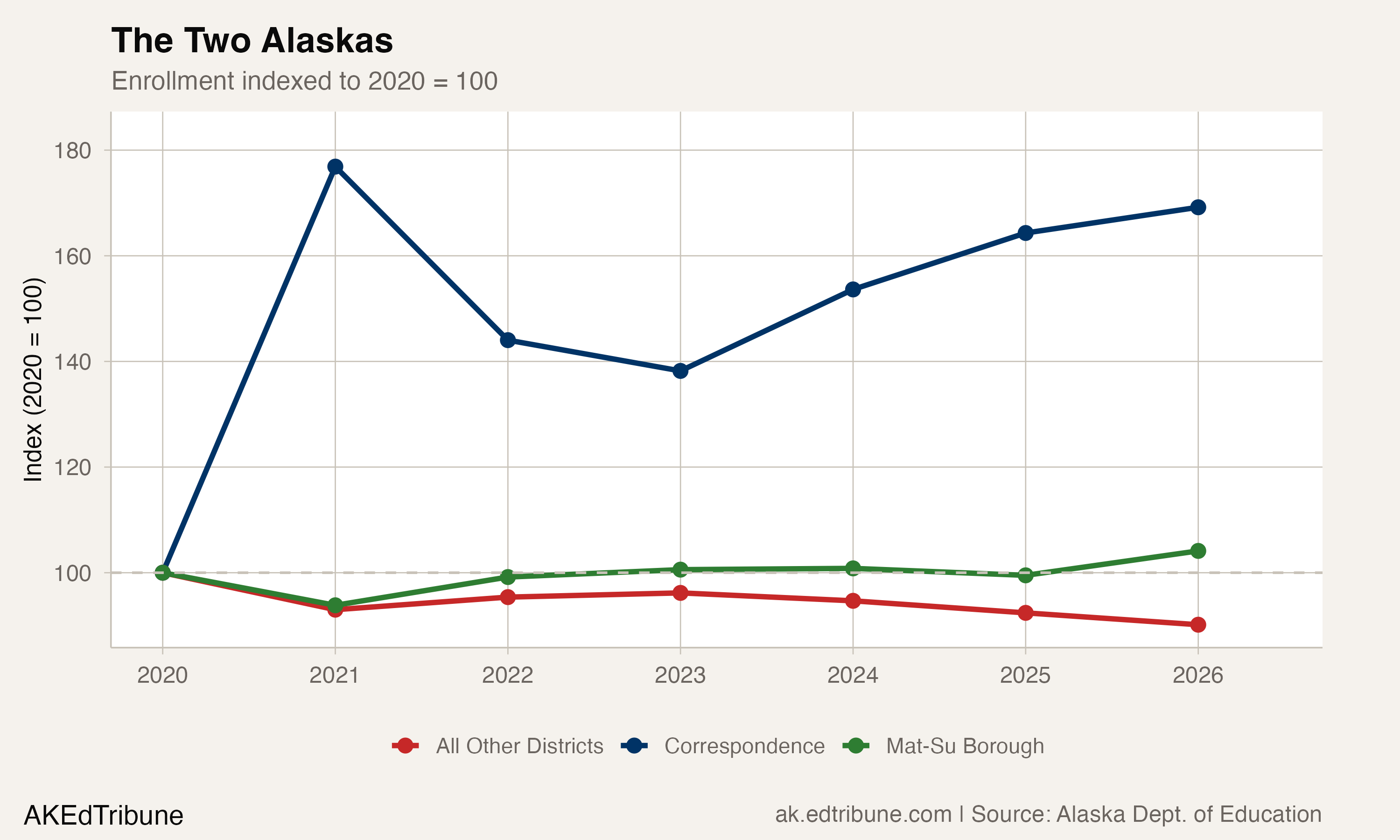
Matanuska-Susitna Borough↗ET, Alaska's second-largest district, shows 19,903 students in DEED's school-level data. That total includes the Mat-Su Hybrid Learning Academy, a new virtual program that launched in 2025-26 with 1,114 students. Superintendent Randy Trani's district-level count is 18,912, a slight decline from the prior year — an important distinction between what DEED's school-level files capture and what the district counts as its traditional enrollment. Mat-Su Borough surpassed 100,000 residents in 2024, growing at 3.4% annually while the state grew at 1.2%. But Trani told Alaska Public Media that the district faces a $22.5 million budget shortfall, and is planning three school closures.
"$700,000 in a budget of more than a quarter of a billion is essentially flat funding, and flat funding is a cut." — Randy Trani, Mat-Su Superintendent, Alaska Public Media, March 2026
Nenana City School District, home to the CyberLynx correspondence program, hit a record 2,231 students, up 58.1% since 2020. Several small traditional districts, including Delta/Greely (1,007), Petersburg (473), and Kake (112), also reached highs. These are genuine bright spots, though all three combined hold fewer students than Anchorage lost in a single year.
What is driving this
The most direct driver is demographic. Alaska is in its 13th consecutive year of negative net migration, the longest such streak since 1945. Between 2024 and 2025, 1,740 more people left the state than arrived. The school-age population is shrinking while the over-65 population grew 3.2% in a single year. The child population (birth to 17) shrank 0.8% in a single year.
The strain is concentrated in Southeast Alaska, where population is projected to drop 17% by 2050, a loss equal to the populations of Sitka and Wrangell combined. Housing costs are the primary barrier. "The price of a home and the cost of being here is just too much of a challenge" for young families, Southeast Conference economic development leader Brian Holst told KTOO. In Juneau, the over-60 population now outnumbers those under 20.
A second factor is student migration within the state. Approximately 10,000 students have shifted from neighborhood schools to correspondence programs, funding that follows them out of traditional districts. This transfer does not reduce statewide enrollment, but it hollows out the brick-and-mortar system: Fairbanks board member Brandy Harty told Alaska Public Media that "the problem isn't at our school board, it's in Juneau, with funding."
Record lows in every size category
The pattern is not confined to small rural districts or large urban ones. Record lows appear across every size category. Nine of 14 mid-sized districts (1,000 to 4,999 students) are at their lowest ever, a 64.3% rate higher than any other size bucket. The list includes Ketchikan Gateway↗ET (1,871, down 14.9%), North Slope Borough↗ET (1,610, down 17.2%), and Northwest Arctic Borough (1,756, down 10.0%).
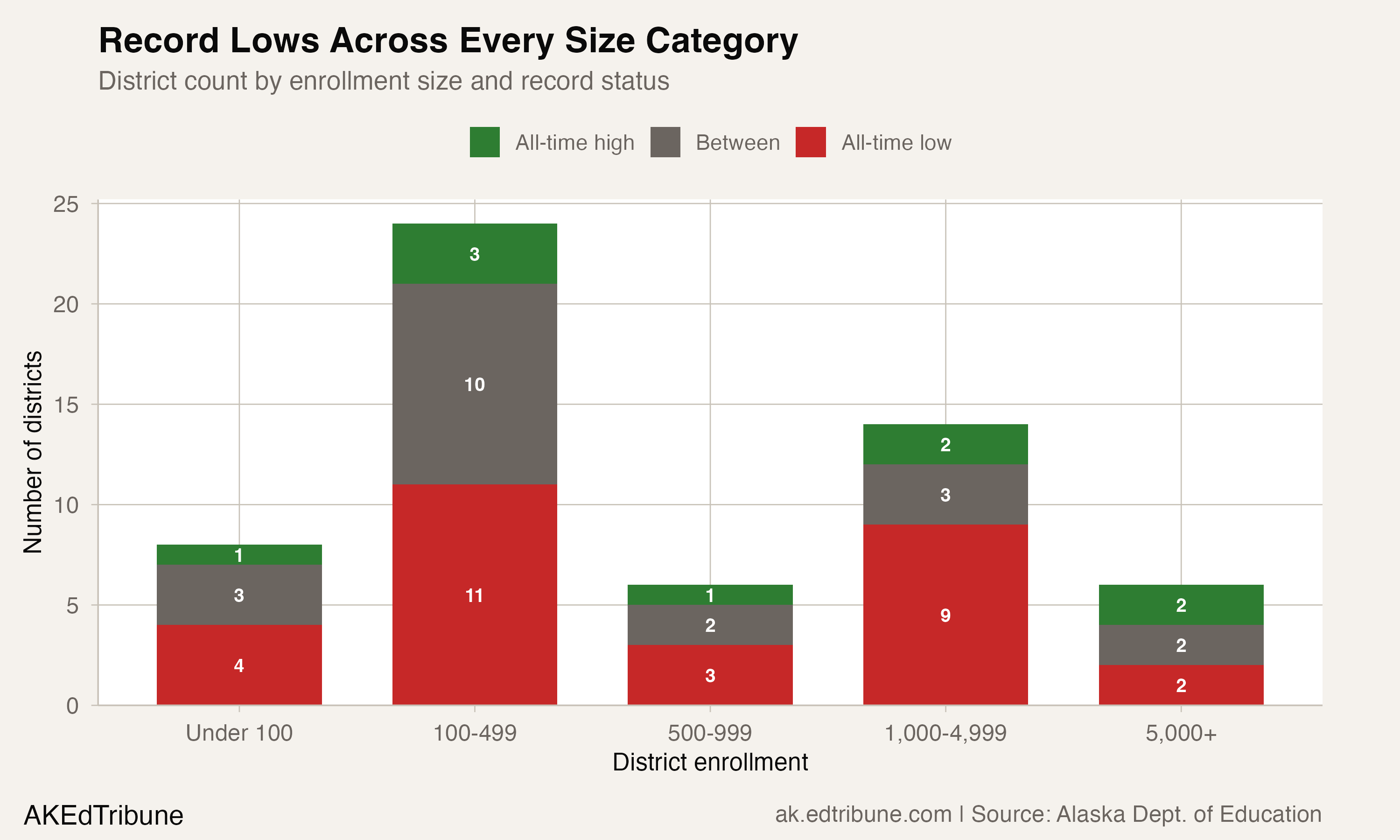
Thirty-two of Alaska's districts enroll fewer than 500 students. Eight enroll fewer than 100. These micro-districts face an arithmetic that larger systems do not: losing 15 students can mean losing a teacher, a program, or a building. Kuspuk illustrates the bind. The district relies entirely on state funding as a Regional Education Attendance Area with no local tax base. Its superintendent, Madeline Aguillard, told NPR the district spent over $200,000 since 2021 just strengthening capital funding applications, plus tens of thousands more on a lobbyist, to compete for repairs that never came.
"These bright young children show up every morning to go to school in a building that's not fit for even anything but being ready to be demolished." — House Speaker Bryce Edgmon, NPR, March 2025
The lawsuit and the ledger
In January 2026, Fairbanks North Star and Kuspuk filed suit against the state, alleging that Alaska has failed to meet its constitutional obligation to provide adequate public education funding. The Base Student Allocation, Alaska's primary per-pupil funding mechanism, has increased just 2.2% since 2015 while inflation rose 37% over the same period. Last year's celebrated $700 increase actually netted only $20 more per student than the one-time funding districts received the year before.
Nearly 80% of Alaska school districts are facing deficits, according to an Alaska Council of School Administrators survey. Anchorage is cutting 389 positions to close a $90 million gap. Fairbanks has closed seven schools in five years. Kodiak needs $1 million in cuts. Mat-Su is planning three closures despite its DEED total showing growth — a total that includes a new virtual program with 1,114 students.
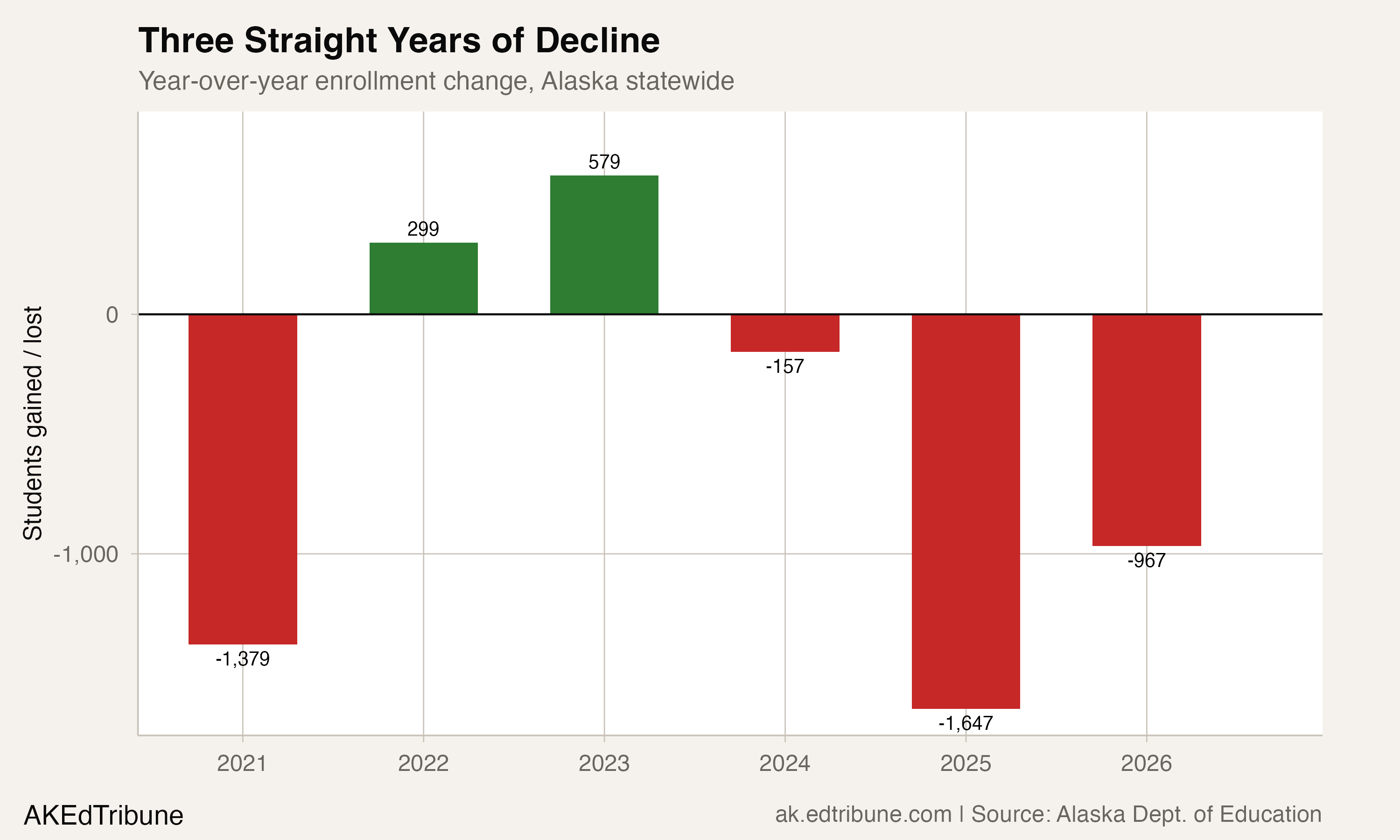
Enrollment decline and underfunding are separate problems, but they compound. A district losing students loses per-pupil revenue, but fixed costs for heating, maintenance, and transportation do not shrink proportionally. In rural Alaska, where buildings serve as community centers, storm shelters, and the only indoor gathering space for miles, closing a school has consequences the funding formula does not measure.
Alaska's state enrollment stands at 125,317, down 2.5% from its 2020 peak of 128,589. The state DEED projects another 1,500-student decline next year. The question is how many of the districts still above their record lows will join the other half.
Detailed code that reproduces the analysis and figures in this article is available exclusively to EdTribune subscribers.
Discussion
Sign in to join the discussion.
Loading comments...