Galena City School District↗ET is a village of roughly 500 people on the Yukon River, 270 air miles west of Fairbanks. It has one road in and no road out. It also enrolls 8,279 students, making it the fourth-largest school district in Alaska. Only one of those students lives in Galena.
The rest are scattered across the state, enrolled in the Interior Distance Education of Alaska, known as IDEA. It is, by enrollment, the single largest school in Alaska. And it is not alone. Three correspondence districts, Galena, Yukon-Koyukuk↗ET (home to the Raven Homeschool program), and Nenana↗ET (CyberLynx), have collectively added 5,880 students since 2020. Their combined enrollment reached 14,379 in 2026, up from 8,499. But these three are just the largest programs. The state reports more than 24,000 correspondence students across 30-plus programs statewide.
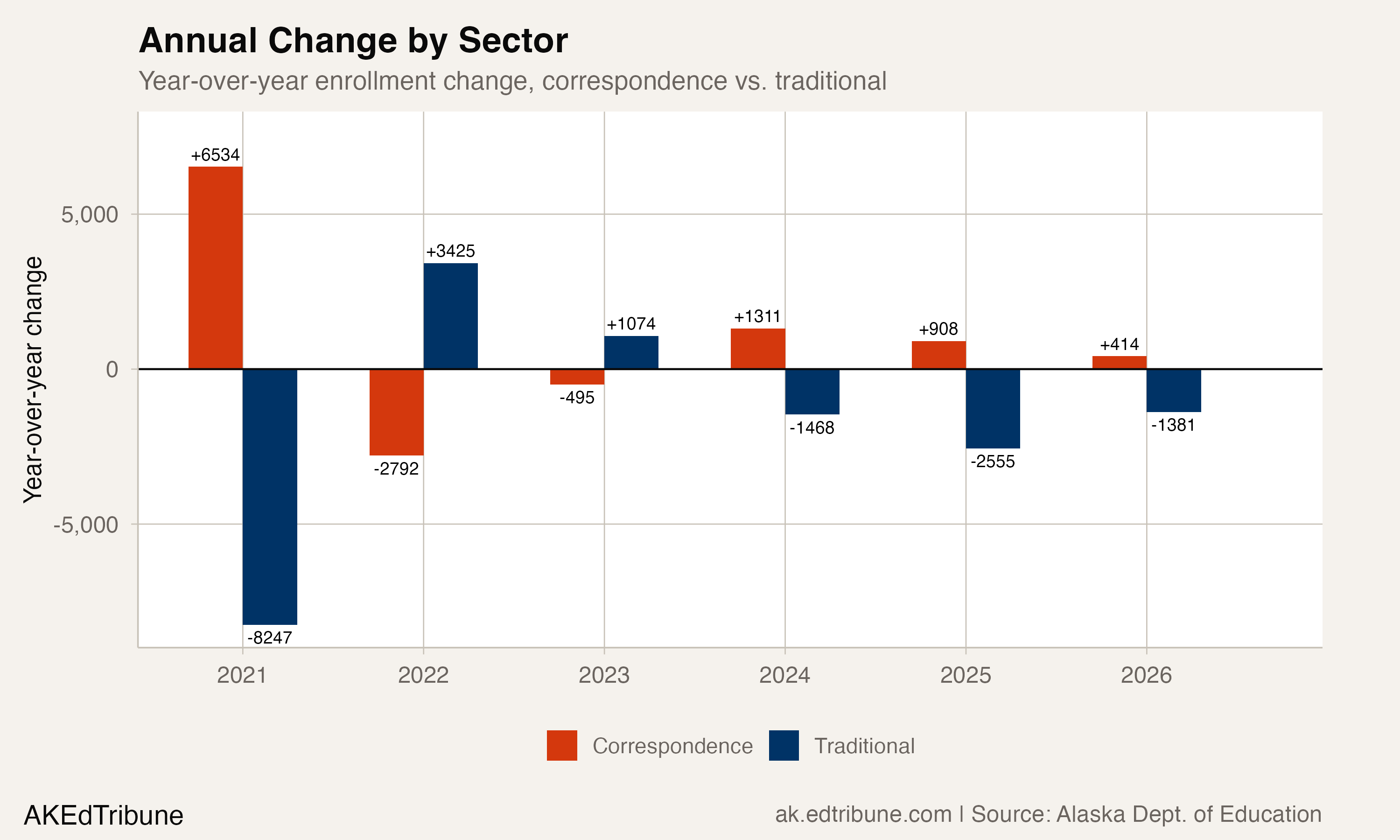
In the same period, traditional brick-and-mortar districts across Alaska lost thousands. The state's total enrollment fell to 125,317, an all-time low in the seven-year dataset. The state lost 3,272 students overall, but the three largest correspondence districts alone gained 5,880, meaning the rest of the system shed more than 9,100 students, a contraction masked by virtual growth flowing into remote village district budgets.
A village economy built on distant students
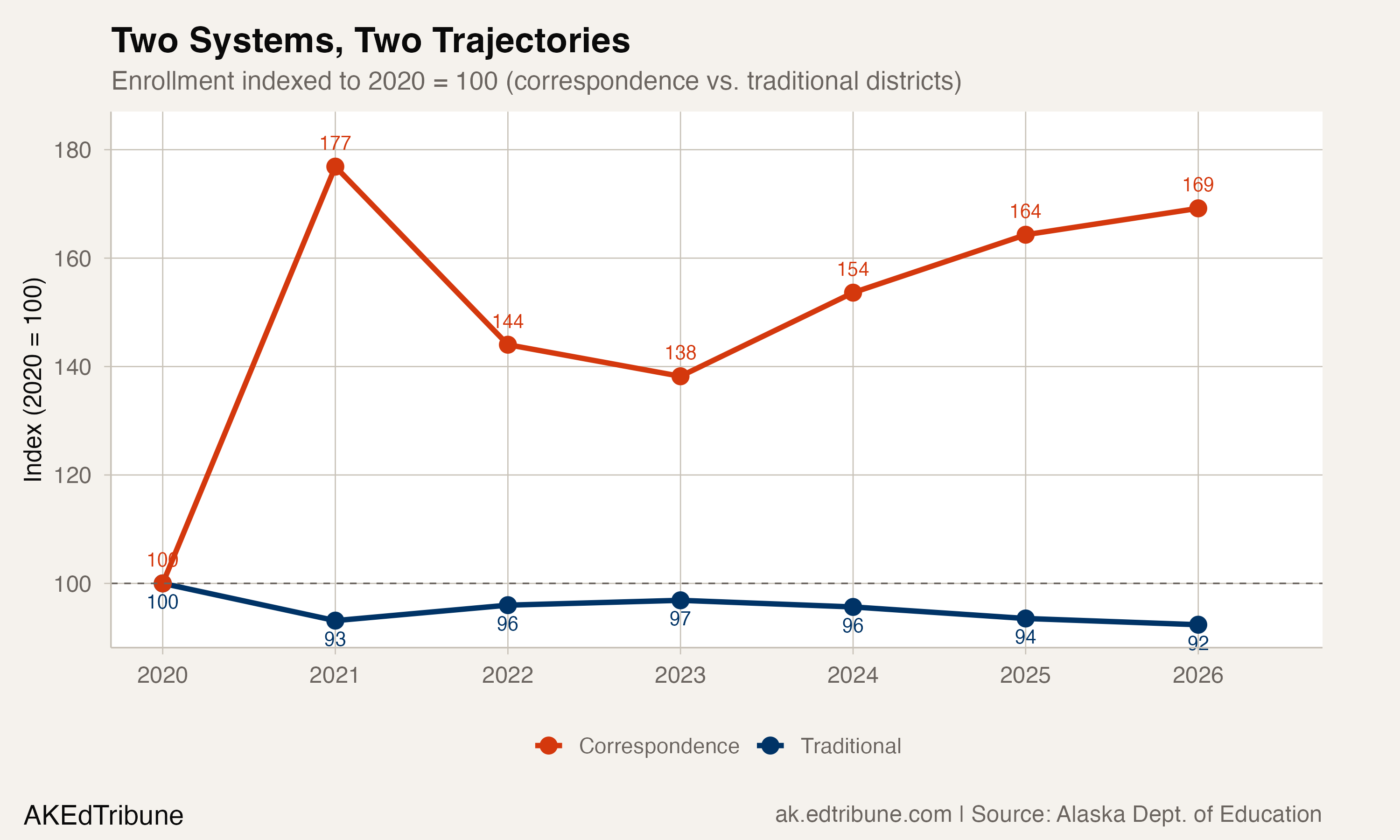
Galena's IDEA program grew from 5,155 students in 2020 to 8,279 in 2026, a 60.6% increase. The COVID-19 pandemic supercharged enrollment: the program surged by 3,875 students in a single year (2020 to 2021), nearly doubling. Enrollment then pulled back, losing 2,097 students over the next two years, before climbing steadily again from 2023 onward.
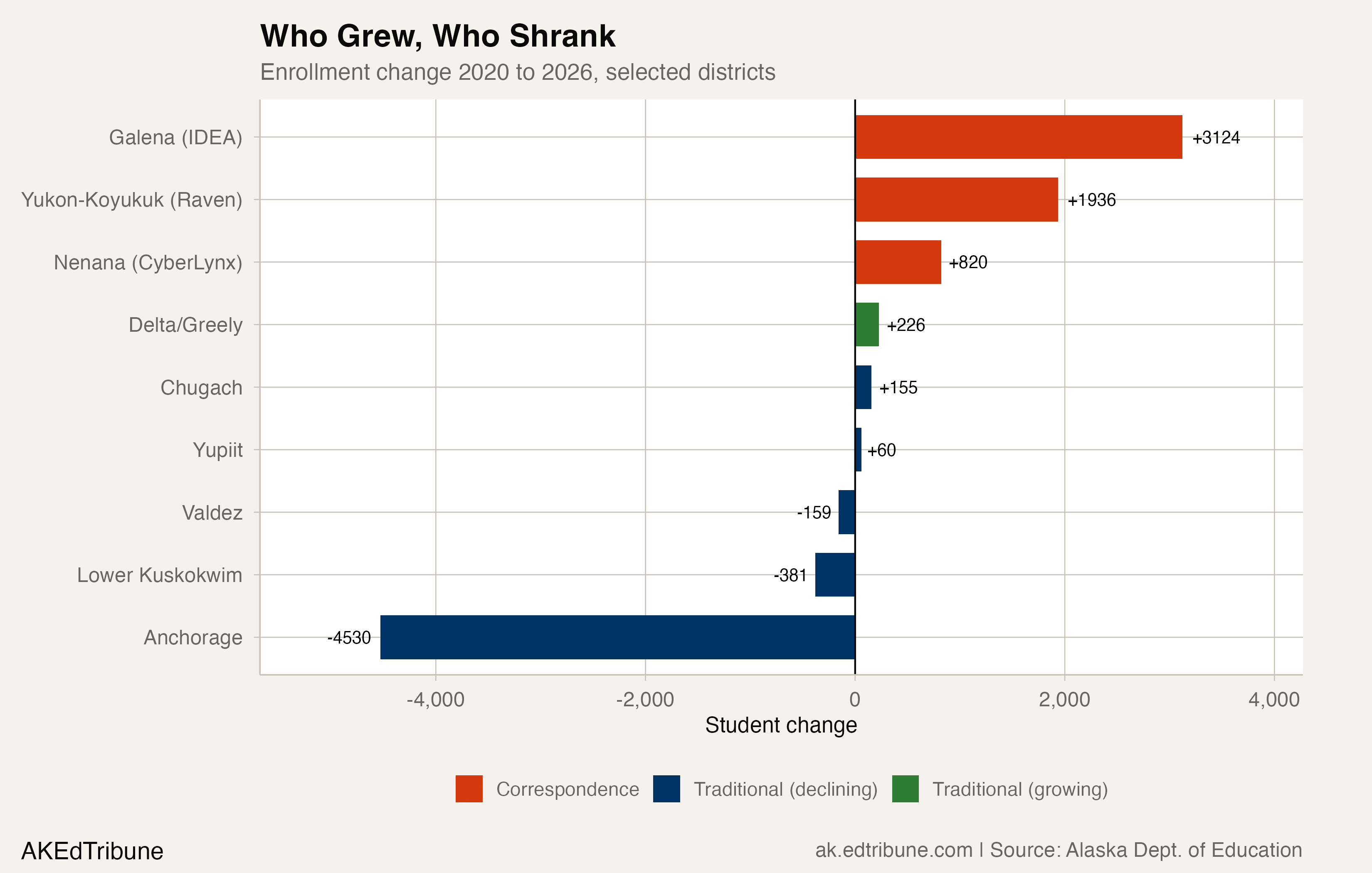
Yukon-Koyukuk's Raven Homeschool program followed a similar arc. It doubled from 1,933 to 3,869 students (+100.2%), with an even sharper COVID spike of 2,227 students in 2021 that partially reversed before resuming growth. Nenana's CyberLynx added 820 students (+58.1%), growing from 1,411 to 2,231.
The funding model explains part of the appeal. Each correspondence student receives an annual allotment typically around $2,700, though amounts vary by program and grade level, that families can spend on curriculum, supplies, technology, and extracurricular activities. The state spent $47.2 million on correspondence allotments in fiscal year 2024 alone, with $26 million going to supplies and materials and another $14 million to professional services.
A lawsuit now working through Alaska courts alleges that some families have used their allotments to pay private school tuition, an arrangement the plaintiffs argue violates the state constitution. Galena, Anchorage, Mat-Su, and Denali borough school districts are named as defendants. An Anchorage Superior Court initially ruled the practice unconstitutional, but the Alaska Supreme Court sent the case back to the lower court for further proceedings.
The $47 million question in Juneau
Senate Bill 277, introduced in the current legislative session, would restructure how correspondence money flows. Under the bill, correspondence students would be counted by the district where they live, not the district running the program. That would redirect tens of millions of dollars from programs like IDEA and Raven to students' home districts, which would retain a percentage for administrative costs and local services like sports and in-person classes.
Galena Superintendent Jason Johnson told the Anchorage Daily News the bill would be devastating:
"Most Alaskan statewide correspondence programs will sink."
Sen. Loki Tobin, chair of the Senate Education Committee and the bill's sponsor, framed it differently:
"The hope for this is to continue to support our brick-and-mortar schools and then also recognize that they are also providing services."
The stakes are structural. Of the roughly 24,000 students enrolled in correspondence programs statewide, nearly 16,000 attend programs outside their home district. That means the revenue from those students flows to Galena, Yukon-Koyukuk, and Nenana rather than to the districts where the students actually live, attend local activities, and might use district facilities. The bill would reverse that flow.
Mat-Su: a closer look at the numbers
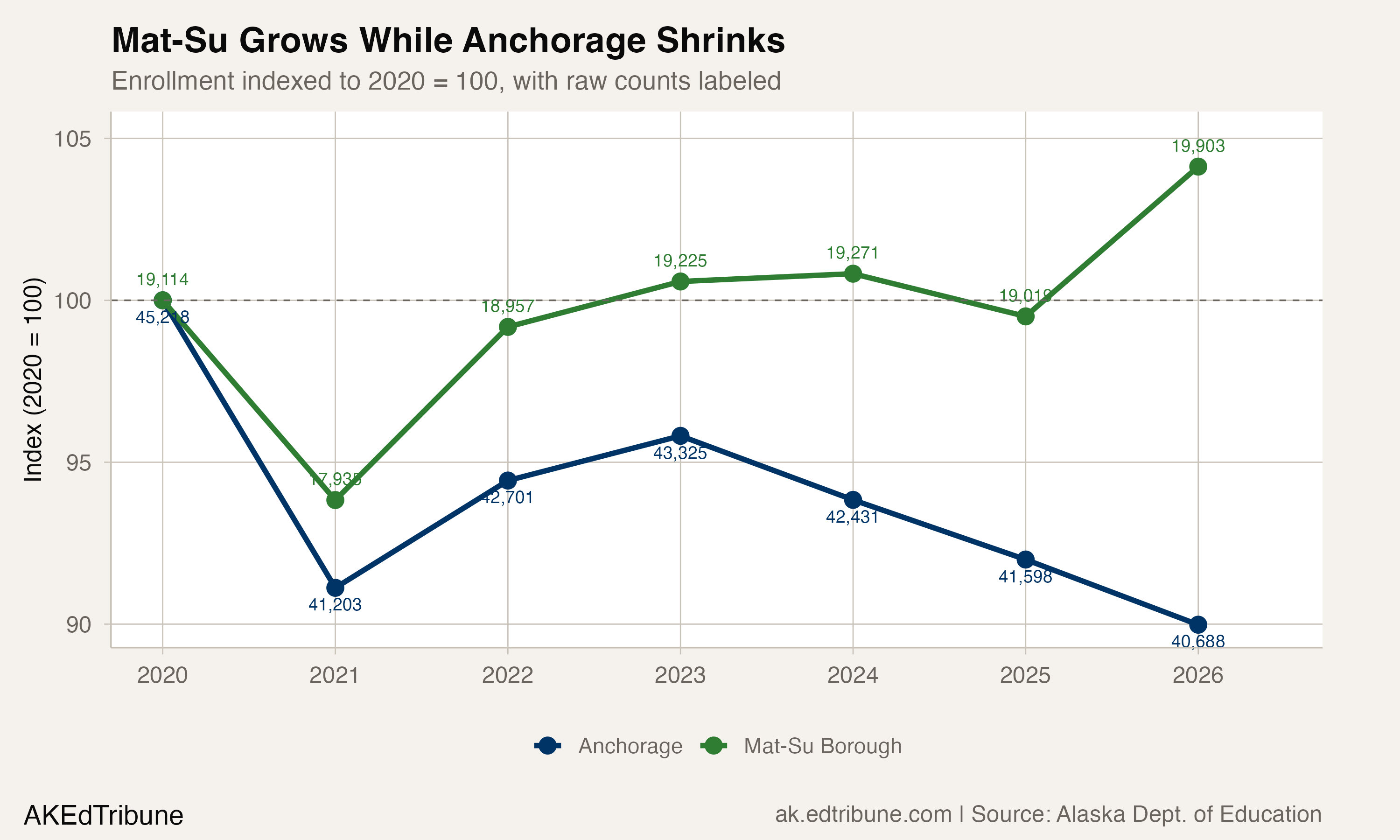
Matanuska-Susitna Borough↗ET, Alaska's third-largest district, shows 19,903 students in DEED's school-level data for 2025-26, up from 19,114 in 2020. At first glance, it looks like the only traditional system posting sustained growth. But there is an important distinction between DEED's school-level aggregate and what the district itself counts.
Superintendent Randy Trani puts Mat-Su's enrollment at 18,912, a decline of 155 from the prior year. The difference is largely one program: the Mat-Su Hybrid Learning Academy, a new virtual program that launched in 2025-26 with 1,114 students under Mat-Su's district ID. Mat-Su Central School, a long-running correspondence program, has also grown steadily, from 1,820 students in 2020 to 3,034 in 2026. Combined, these two non-traditional programs account for 4,148 students, or 20.8% of Mat-Su's DEED total.
The Mat-Su Borough is genuinely growing — it added 1,696 residents from 2024 to 2025, the largest gain of any borough in the state. But the same pattern playing out statewide is playing out here too: virtual and correspondence enrollment is growing while traditional classroom enrollment holds flat or declines.
The contrast with Anchorage↗ET, 40 miles to the south, remains stark. Anchorage lost 4,530 students over the same period, a 10.0% decline, from 45,218 to 40,688. The state's largest district is closing schools and cutting hundreds of positions amid a $90 million budget deficit.
Small districts that grew are genuinely small
Beyond Mat-Su, eight other traditional districts posted enrollment gains. None of them are large. Delta/Greely↗ET, near Fort Greely, added 226 students (+28.9%) to reach 1,007, its all-time high, likely reflecting military installation activity. Chugach gained 155 (+32.4%), and the remaining six grew by fewer than 100 students combined: Yupiit (+60), Cordova (+33), Southeast Island (+21), Kake (+11), Kashunamiut (+5), and Chatham (+1).
Together, these eight districts added 512 students. The three correspondence districts added 5,880. The ratio tells the story: for every student gained in a traditional Alaska classroom, 11 were gained behind a screen.
The budget math that worries superintendents
Nearly 80% of Alaska's school districts face budget deficits, according to Alaska Public Media. Last year's $700 Base Student Allocation increase amounted to only $20 more per student than the prior year's one-time funding. Mat-Su Superintendent Randy Trani characterized it plainly:
"Flat funding is a cut."
The correspondence growth intensifies this pressure. When students enroll in IDEA or Raven from Anchorage, Fairbanks, or Juneau, the BSA funding follows them to Galena or Yukon-Koyukuk. The home district loses the revenue but still operates the buildings, buses, and programs those families may occasionally use. SB 277 is an attempt to address that mismatch.
What the data cannot separate
The central question is whether correspondence growth represents families choosing a better option or families fleeing a deteriorating one. The data shows both trends happening simultaneously: correspondence enrollment surged during COVID and never fully retreated, while traditional enrollment has declined every year since 2023.
It is also worth noting what this analysis measures and what it does not. The three largest correspondence districts, Galena, Yukon-Koyukuk, and Nenana, serve as proxies for the correspondence sector. Alaska DEED reports more than 30 correspondence programs enrolling over 24,000 students. Some of those programs are embedded within traditional districts and would not appear in this district-level comparison.
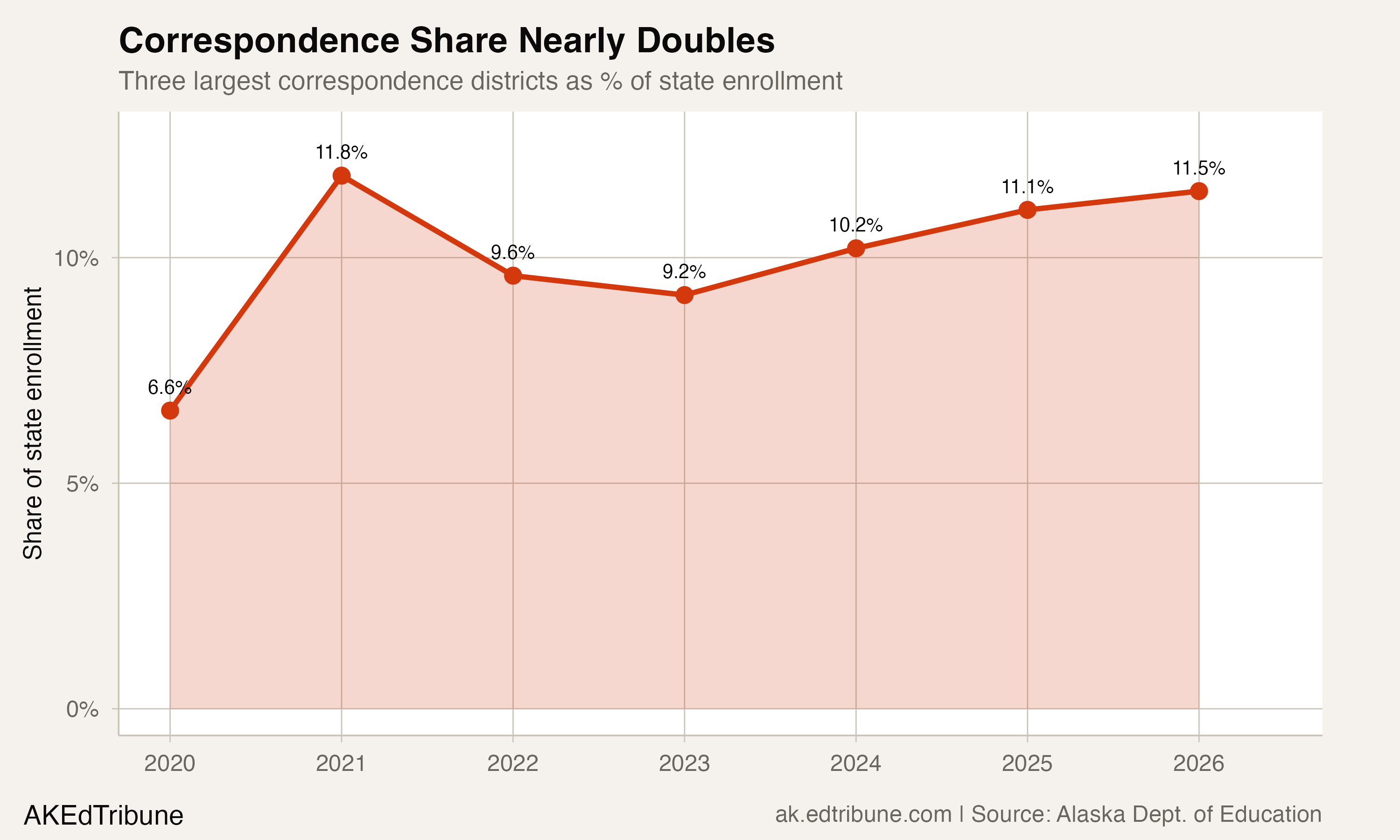
The 11.5% share captured by these three districts is a floor, not a ceiling, for Alaska's total correspondence enrollment.
A system at a crossroads
SB 277 will not resolve the underlying demographic forces pushing Alaska's enrollment downward. The state is in its 13th consecutive year of net outmigration, the longest streak since 1945, and its total population is projected to decline through 2050. Fewer children in the state means fewer students in every type of school.
But the bill will determine where the money lands while enrollment contracts. If correspondence funding shifts to home districts, programs like IDEA would need to compete for students without the financial infrastructure they have built over decades. If the bill fails, traditional districts will continue watching revenue flow to village districts hundreds of miles away while they close schools and cut teachers.
The legislature is halfway through its session. Whatever it decides, the enrollment data has already delivered its verdict: Alaska's traditional school system is shrinking everywhere — and even Mat-Su's DEED growth includes a new virtual program with 1,114 students. The only sector posting consistent growth exists almost entirely online.
Detailed code that reproduces the analysis and figures in this article is available exclusively to EdTribune subscribers.
Discussion
Sign in to join the discussion.
Loading comments...