In February, the Anchorage↗ET School Board voted 5-2 to close three more elementary schools. Fire Lake and Lake Otis were running at roughly 50% capacity. The district has now shuttered eight schools in a decade.
Superintendent Jharrett Bryantt did not frame the closures as a choice.
"These difficult reductions do not reflect our aspiration as ASD. This budget purely reflects the real-world impacts of declining enrollment, rising costs and funding uncertainty." — Anchorage Daily News, Feb. 25, 2026
The closures are part of a story Alaska told itself for two years and then stopped believing. After COVID knocked 1,379 students out of the system in 2021, enrollment ticked back up: 299 students in 2022, 579 more in 2023. It looked like recovery. It was not.
Even at the 2023 peak, the state was still 501 students short of its pre-pandemic count. Then the floor opened: a loss of 157 in 2024, 1,647 in 2025, and 967 more in 2025-26. Alaska is now 3,272 students below its pre-COVID enrollment, a 2.5% decline. The recovery rate is negative 137.3%, meaning the state has lost more ground since the initial COVID drop than the pandemic itself took.
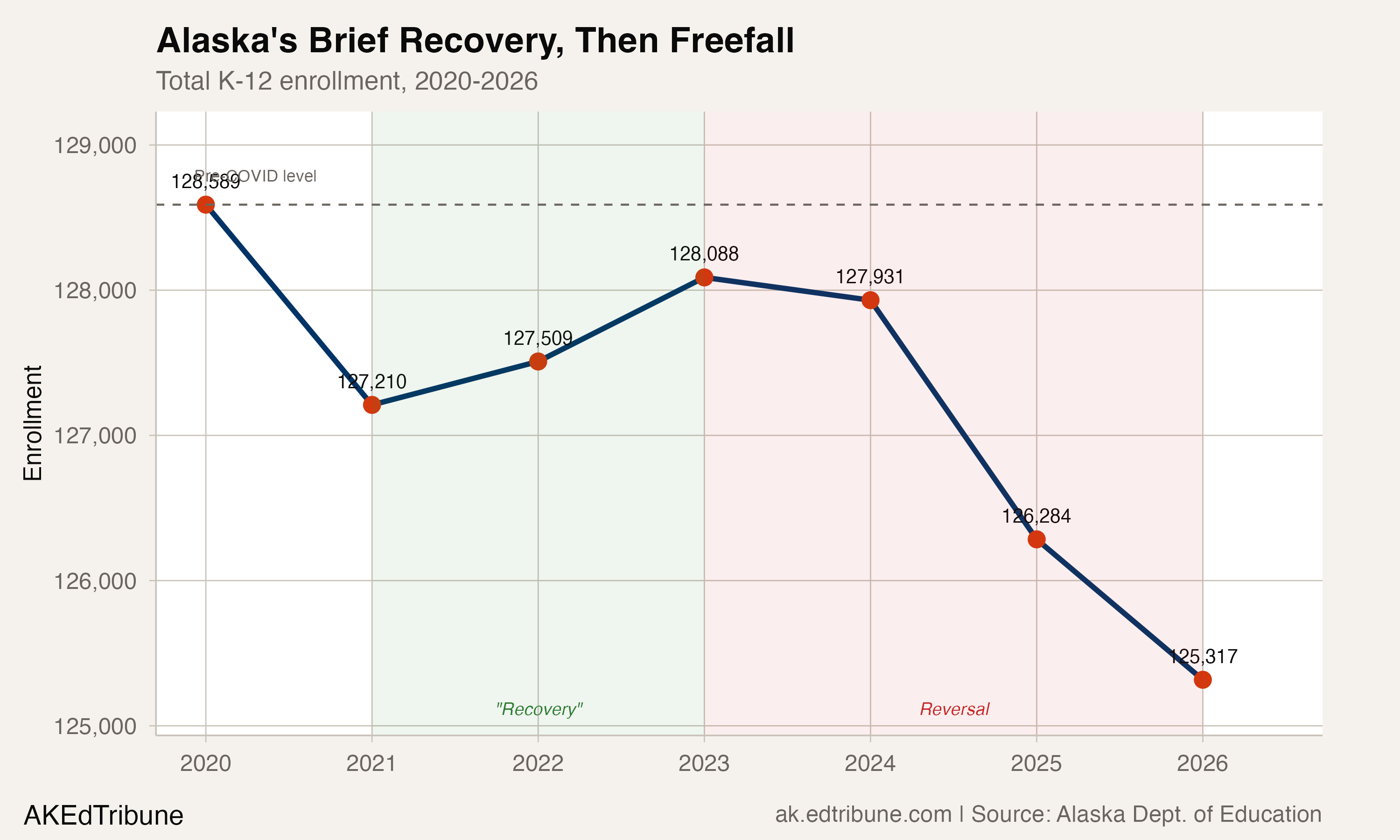
The numbers behind the illusion
The year-over-year pattern tells the story cleanly. Two modest green bars followed by three red ones, two of which individually exceed the entire two-year rebound.
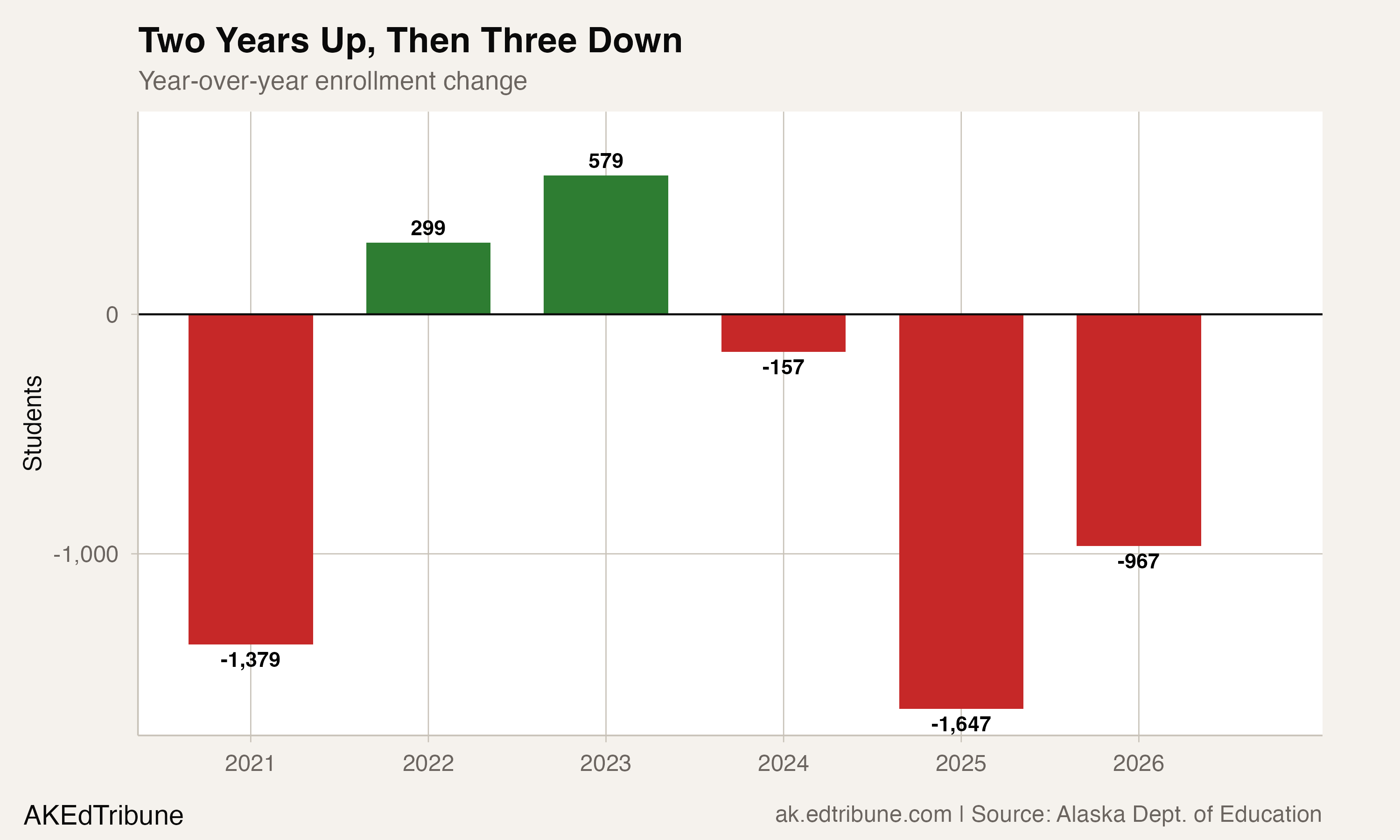
The 2021 COVID loss of 1,379 students looked recoverable. The 878-student rebound over the next two years suggested Alaska was on the path back. But the 2025 loss alone, 1,647 students, exceeded the entire COVID drop. The cumulative gap has widened every year since 2023.
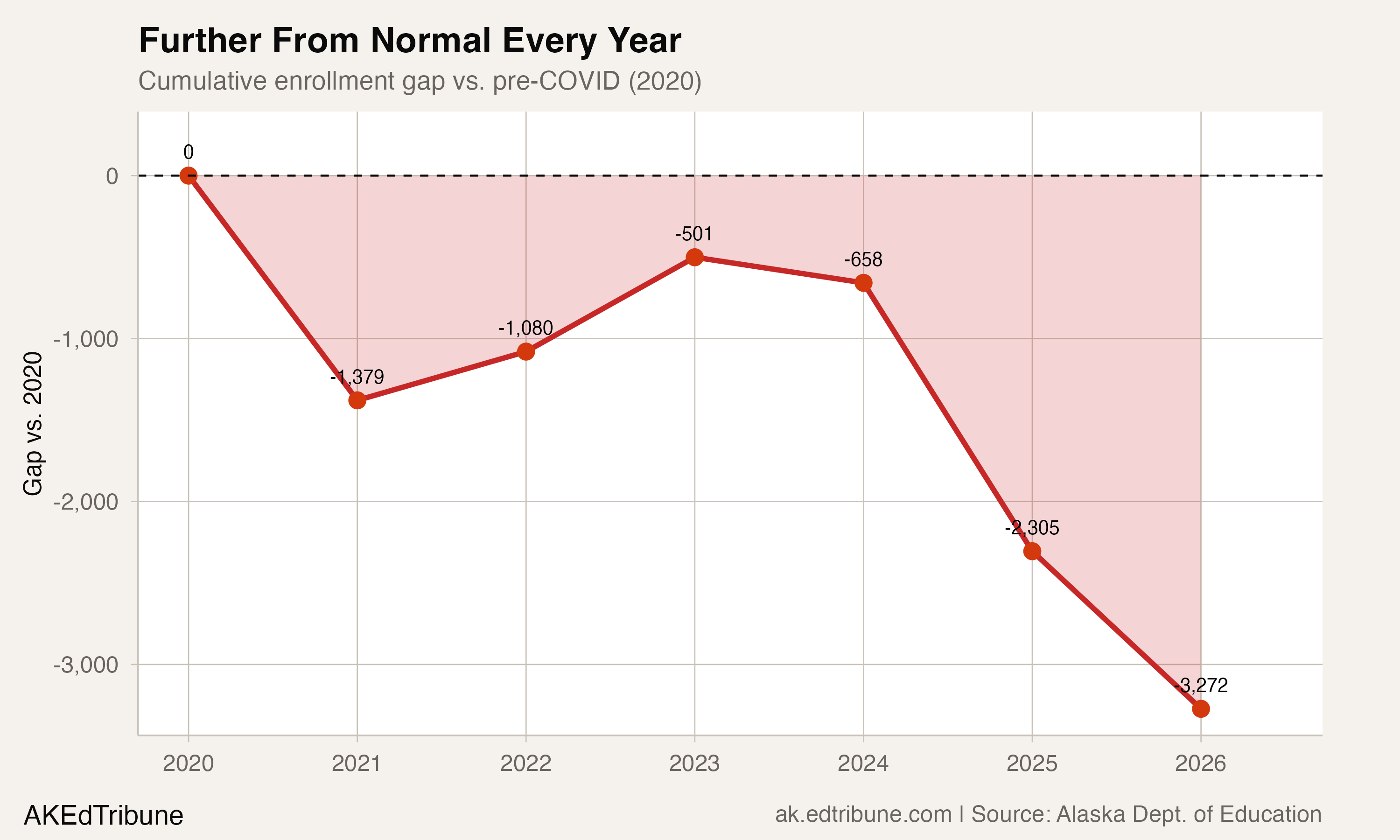
What makes Alaska's trajectory distinct from other post-COVID states is the timing. Most states experienced their sharpest losses during the pandemic year itself. Alaska's worst single year was 2025, four years after COVID. The pandemic did not cause this decline so much as interrupt a trend that resumed with force.
A tale told in two school systems
Underneath the statewide numbers, two separate systems are moving in opposite directions. Traditional brick-and-mortar districts have lost 9,152 students since 2020, a 7.6% decline. Correspondence districts, led by Galena↗ET (home to IDEA, the state's largest school), Yukon-Koyukuk (Raven), and Nenana (CyberLynx), grew by 5,880 students, a 69.2% increase.
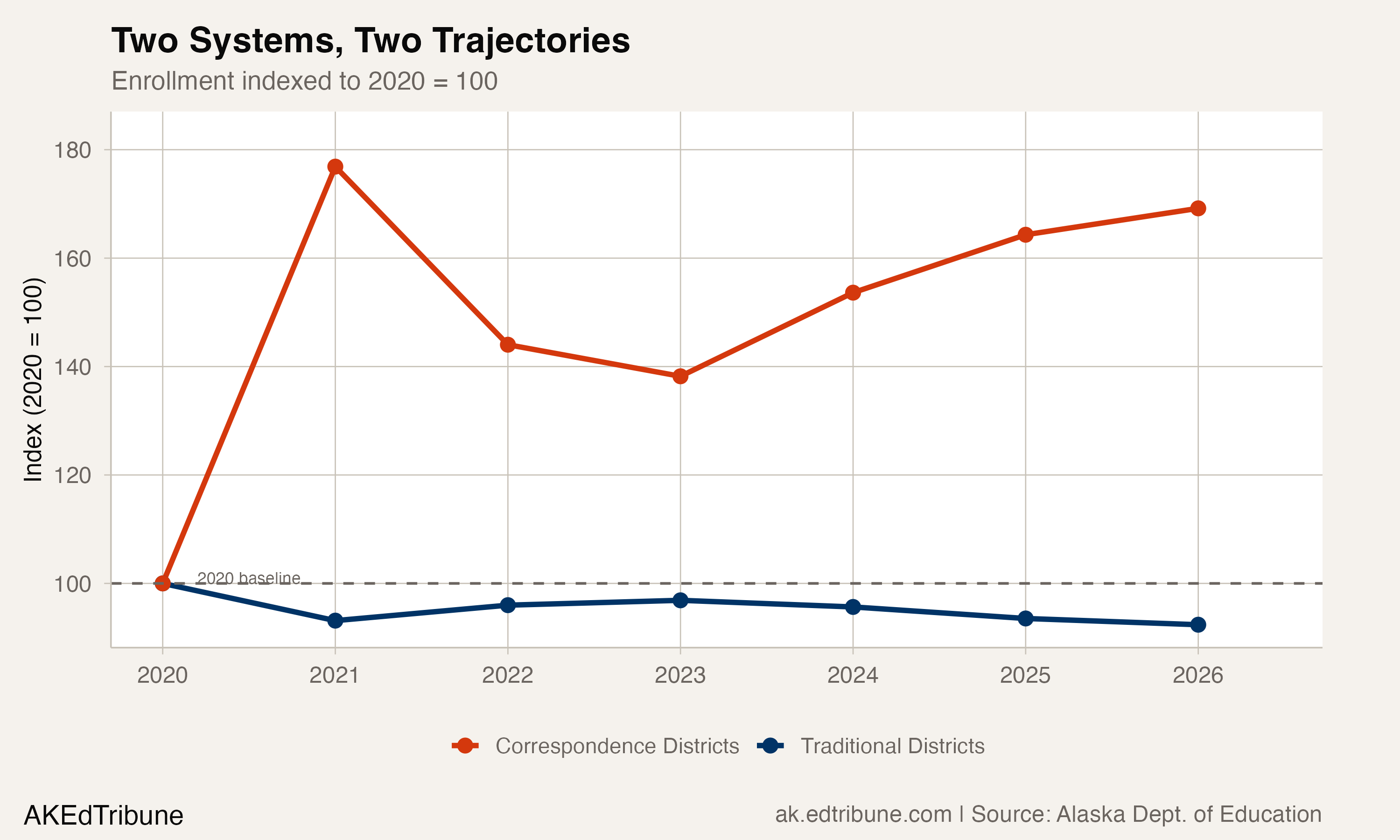
The divergence means the statewide number understates the traditional sector's crisis. Traditional district enrollment is down to 110,938 from 120,090 in 2020. Correspondence districts, which enrolled 6.6% of Alaska students before the pandemic, now account for 11.5%.
Galena City School District, population roughly 500, enrolls 8,279 students through IDEA. Nearly all of them live elsewhere. Yukon-Koyukuk doubled from 1,933 to 3,869 over the same period, almost entirely through its Raven correspondence program. These are not schools in the physical sense. They are funding conduits that allow families to direct a $2,700 annual allotment toward homeschool materials, lessons, and activities.
The legislature is actively debating whether correspondence students should receive the same per-pupil funding as brick-and-mortar students. The question carries billions of dollars in implications, but for the enrollment story, the key point is simpler: without correspondence growth, Alaska's net loss since 2020 would be 9,152, not 3,272.
Where the students disappeared
Anchorage alone accounts for 4,530 of the state's losses, more than the statewide net decline. Fairbanks North Star↗ET lost another 2,017, a 15.4% drop that prompted the district to close Midnight Sun, Pearl Creek, and Two Rivers Elementary in 2025. Together, Alaska's two largest urban districts lost 6,547 students. Correspondence growth in Galena, Yukon-Koyukuk, and Nenana offset 5,880 of that.
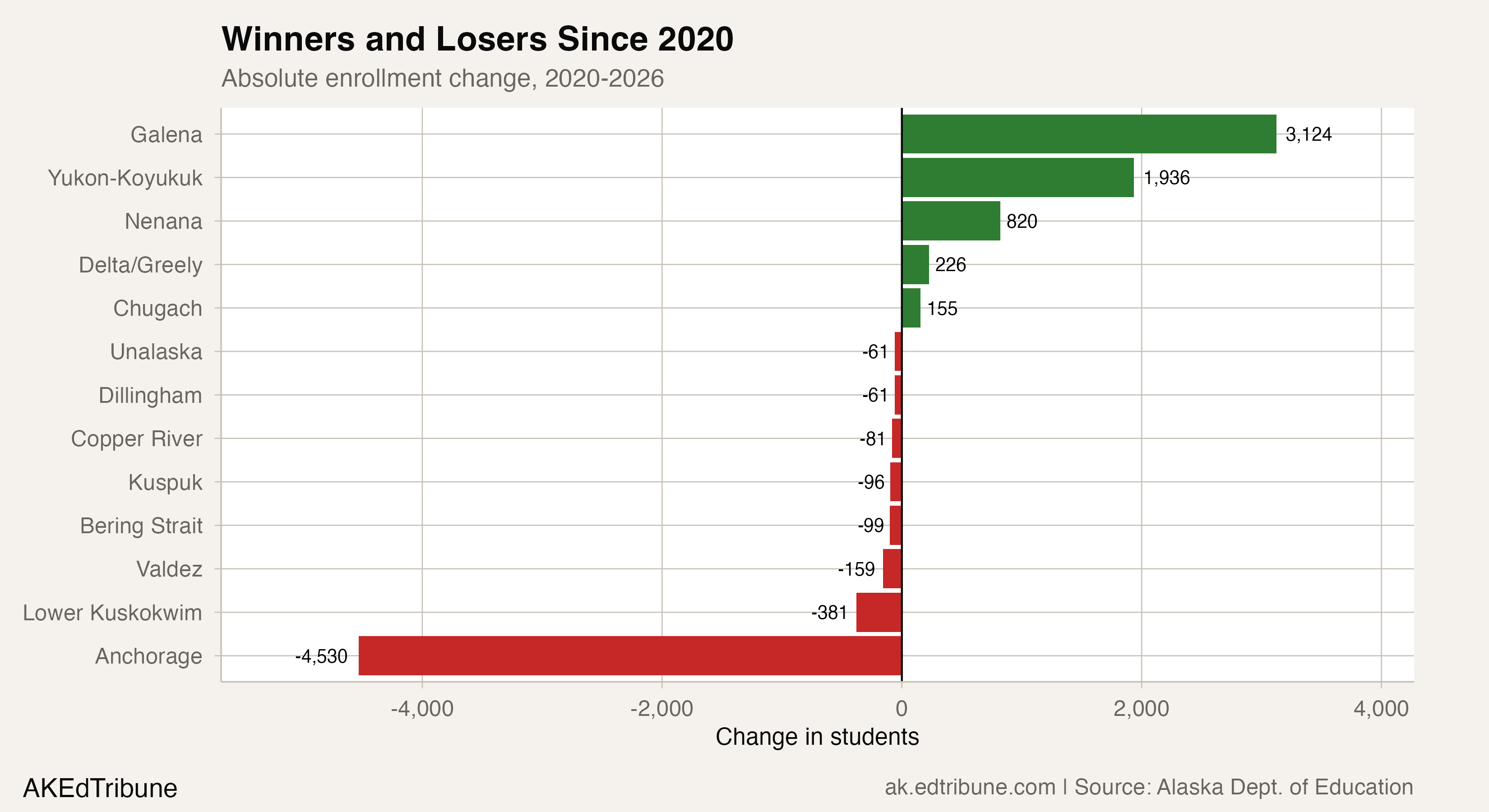
The losses are not confined to the cities. Lower Kuskokwim, the largest rural district in the Yukon-Kuskokwim Delta, lost 381 students (9.4%). Valdez lost 159 (23.2%). Kuspuk, a district of small villages along the Kuskokwim River, went from 368 to 272, a 26.1% decline.
Only 12 of 34 districts with comparable data from 2020 and 2026 have recovered to their pre-pandemic levels. Every one of the districts that gained, besides the three correspondence programs, is small: Delta/Greely (+226), Chugach (+155), Cordova (+33). Mat-Su↗ET, the state's second-largest traditional district and the one sitting in Alaska's fastest-growing borough, shows 19,903 in DEED's school-level data — a total that includes the Mat-Su Hybrid Learning Academy, a new virtual program with 1,114 students. Superintendent Randy Trani's district-level count is 18,912. Mat-Su dipped as low as 17,935 during COVID and has rebounded, though the DEED total and the district's own count tell different stories about how far.
Why the bleeding has not stopped
Alaska is in its 13th consecutive year of net outmigration, the longest such streak since 1945. In the most recent year, 1,740 more people left the state than moved in. The population still grew slightly, to 738,737, because births exceeded deaths by 3,389. But even that cushion is thinning: the state recorded its fewest births since the trans-Alaska pipeline was built, and the number of children under 17 fell 0.8% in a single year. There are now roughly 1,000 more 17-year-olds in Alaska than 4-year-olds.
The state Department of Labor projects the population will start declining steadily by 2050. For schools, the decline is already here.
The fiscal squeeze compounds the enrollment pressure. Last year's $700-per-student increase to the Base Student Allocation made headlines, but Mat-Su superintendent Randy Trani pointed out the math: it represented only a $20 actual boost over the prior year's one-time funding of $680 per student. Nearly 80% of Alaska school districts face deficits going into next year. Anchorage's $90 million gap led to the elimination of nearly 50 middle school teaching positions, the gifted education program, and bus transportation for athletes. An additional $42 million deficit is projected for 2027-28.
"The desperation is real. We cannot meet all of our students' needs at this point in time with the budget that we have been given." — Board Member Kelly Lessens, Anchorage Daily News, Feb. 25, 2026
What Anchorage's vote means for Alaska
Anchorage enrolled 35.2% of Alaska's students in 2020. It now enrolls 32.5%. The district's 10.0% decline since the pandemic is more than a local problem. It functions as a leading indicator for a state where the school-age population is shrinking, outmigration shows no sign of reversing, and the primary growth sector, correspondence programs, does not require school buildings, bus routes, or cafeteria staff.
State officials project Alaska schools will lose another 1,500 students next year. If that materializes, enrollment will fall below 124,000 for the first time in recorded state data. The question facing districts is not whether the decline will continue but how many more buildings will be too large for the students who remain, and at what point the fixed costs of heating, maintaining, and staffing rural schools in a subarctic climate exceed what a shrinking student body can justify.
Anchorage voters will decide on Proposition 9 in April, an $11.8 million funding measure that would rehire 80 teachers and cut the class-size increase in half. It is a temporary fix for a structural problem. The recovery that everyone watched for in 2022 and 2023 turned out to be a pause on the way down.
Detailed code that reproduces the analysis and figures in this article is available exclusively to EdTribune subscribers.
Discussion
Sign in to join the discussion.
Loading comments...