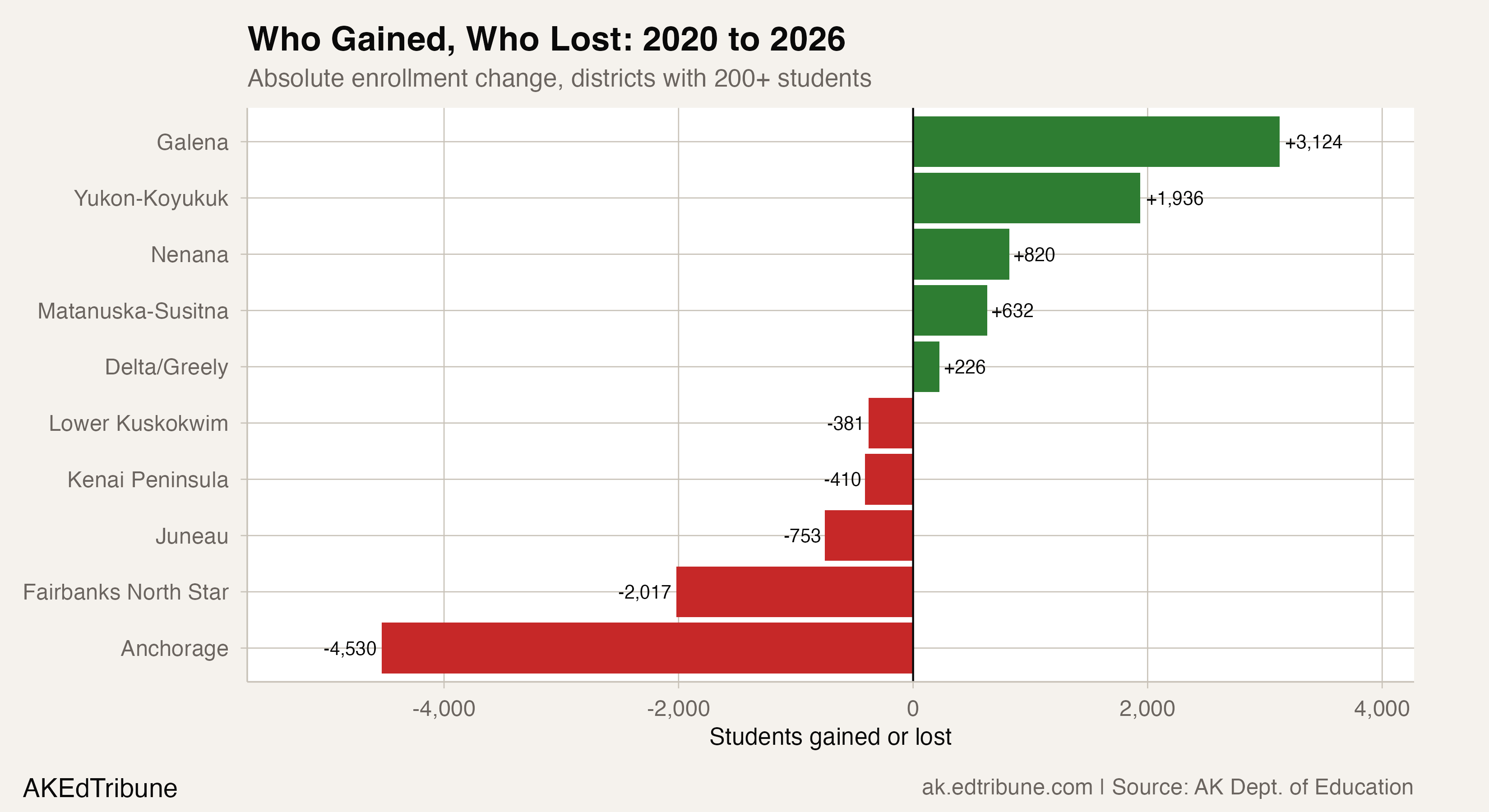
Anchorage↗ET lost 4,530 students in seven years. Fairbanks↗ET lost 2,017. Juneau↗ET lost 753. Together, Alaska's three largest traditional school districts shed more students than the entire state did, because a handful of fast-growing correspondence programs absorbed enough newcomers to partially offset the bleeding.
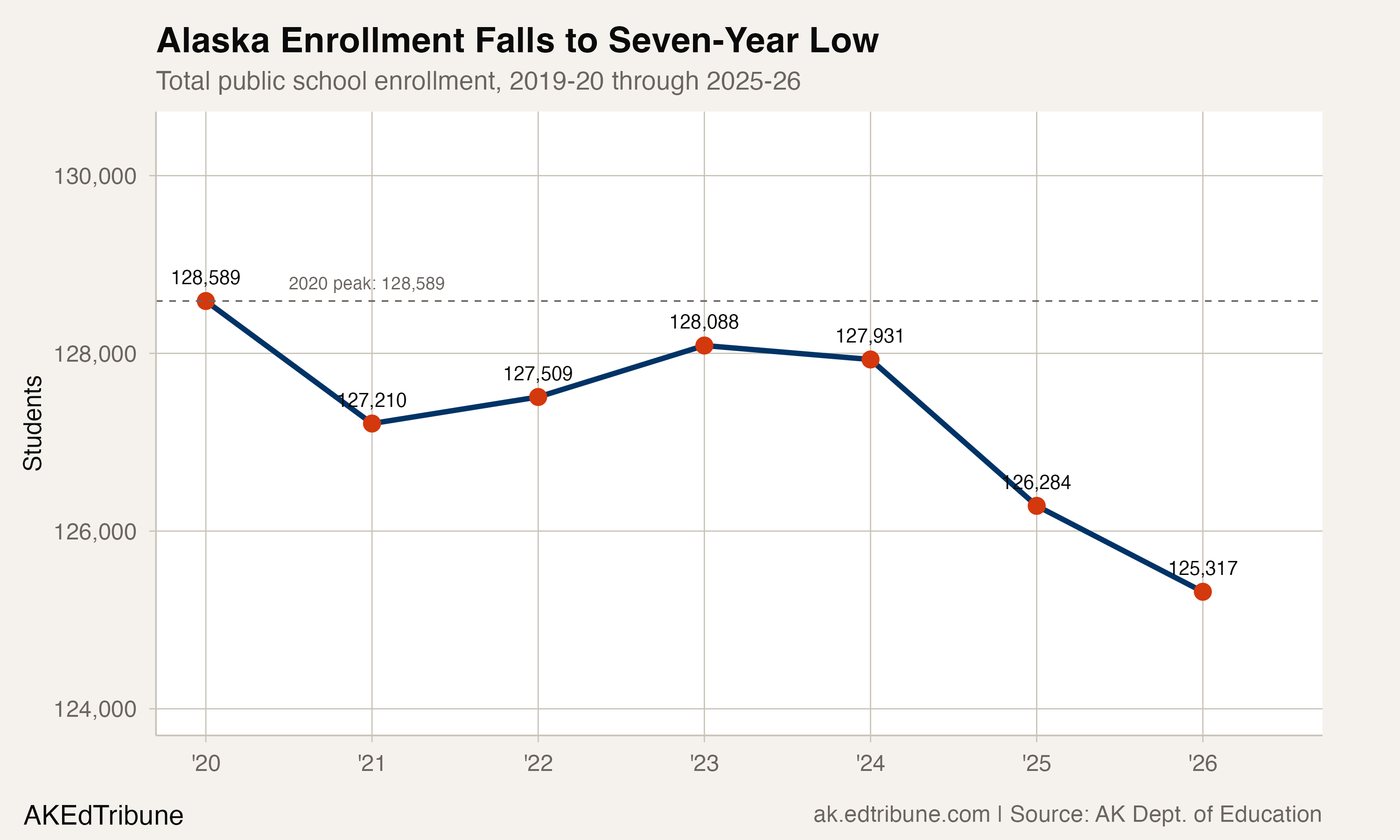
The net result: 125,317 students enrolled in Alaska public schools in 2025-26, the lowest total in the seven-year dataset. The state has lost 3,272 students, or 2.5%, from its 2020 peak of 128,589.
A recovery that did not hold
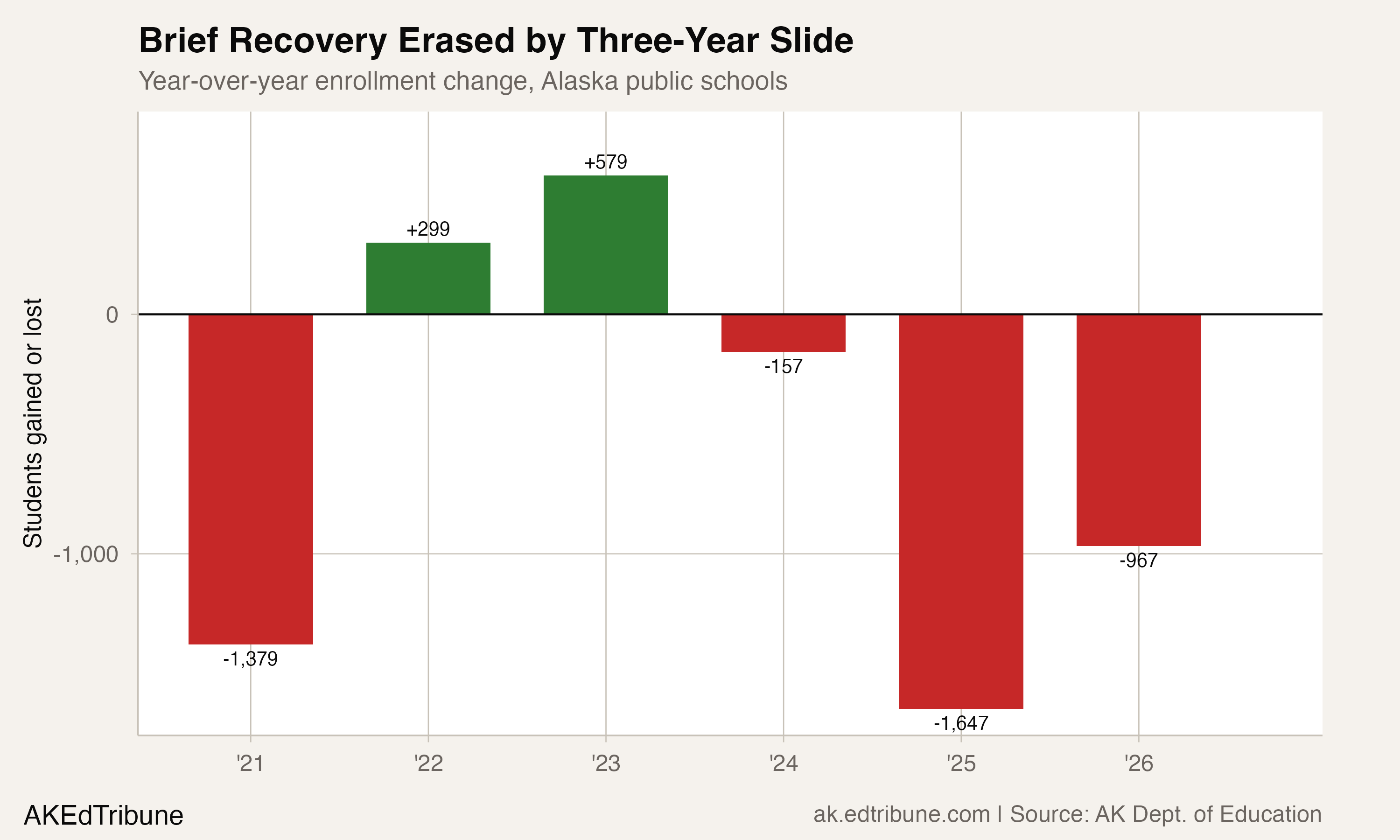
The trajectory is not a clean downward line. Alaska lost 1,379 students in 2020-21, likely a COVID artifact, then clawed back 878 over the next two years. By 2022-23, enrollment stood at 128,088, within 500 of the 2020 peak.
Then it reversed. The state lost 157 students in 2023-24, 1,647 in 2024-25, and 967 in 2025-26. The three-year slide totals 2,771 students and has erased the entire post-COVID recovery plus an additional 1,893.
At the compound annual growth rate of the past six years (-0.43%), Alaska would fall below 120,000 students by the early 2030s. State budget documents presented to lawmakers in February 2026 project a further loss of 1,500 students next year, roughly 1% of enrollment.
Anchorage's loss exceeds the state's
The statewide number understates what is happening in Alaska's urban core. Anchorage, which enrolls 32.5% of the state's students, lost 4,530 students since 2020, a 10.0% decline. That loss alone is 138% of the state's total decline, meaning the rest of Alaska, on net, grew.
But that growth is misleading. It comes almost entirely from correspondence programs. Galena City School District, home to IDEA (Interior Distance Education of Alaska), grew from 5,155 to 8,279 students (+60.6%). Yukon-Koyukuk, which houses the Raven correspondence program, doubled from 1,933 to 3,869 (+100.2%). Together, those two districts added 5,060 students. Strip out correspondence growth, and the traditional system lost roughly 8,300 students statewide.
Fairbanks North Star Borough lost 2,017 students (-15.4%). Juneau lost 753 (-16.5%). Kenai Peninsula lost 410 (-4.8%). Every one of Alaska's five largest traditional districts is at an all-time low.
Half the state at record lows
Twenty-nine of Alaska's 53 districts are at their lowest enrollment on record. The list spans geography and scale: from Anchorage (40,688 students) to Hydaburg (62 students), from the North Slope Borough to the Aleutians East.
Thirteen districts are at all-time highs. The largest gains come from correspondence providers: Nenana↗ET (CyberLynx, 2,231 students), Delta/Greely↗ET (1,007), Yupiit↗ET (523). A few small traditional districts also reached highs, including Petersburg↗ET (473 students), Kake (112), and Unalaska (351).
Matanuska-Susitna Borough↗ET, Alaska's second-largest district, shows 19,903 students in DEED's school-level data — but there is an important distinction between school-level and district-level counts. DEED's figure includes the Mat-Su Hybrid Learning Academy, a new virtual program that launched in 2025-26 with 1,114 students. Superintendent Randy Trani's district-level count is 18,912, a decline from the prior year. The Mat-Su Borough led Alaska in population growth with 1,696 new residents in 2024-25, but the borough's population growth has not translated into traditional classroom gains. Mat-Su faces a $22.5 million budget shortfall and is considering school closures.
Why fewer students
The most direct driver is demographic. Alaska is in its 13th consecutive year of net outmigration, the longest such streak since 1945. Between 2024 and 2025, 1,740 more people left the state than arrived. The state's population has stayed roughly flat only because births still outnumber deaths, but that margin is narrowing. State demographer Eric Sandberg warned in March 2026 that Alaska's population could begin declining outright: "As the gap continues to close and if we continue our outmigration, we would wind up with a population loss."
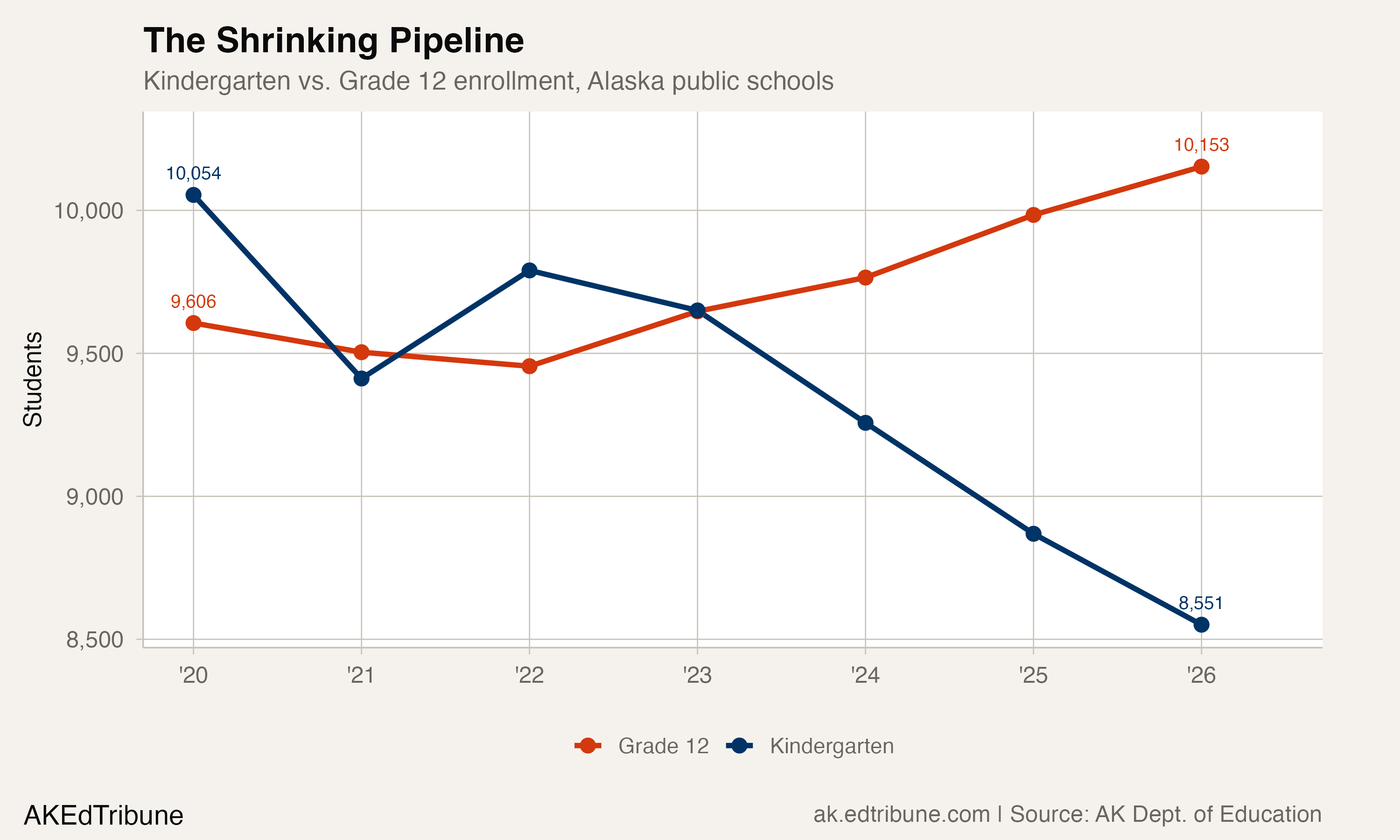
Birth numbers have fallen to their lowest level since the trans-Alaska pipeline era. Alaska's fertility rate of 1.9 children per woman remains the third-highest nationally, but it sits below the 2.1 replacement rate. The kindergarten data makes this visible in schools: Alaska enrolled 10,054 kindergartners in 2020 and 8,551 in 2026, a 14.9% decline. Grade 12, meanwhile, grew from 9,606 to 10,153, a 5.7% increase. The kindergarten-to-twelfth-grade ratio has fallen from 104.7 to 84.2, meaning for every 100 seniors graduating, only 84 kindergartners are entering the pipeline.
A second factor is cost of living. Brian Holst of the Juneau Economic Development Council told KTOO that "people are choosing to live elsewhere...because for too many families the price of a home and the cost of being here is just too much." Southeast Alaska, where Juneau, Sitka, and Ketchikan are all at enrollment lows, is projected to lose 17% of its population by 2050.
A competing explanation is that some families are not leaving Alaska but leaving public schools. DEED Deputy Commissioner Karen Morrison noted that families are transitioning to "independent homeschooling, private schools, out-of-state virtual academies, or relocating from Alaska entirely." The state does not publish homeschool enrollment data, so this channel remains unquantified.
What this means for school buildings
The fiscal consequences are already arriving. Anchorage's school board voted 4-3 in February to close three elementary schools, Fire Lake, Lake Otis, and Campbell STEM, and to eliminate 389 full-time positions.
"Our current footprint and programming no longer aligns with our enrollment and available revenues." — Anchorage Superintendent Jharrett Bryantt, Alaska's News Source, Feb. 2026
Anchorage is not alone. Nearly 80% of Alaska school districts face deficits, according to the Alaska Council of School Administrators. Fairbanks closed three schools in 2025. Kodiak is cutting $1 million. Statewide, 51 schools have closed over the past decade while only 32 have opened, a net loss of 19 buildings.
The legislature raised the Base Student Allocation by $700 per student last year, bringing it to $6,660. But Mat-Su Superintendent Randy Trani clarified that the effective increase was far smaller: "The actual boost to the BSA was about $20" because the prior year had included $680 in one-time funding that did not repeat. A new bill proposes an additional $630 increase, but even if it passes, districts that are losing students will continue to lose per-pupil revenue with it.
The pipeline question
The kindergarten decline is the number to watch. Every grade from kindergarten through fifth lost enrollment between 2020 and 2026. First grade fell 10.3%. Second grade fell 8.5%. These smaller cohorts will ripple upward through middle and high school over the next decade, meaning the current enrollment floor is not the floor.
Meanwhile, state demographer David Howell noted that "there's about 1,000 more 17-year-olds than there are 4-year-olds" in Alaska. The generation entering schools is structurally smaller than the one leaving. For a state where per-pupil funding follows students and fixed costs do not shrink with enrollment, the math gets harder every year.
Detailed code that reproduces the analysis and figures in this article is available exclusively to EdTribune subscribers.
Discussion
Sign in to join the discussion.
Loading comments...