Fire Lake Elementary, Lake Otis Elementary, Campbell STEM Elementary. Three Anchorage↗ET schools that will lock their doors after this school year, casualties of a district staring down a $90 million deficit and a kindergarten class that has shrunk by a fifth since 2020. Anchorage is not unique. Across Alaska, the bottom of the student pipeline is collapsing while the top keeps expanding, and the math points in one direction.
In 2025-26, Alaska enrolled 8,551 kindergartners and 10,153 seniors. That ratio, 84 kindergartners for every 100 12th graders, means the state's schools are graduating students far faster than they are replacing them. Six years ago, kindergarten outnumbered 12th grade by nearly 450 students. The lines have crossed, and the gap is widening.
The scissor pattern
The divergence is stark. Kindergarten enrollment fell from 10,054 in 2019-20 to 8,551 in 2025-26, a loss of 1,503 students, or 14.9%. Over the same period, 12th grade rose from 9,606 to 10,153, a gain of 547 students, or 5.7%, reaching its highest level in the seven-year dataset.
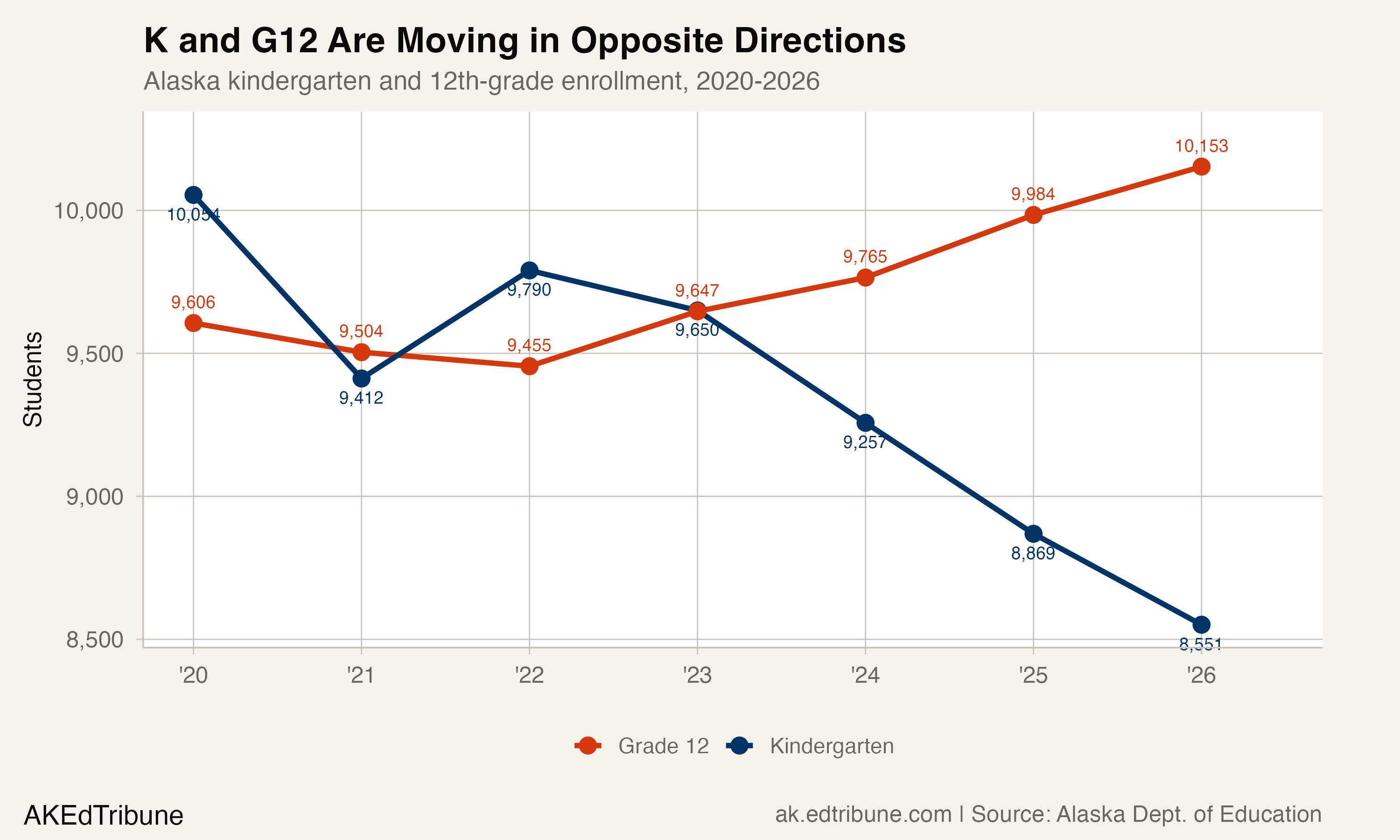
The crossover happened in 2024, when 12th grade first surpassed kindergarten. It has not reversed. The K-to-G12 ratio dropped from 104.7 in 2020 to 84.2 in 2026, a 20-point swing in six years.
Kindergarten is not the only grade shrinking. Every grade from pre-K through 8th lost enrollment over this period. The damage is heaviest at the entry points: kindergarten fell 14.9%, first grade fell 10.3%, and pre-K fell 9.9%. But the losses fade as you move up the grade ladder, and by 9th grade, the numbers flip to gains.
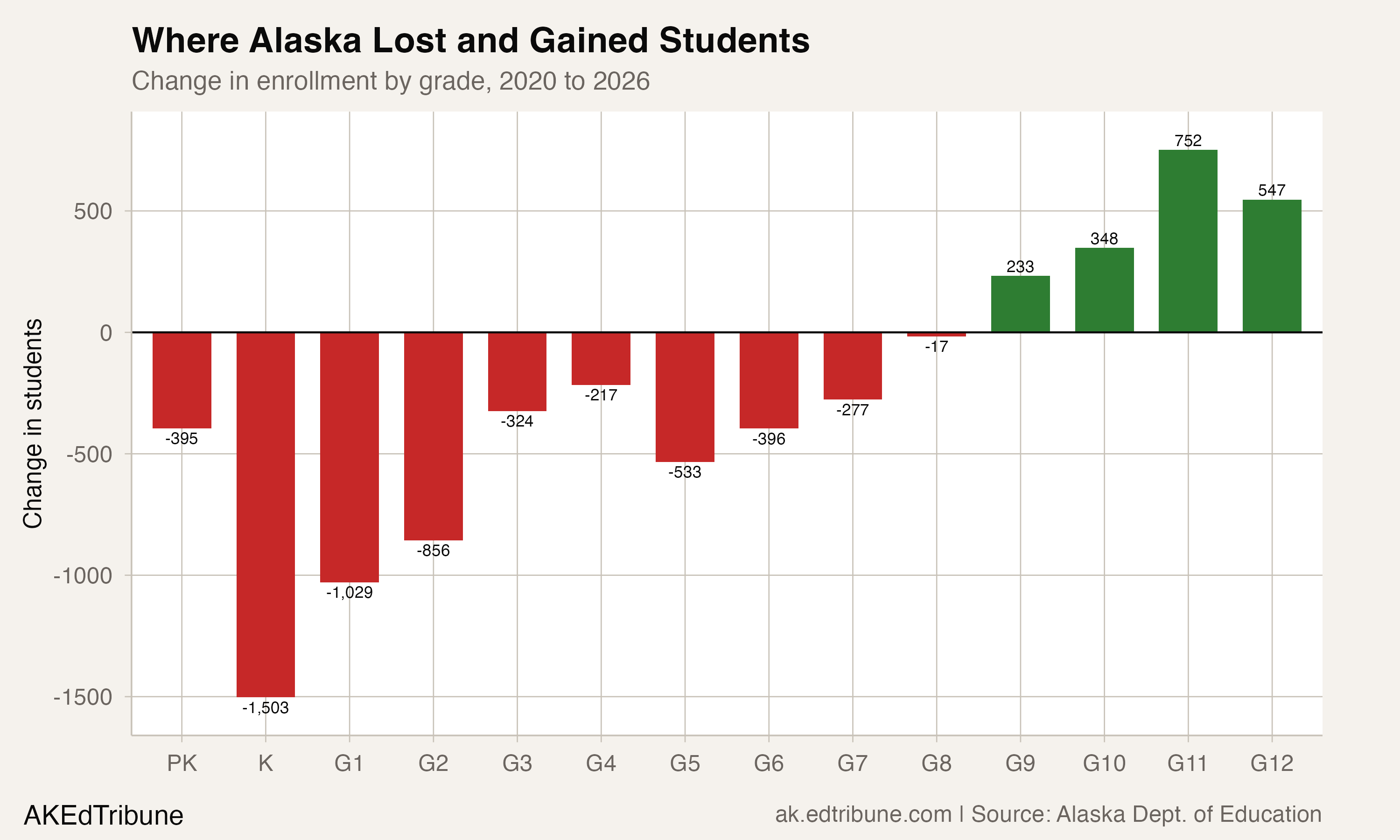
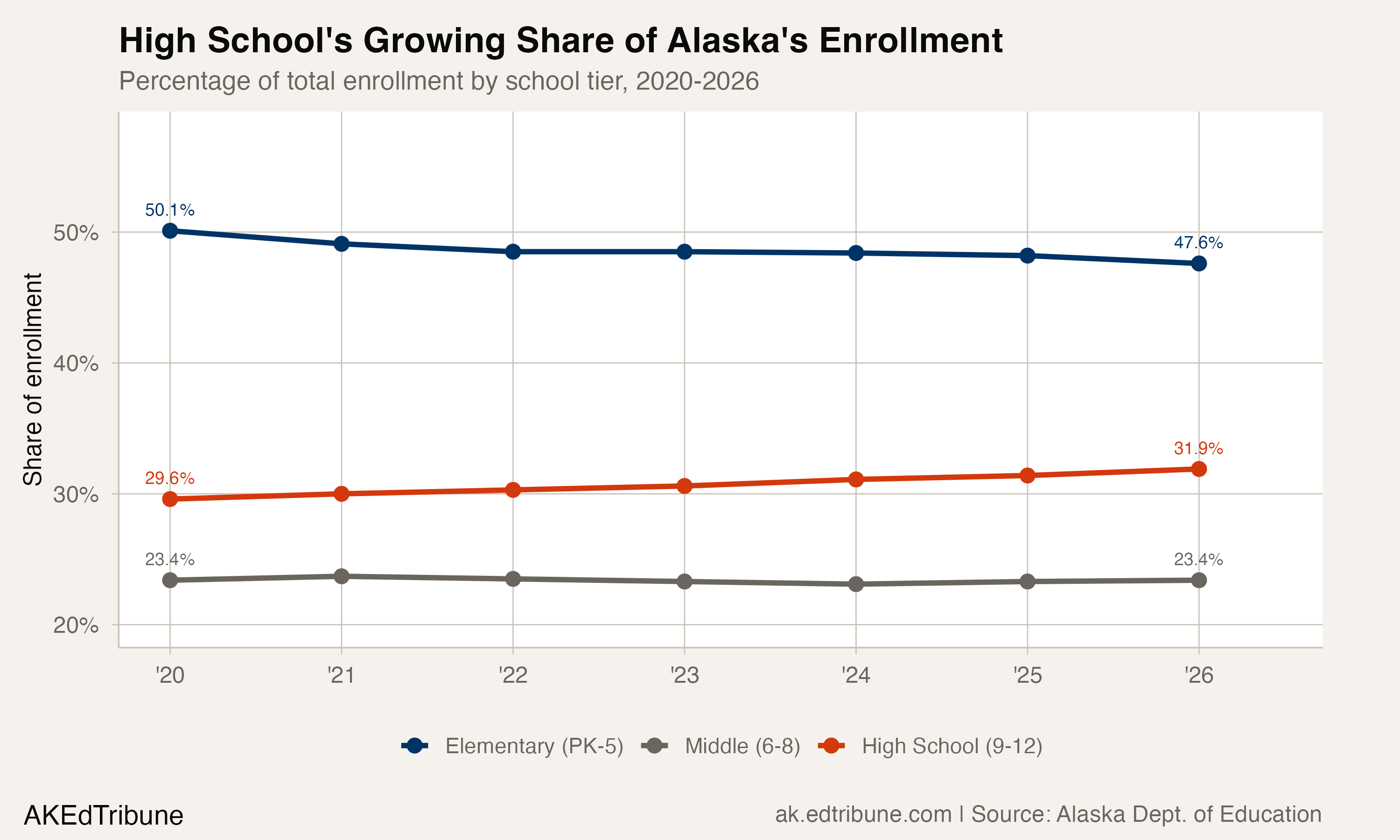
The result is a structural rebalancing. Elementary enrollment (PK through 5th grade) dropped 4,857 students, or 7.5%, from 64,470 to 59,613. High school enrollment (9th through 12th) grew by 1,880, or 4.9%, from 38,051 to 39,931. High school's share of total enrollment climbed from 29.6% to 31.9%.
Fewer babies, fewer kindergartners
The pipeline inversion has a straightforward demographic driver. Alaska's fertility rate has fallen from 2.3 children per woman in 2010 to 1.9 in 2024, below the 2.1 replacement threshold. The state recorded 8,950 births in 2024, down from 9,031 in 2023, extending a five-year streak of annual declines. Today's kindergartners were born in 2019 or 2020, years when Alaska births were already falling.
David Howell, the state demographer, has quantified the gap bluntly: there are roughly 1,000 more 17-year-olds than 4-year-olds in Alaska right now. That age structure means the kindergarten pipeline will not refill anytime soon. Birth rates have reached their lowest levels since the trans-Alaska pipeline was built, and demographers project the state's population will begin declining steadily by 2050.
Outmigration compounds the birth rate decline. Alaska is in its 13th consecutive year of negative net migration, with 1,740 more people leaving than arriving in 2025. The number of children from birth to age 17 fell 0.8% in a single year. The combination of fewer births and continued outmigration is shrinking the school-age population faster than the state as a whole.
Where the losses hit hardest
The three largest traditional districts illustrate the pattern at different scales.
Anchorage lost 757 kindergartners between 2020 and 2026, a 21.3% decline, from 3,559 to 2,802. Its 12th-grade class also shrank, by 168, but far less steeply. The district now enrolls 40,688 students total, down from 45,218 in 2020. Superintendent Jharrett Bryantt told the school board: "ASD faces a $90 million structural deficit going into next fiscal year." The board approved a plan to close three elementary schools and cut 389 positions, including 50 teachers, 9 counselors, and 10 principals.
"A strong public school system is the foundation of our economy." — Anchorage Mayor Suzanne LaFrance, Feb. 2026
Fairbanks North Star Borough↗ET saw the sharpest kindergarten decline among large districts: 31.4%, from 1,093 to 750. The district lost 589 students in a single year in 2024-25 and has already closed three schools since 2025. A net 165 students transferred to correspondence programs outside the district that year alone.
Mat-Su Borough↗ET, the only large traditional district still growing overall, is not immune to the kindergarten trend. Its K enrollment fell from 1,442 to 1,375, a 4.6% decline, even as the borough added more residents than any other in the state. The district still faces a $22.5 million shortfall and is considering three school closures of its own.
The funding squeeze inside the squeeze
Declining kindergarten enrollment is a slow-moving fiscal crisis for districts that fund staffing, transportation, and facilities based on headcount. Alaska's Base Student Allocation stands at $6,660 per student, and each lost kindergartner removes that amount from a district's formula. When Mat-Su Superintendent Randy Trani told the legislature that last year's $700 BSA increase amounted to "about $20" in actual new funding, because it replaced one-time allocations rather than adding to them, he was describing a system where flat funding and falling enrollment are compounding each other.
"We don't have any fat to cut." — Eric Morrison, Southeast Island School District superintendent, March 2026
Nearly 80% of Alaska's school districts are running deficits. Anchorage, Fairbanks, Kenai, Juneau, Kodiak, and Mat-Su all report multimillion-dollar shortfalls. Elementary schools, designed for cohort sizes that no longer exist, are the first buildings on the closure list. Districts across the state have closed or are considering closing schools, including Kodiak (North Star Elementary), Fairbanks (three elementary schools closed after a five-school proposal), and Anchorage (three approved for closure).
Kindergarten losses, year by year
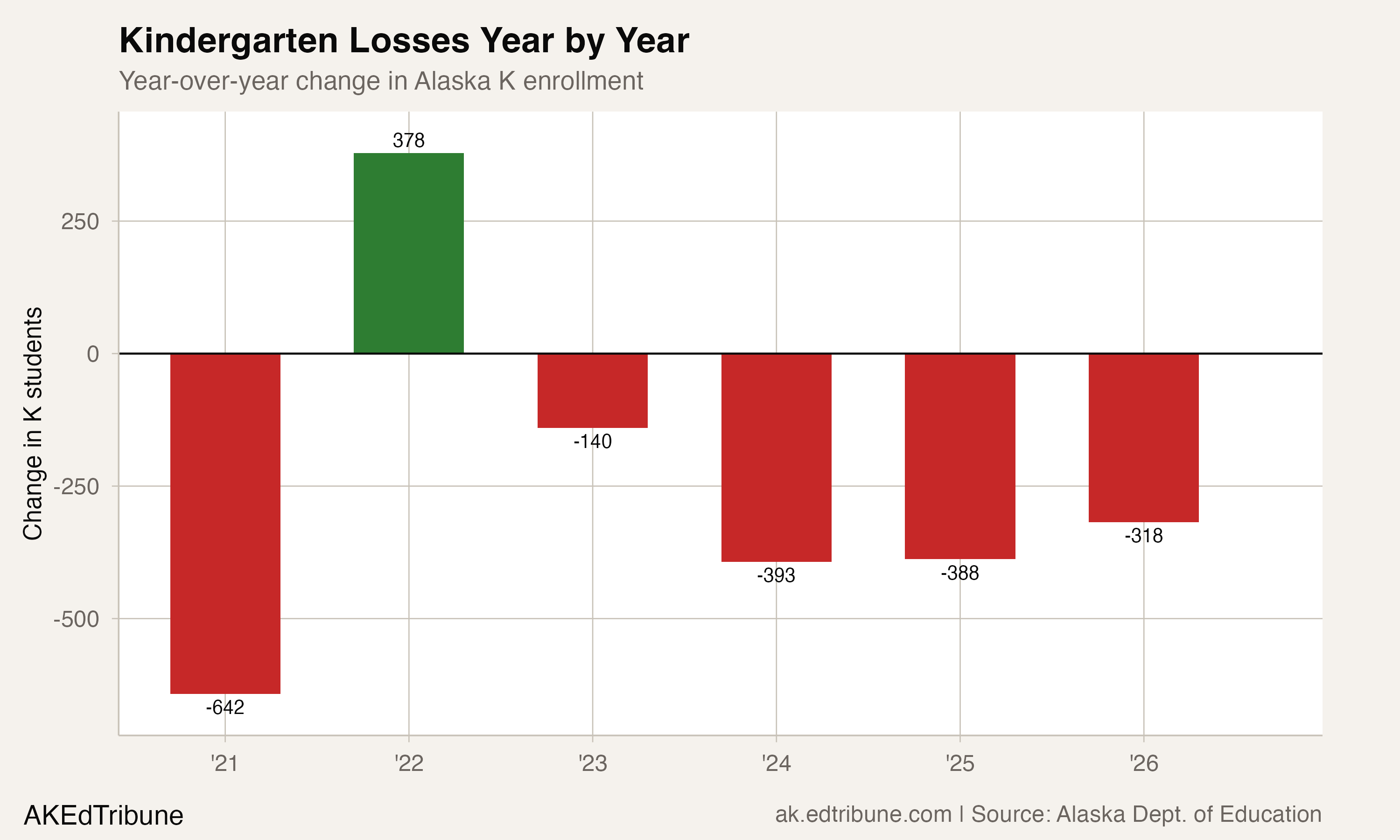
The kindergarten decline has not been a smooth glide. After a steep COVID-era drop of 642 students in 2021, there was a brief bounce of 378 in 2022. Since then, the losses have resumed at a pace of 300 to 400 per year. The last three years alone have erased 1,099 kindergartners from the system.
Correspondence and homeschool programs may be absorbing some would-be kindergartners, though the data cannot distinguish between families who never enroll and those who enroll elsewhere. Fairbanks lost a net 165 students to outside correspondence programs in a single year. Statewide, nearly one-fifth of public school students now learn through correspondence programs, and over the past 25 years, 10,000 students have moved from neighborhood schools to correspondence.
Whether declining kindergarten reflects fewer 5-year-olds in Alaska or more families choosing alternatives to traditional schools, the effect on brick-and-mortar elementary buildings is the same: classrooms designed for 25 students serving 18.
What the next six years look like
The 12th-grade bulge is temporary. Today's large senior classes were born during Alaska's higher birth years. Once they graduate, they will be replaced by the smaller cohorts now moving through elementary school. The 8,551 kindergartners of 2026 will, roughly speaking, become the 12th-grade class of 2038. When that happens, both ends of the pipeline will be small.
The middle of the pipeline offers no relief. Middle school enrollment (6th through 8th) held roughly steady over this period, declining just 2.3%, from 30,056 to 29,366. But middle schoolers in 2026 were elementary students in 2020. The steep elementary losses of the past six years have not yet reached middle school in full force.
The question facing Alaska's education planners is not whether enrollment will continue falling, but how fast. The school-age population is shrinking, births are declining, and outmigration persists. Anchorage School Board member Andy Holleman acknowledged the bind: "There is no good solution here." For districts weighing whether to close an elementary school now or in three years, the kindergarten numbers offer an answer: the cohorts entering the building are not going to get larger.
Detailed code that reproduces the analysis and figures in this article is available exclusively to EdTribune subscribers.
Discussion
Sign in to join the discussion.
Loading comments...