In most states, the transition from 11th to 12th grade is where the pipeline leaks. Nationally, cohorts lose 3% to 5% of their students between junior and senior year to dropouts, transfers, and early departures. Alaska does the opposite. In 2025-26, the state enrolled 10,153 seniors, 248 more than the 9,905 juniors from the year before, a 2.5% gain at a transition that everywhere else means loss.
This is not a one-year anomaly. In every year of available data, from 2020-21 through 2025-26, Alaska's 12th grade class has been larger than the previous year's 11th grade class. The gains range from 124 students to 248. Six consecutive years of growth at a point in the pipeline where students are supposed to disappear.
The explanation sits in a school system that most Alaskans interact with but few outside the state fully understand.
The cohort that swells
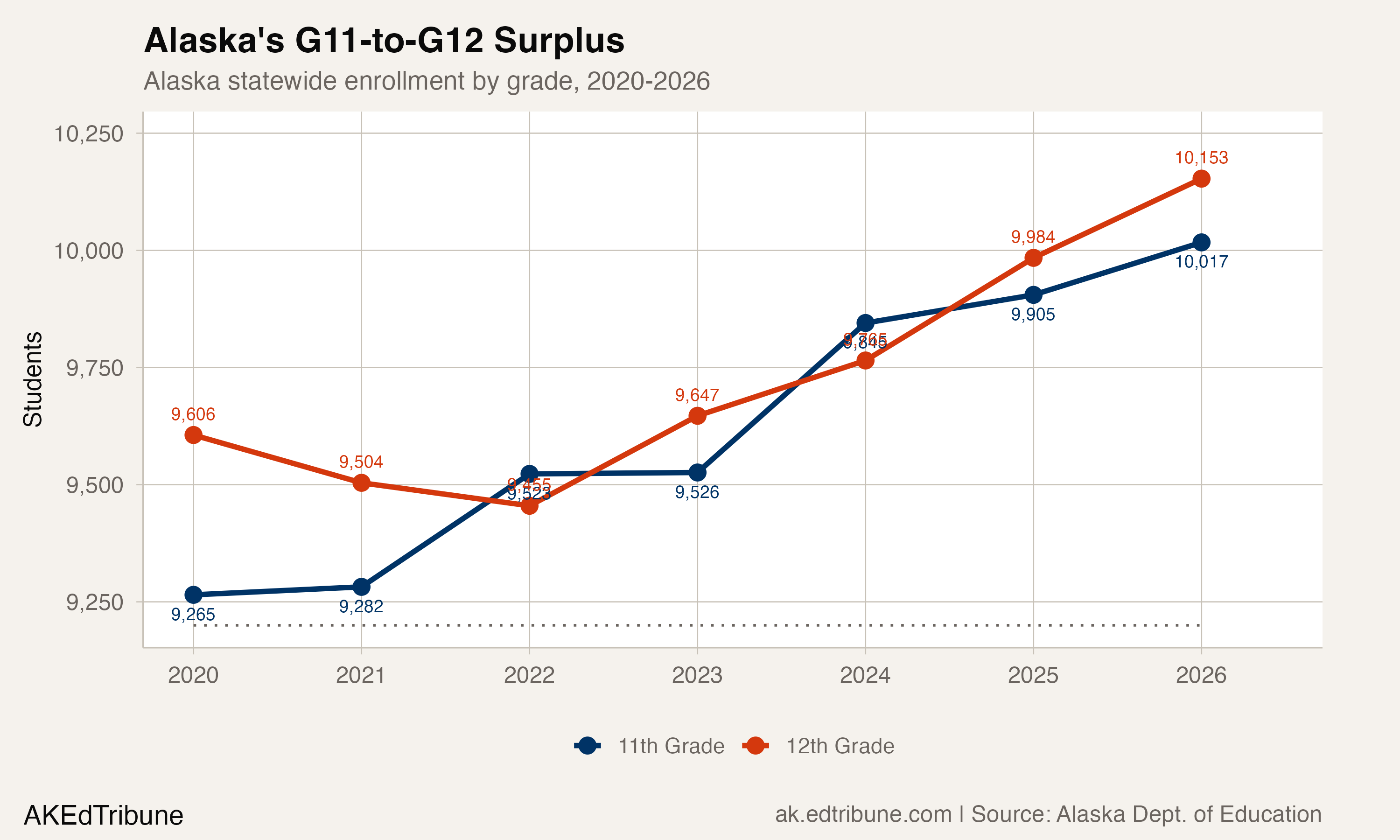
Track a cohort of Alaska juniors forward one year and the class gets bigger, not smaller. The 9,905 students enrolled as 11th graders in 2024-25 became 10,153 12th graders in 2025-26: 248 more students. That is the largest single-year cohort gain in the dataset, but every year follows the same pattern. The smallest gain was 124 students (2022-23), the largest 248 (2025-26), and the average across all six tracked cohorts is 194.
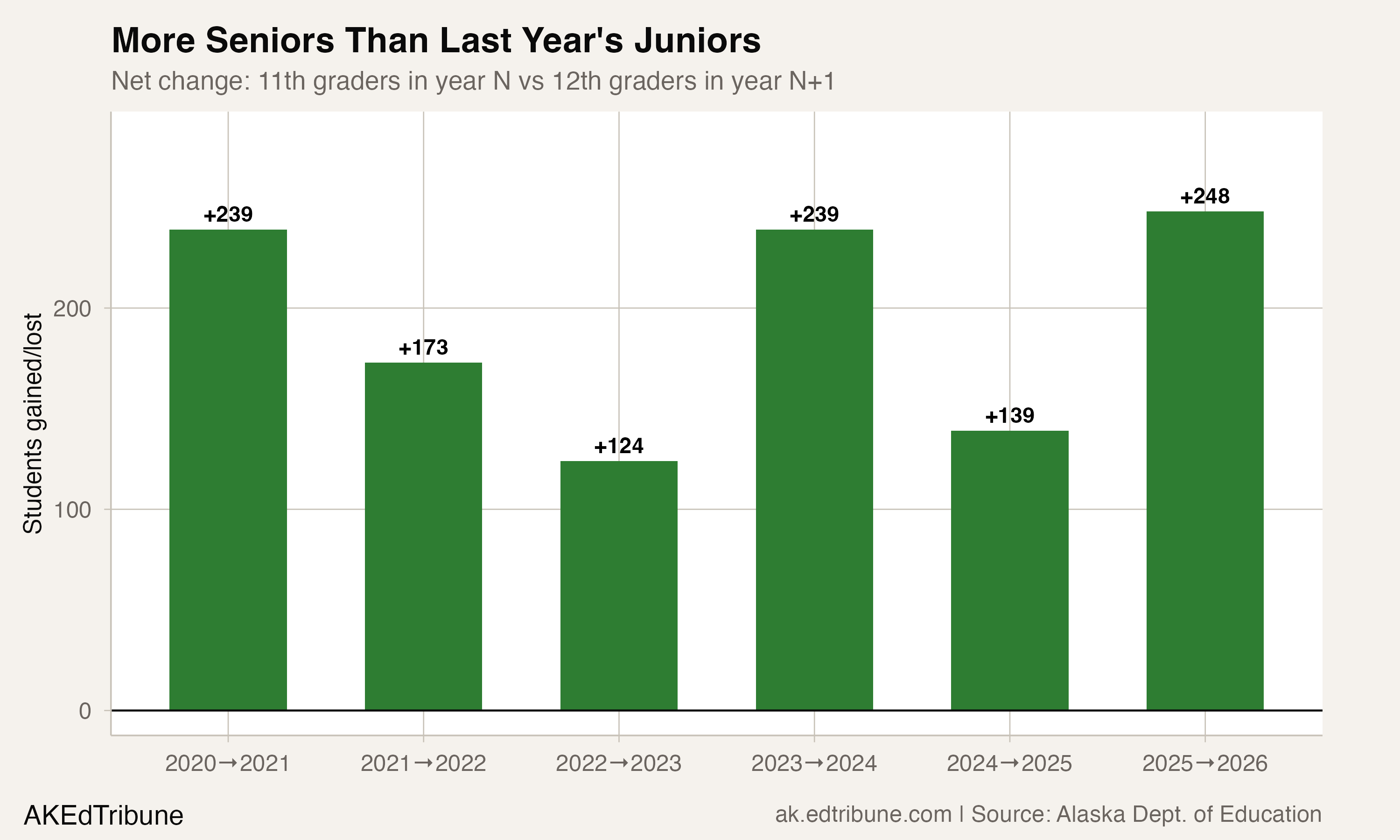
The 12th grade class hit 10,153 in 2025-26, an all-time high within the seven-year window. It has grown 5.7% since 2019-20 while overall state enrollment fell 2.5%, from 128,589 to 125,317. Whatever is producing these seniors is working against the statewide tide.
Correspondence schools: the re-entry door
Galena City School District↗ET is a village of roughly 500 people on the Yukon River, 270 miles west of Fairbanks. Its school district enrolls 8,279 students. The math only works because Galena is home to IDEA, the Interior Distance Education of Alaska, the single largest school in the state. IDEA is a public correspondence program, open to any Alaska family, that started in 1997 with a small group of families and now serves more than 8,000 students statewide.
In 2025-26, Galena's district had 598 juniors and 747 seniors, a 24.9% surplus. That surplus, 149 students, accounts for 60% of the entire statewide G11-to-G12 cohort gain. IDEA is not the only program producing this pattern. Yukon-Koyukuk School District↗ET, home to Raven School, enrolled 368 juniors and 466 seniors, a 26.6% surplus. Together, IDEA and Raven added 247 seniors beyond their junior classes, virtually the entire statewide gain.
Correspondence programs are the re-entry door. Students who leave brick-and-mortar high schools can enroll in these programs to complete remaining credits at their own pace. A student who dropped out at 16 can re-enroll at 18 through IDEA or Raven, show up in the enrollment count as a 12th grader, and finish without returning to a physical classroom. The data cannot distinguish a 5th-year senior from a returning dropout from a transfer student, but the pattern is consistent: correspondence districts show enormous G12 surpluses, while brick-and-mortar districts do not.
Across all identified correspondence campuses, roughly 1,800 students were enrolled as seniors in 2025-26, accounting for about 18% of all 12th graders in the state.
The brick-and-mortar pattern is different
Anchorage School District↗ET, with 3,180 juniors and 3,330 seniors in 2025-26, shows a 4.7% surplus. That gap is consistent, averaging 7.2% across all seven years, suggesting Anchorage's correspondence programs (PACE and Family Partnership, both housed within the district) contribute to the surplus even in the state's largest urban district.
Not every correspondence program inflates the senior class. Nenana City School District↗ET, home to CyberLynx, shows the inverse: 350 juniors and only 200 seniors in 2025-26, a deficit of 42.9%. CyberLynx appears to function differently from IDEA and Raven, losing students rather than gaining them at the senior transition.
The districts that consistently lose seniors are the ones you would expect: Fairbanks North Star Borough, the state's second-largest district, averages an 18.0% G12 deficit relative to G11. Mat-Su Borough averages a 4.2% deficit. These are the districts whose departing students land in correspondence programs and reappear in someone else's senior class.
The full grade-level map
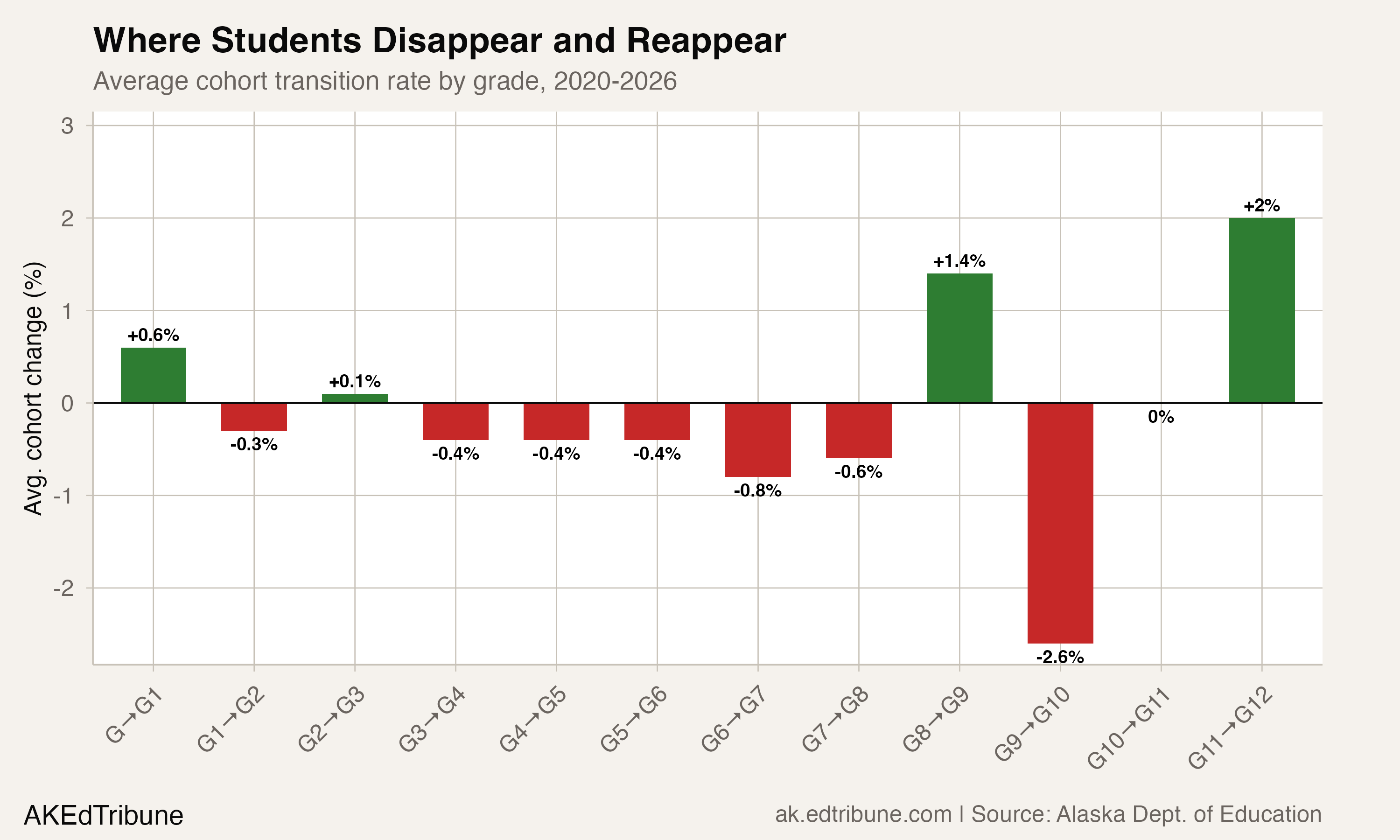
The G11-to-G12 surplus is not the only unusual transition in Alaska's pipeline. The 8th-to-9th grade step averages a +1.4% cohort gain, also anomalous. Students entering high school show up in larger numbers than their 8th grade cohorts would predict, likely because some correspondence students enroll or re-enroll at the start of high school.
Then comes the sharpest loss: 9th-to-10th grade averages a -2.6% cohort decline, the steepest attrition at any grade level. The pattern suggests a cycle: students enter the system at 9th grade, some leave by 10th, and then return at 12th to finish.
Between those extremes, the middle grades drift slowly downward, with most transitions losing 0.3% to 0.8% per step. The system leaks slowly through elementary and middle school, gains at 9th, hemorrhages at 10th, stabilizes at 11th, and then surges at 12th.
$2,700 per student, and a legislative fight
Correspondence programs operate on a specific funding model. Each student receives a $2,700 annual allotment for educational materials, classes, and activities. Roughly 16,000 of the state's 24,000-plus correspondence students are enrolled in programs outside their home districts, meaning the funding follows them to places like Galena and Yukon-Koyukuk rather than flowing to the district where the student lives.
Senate Bill 277, currently before the Alaska Legislature, would change that. The bill would route correspondence funding through students' home districts first, which could then retain a percentage for administrative costs.
Galena Superintendent Jason Johnson called the bill an "existential threat" to correspondence programs:
"Section 7 of the bill would close statewide correspondence programs, including IDEA, as the district of residence would receive all funding for the student; statewide correspondence programs like ours would receive zero funding." Source: Alaska Watchman, March 2026
CyberLynx Superintendent Patrick Manning echoed the concern, warning that statewide correspondence programs would "lose essential funding needed to operate."
The fiscal stakes extend beyond the allotment itself. Correspondence programs bring revenue and employment into small, remote districts. Without IDEA, Galena's district would serve roughly 270 students instead of 8,279. The program is the economic anchor of the village.
What the data cannot say
The enrollment snapshot counts students at a point in time. It does not reveal whether a given 12th grader is 17 or 22, whether they left and came back, or whether they are in their first or third year of senior coursework. Research published in the Journal of School Choice found that Alaska correspondence students had "significantly lower 4- and 5-year cohort graduation rates" than students in traditional public schools, even as correspondence enrollment steadily increased. The surplus may mean more students are attempting to finish, not that more are succeeding.
Alaska's statewide graduation rate was 79.9% in 2024-25, below the national average. The senior surplus and the below-average graduation rate can coexist if a substantial share of those additional 12th graders take more than one year to finish, or never do.
The pipeline narrows from the bottom
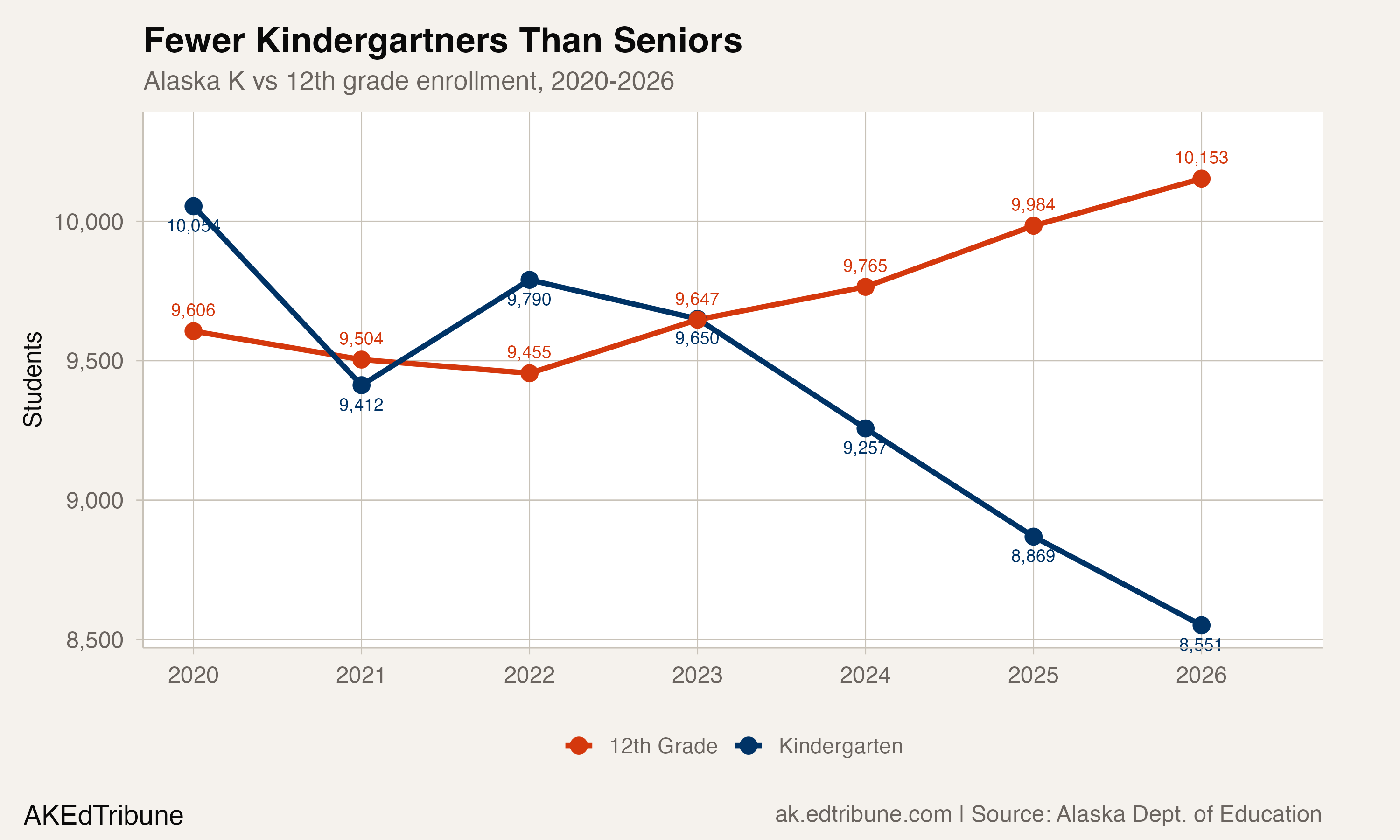
In 2019-20, Alaska enrolled 10,054 kindergartners and 9,606 seniors, a K-to-G12 ratio of 104.7, meaning more students entered the system each year than exited it. By 2025-26, that ratio had inverted: 8,551 kindergartners, 10,153 seniors, a ratio of 84.2. Alaska now has 1,602 fewer kindergartners than seniors.
Kindergarten enrollment has fallen 14.9% in seven years. 12th grade enrollment has risen 5.7%. The lines crossed in 2021 and have been diverging since. For a state already in its 13th consecutive year of net outmigration, the kindergarten decline means the senior surplus will eventually run out of students to recapture. The correspondence system can recycle students who left and came back, but it cannot manufacture students who were never born.
The question for Alaska's legislature, as it debates SB 277, is whether the correspondence system's capacity to recover students at the end of the pipeline justifies a funding model that concentrates resources in a handful of remote districts. The enrollment data suggests these programs are doing something most states cannot: pulling students back across the finish line. Whether the finish line means a diploma is a different question, and one the enrollment data alone cannot answer.
Detailed code that reproduces the analysis and figures in this article is available exclusively to EdTribune subscribers.
Discussion
Sign in to join the discussion.
Loading comments...